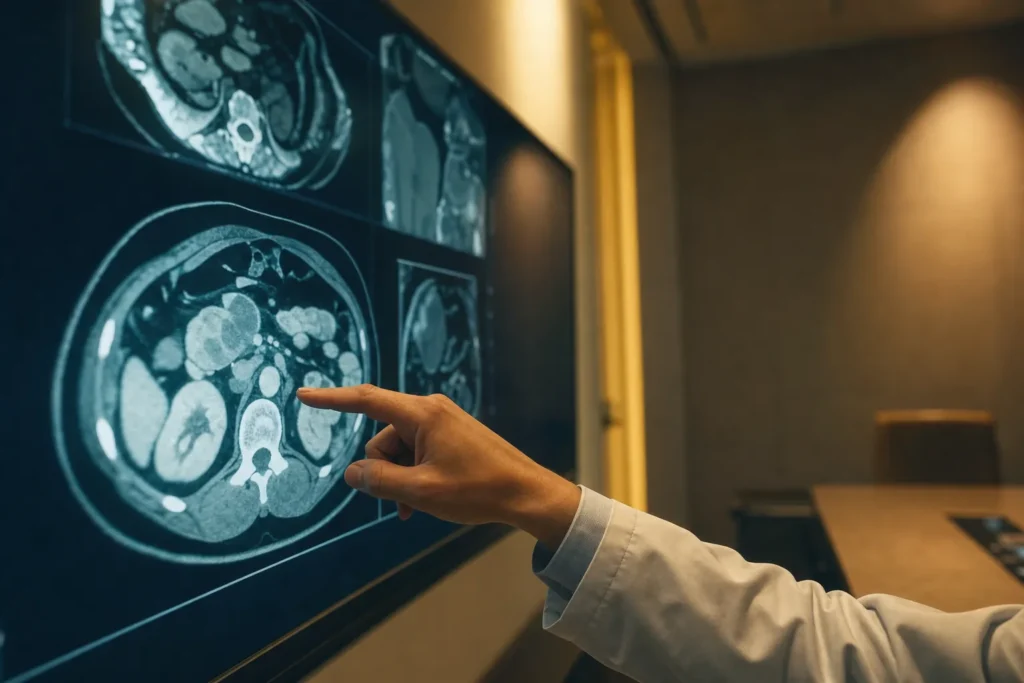
Pancreatic cancer
A pancreatic cancer diagnosis raises urgent, frightening questions for patients and families. This guide explains, in plain language and drawing on established cancer authorities, what pancreatic cancer is, how it is staged and treated, what the survival statistics do and do not mean, and how to prepare if you are considering care abroad, including in Turkiye. Our aim is to help you make informed decisions alongside a qualified oncology team, not to replace their advice.
What pancreatic cancer is
Pancreatic cancer is a disease in which cells in the pancreas grow in an uncontrolled way. The pancreas is a fish-shaped organ, about 15 centimetres long, that sits behind the stomach. It is divided into three parts: the wider head on the right side of the abdomen, the body in the middle, and the narrow tail on the left.
The pancreas does two main jobs. Its exocrine cells make digestive enzymes that travel through ducts into the small intestine to help break down food. Its endocrine cells produce hormones such as insulin and glucagon that control blood sugar. The type of cell where the cancer begins shapes how it behaves and how it is treated.
Most pancreatic cancers start in the exocrine cells. According to the American Cancer Society, about 95% of cancers of the exocrine pancreas are adenocarcinomas, which usually begin in the cells lining the pancreatic ducts. Because the pancreas lies deep inside the body, early tumours often cause no symptoms, which is why many cases are not found until later. Understanding the basics is a first step toward asking your medical team the right questions.
Types and subtypes
Pancreatic cancers fall into two broad groups based on the cells they arise from.
Exocrine tumours are by far the most common. The great majority are pancreatic ductal adenocarcinoma. Less common exocrine subtypes include acinar cell carcinoma, adenosquamous carcinoma, and squamous cell carcinoma. Ampullary cancer forms where the bile duct and pancreatic duct join before entering the small intestine; because it tends to block the bile duct early and cause jaundice, it is often found at an earlier, more treatable stage.
Pancreatic neuroendocrine tumours (NETs), sometimes called islet cell tumours, develop in the hormone-producing endocrine cells. They are much less common than adenocarcinoma and behave quite differently, with their own staging, treatments, and generally a more favourable outlook. This guide focuses mainly on pancreatic adenocarcinoma, the most common form; if you have a NET, your team will follow a different pathway.
Some growths in the pancreas are not cancer but may need monitoring or removal because they can change over time. These include serous cystic neoplasms, mucinous cystic neoplasms, intraductal papillary mucinous neoplasms (IPMNs), and solid pseudopapillary neoplasms. Your pathology report will name the exact type, which is essential for planning care.
Risk factors and causes
Pancreatic cancer is caused by changes (mutations) in the DNA of pancreatic cells. Some risk factors can be changed and some cannot. Having one or more risk factors does not mean you will develop the disease, and many people who develop it have no obvious risk factors.
Risk factors you may be able to change include:
- Smoking, which roughly doubles the risk and is thought to account for about 25% of cases; risk falls after stopping.
- Excess body weight; the American Cancer Society notes that people with obesity are about 20% more likely to develop pancreatic cancer.
- Type 2 diabetes, which is more common in people with pancreatic cancer.
- Chronic pancreatitis (long-term inflammation of the pancreas), often linked to heavy alcohol use and smoking.
- Heavy workplace exposure to certain chemicals used in dry cleaning and metal working.
Risk factors you cannot change include older age (the average age at diagnosis is about 70), being male, and family history. Inherited gene changes may account for as many as 10% of cases and include syndromes linked to BRCA1, BRCA2, PALB2, ATM, CDKN2A, PRSS1 (hereditary pancreatitis), Lynch syndrome, and Peutz-Jeghers syndrome. Most people who develop pancreatic cancer do not have a family history of it. If cancer runs in your family, a genetic counsellor can help you understand your risk.
Signs and symptoms, and when to see a doctor
Early pancreatic cancer often causes no symptoms. When symptoms do appear, they can include:
- Jaundice, a yellowing of the skin and the whites of the eyes, sometimes with dark urine, pale greasy stools, and itchy skin, caused by a blocked bile duct.
- Pain in the upper abdomen or middle of the back.
- Unintended weight loss and loss of appetite.
- Nausea and vomiting, especially if a tumour presses on the stomach.
- Fatigue and general lack of energy.
- New-onset diabetes, or diabetes that suddenly becomes harder to control.
- Blood clots, such as a deep vein thrombosis in the leg.
- An enlarged gallbladder or liver, sometimes found on examination or imaging.
These symptoms are far more often caused by conditions other than cancer, such as gallstones or hepatitis. Still, because they overlap with many illnesses, it is important not to ignore them. See a doctor promptly if you notice unexplained jaundice, persistent abdominal or back pain, ongoing unexplained weight loss, or new diabetes without a clear cause, so the right tests can be arranged.
Screening and early detection
There is currently no recommended routine screening test for pancreatic cancer in people at average risk. As the American Cancer Society notes, no major professional group recommends routine screening for average-risk people, because no screening test has been shown to lower the risk of dying from this cancer. Pancreatic tumours form deep in the body and often grow or spread before they can be detected.
The situation is different for people at high risk, such as those with certain inherited syndromes or a strong family history of pancreatic cancer. For these individuals, specialists may offer surveillance using endoscopic ultrasound (EUS) and MRI/MRCP. These tests have sometimes found early, more treatable cancers in members of high-risk families. They are targeted tools for selected people, not a population screening programme.
If pancreatic or related cancers run in your family, ask your doctor about referral to a genetic counsellor. Genetic counselling and testing can clarify whether you carry an inherited risk and whether a surveillance programme is appropriate for you. Testing decisions are personal and are best made with expert guidance about what the results can and cannot tell you.
Diagnosis and staging
Diagnosing pancreatic cancer usually involves a combination of imaging, tissue sampling, and blood tests. Common imaging tests include a multiphase (pancreatic protocol) CT scan, which is often the main tool; MRI with MRCP to look at the ducts and liver; endoscopic ultrasound (EUS), which is accurate and allows tissue sampling; and sometimes PET/CT to check for spread. ERCP may be used to examine the bile and pancreatic ducts and relieve a blockage.
A biopsy, often a fine-needle aspiration guided by EUS or CT, confirms the diagnosis and provides tissue for molecular testing (for example for BRCA, KRAS, and other markers) that can guide treatment. Blood tests include liver function tests and the tumour marker CA 19-9; CA 19-9 and CEA can support monitoring but are not accurate enough to diagnose pancreatic cancer on their own. Sometimes a diagnostic laparoscopy is used to look for spread not seen on scans.
Doctors describe how far the cancer has spread using the AJCC TNM system (tumour size and growth, lymph node involvement, and metastasis), grouped into stages 0 to IV. For planning treatment, they also use a practical classification based on whether surgery can remove the tumour: resectable (removable), borderline resectable (touching blood vessels but possibly removable after initial therapy), locally advanced/unresectable (has grown into major vessels but not spread to distant organs), and metastatic (spread to distant sites such as the liver, lungs, peritoneum, or bones).
Treatment options
Treatment depends on the type and stage of the cancer and on your overall health, and it is planned by a multidisciplinary tumour board, a team that typically includes surgeons, medical oncologists, radiation oncologists, radiologists, pathologists, and supportive care specialists. Reviewing each case as a team helps match an appropriate combination of treatments to each person.
Surgery offers the only realistic chance of cure and is possible when the tumour is resectable or becomes resectable after therapy. The main operations are the Whipple procedure (pancreaticoduodenectomy), used for tumours in the head of the pancreas, which removes the head of the pancreas along with parts of the small intestine, the bile duct, the gallbladder, and nearby lymph nodes; distal pancreatectomy for tumours in the body or tail, usually with removal of the spleen; and, less often, total pancreatectomy. These are major operations, and the American Cancer Society notes that outcomes tend to be better when they are performed at hospitals that do many of them, by experienced surgeons.
Chemotherapy uses drug combinations such as multi-drug regimens or gemcitabine-based regimens. It may be given before surgery (neoadjuvant) to shrink the tumour, after surgery (adjuvant) to lower the chance of recurrence, or as the main treatment in advanced disease. Radiation therapy, sometimes combined with chemotherapy as chemoradiation, may be used in borderline resectable or locally advanced disease. Targeted therapy and immunotherapy can help selected patients whose tumours carry specific genetic changes, which is one reason molecular testing matters. For tumours that cannot be removed, palliative procedures such as bile duct stents or bypass surgery can relieve blockage and improve comfort.
Prognosis and survival
Pancreatic cancer is a serious illness, and it is right to want honest information. Survival statistics describe groups of people, not individuals, and they cannot predict what will happen to any one person. They depend on the stage at diagnosis and on many other factors, and treatments continue to evolve.
The American Cancer Society reports 5-year relative survival for exocrine (adenocarcinoma) pancreatic cancer, based on people diagnosed between 2015 and 2021 in the United States, using the SEER database's three groupings:
- Localized (confined to the pancreas): about 44%.
- Regional (spread to nearby structures or lymph nodes): about 17%.
- Distant (spread to distant organs): about 3%.
- All stages combined: about 13%.
These figures come with important caveats. They reflect the stage when the cancer was first diagnosed, not later changes. They do not account for individual factors such as age, overall health, the specific tumour features, or how well a cancer responds to treatment. Because they are based on people treated years ago, people diagnosed today may have a different outlook than these numbers suggest. They are a population-level reference point and are not a prediction for any individual. Your oncologist is the right person to discuss what these numbers may mean in your situation.
Supportive and follow-up care
Supportive care, sometimes called palliative care, focuses on relieving symptoms and maintaining quality of life, and it can be given alongside treatments aimed at the cancer at any stage. It is not only for end-of-life care. Common needs in pancreatic cancer include managing pain, nausea, and fatigue, and addressing nutrition.
Many people benefit from pancreatic enzyme replacement to help digest food and absorb nutrients, support from a dietitian, and management of blood sugar, especially after surgery that removes part or all of the pancreas. If a bile duct or the bowel becomes blocked, a stent or bypass can relieve jaundice, itching, or obstruction. Emotional and psychological support, for both patients and families, is an important part of comprehensive care.
After treatment, follow-up usually includes regular clinic visits, physical examinations, imaging such as CT scans, and sometimes CA 19-9 blood tests to watch for any return of the cancer and to manage longer-term effects of treatment. Keeping a record of your treatments and follow-up plan helps coordinate care, particularly if you are treated in more than one place.
Planning treatment abroad: what affects cost and how to prepare your records
Some families consider treatment in another country to access multidisciplinary cancer centres or to combine care with shorter waiting times. If you are weighing this option, it helps to understand the factors that influence the overall cost and complexity of care rather than focusing on a single figure. These factors include the stage and type of your cancer, the specific treatments recommended (for example major surgery such as a Whipple procedure versus chemotherapy alone), the length of any hospital stay, the need for intensive care, imaging and laboratory tests, medicines, and follow-up. Travel, accommodation, interpreter services, and the duration of your stay also matter.
Because each treatment plan is individual, the most reliable way to understand what your care may involve is to request a personalised assessment. To prepare, gather your records in advance: recent imaging (CT, MRI, EUS) on disc or digital files, pathology and biopsy reports including any molecular or genetic test results, blood test results such as CA 19-9, a current medication list, and a summary from your treating doctor. Clear, complete records let an international tumour board review your case accurately and recommend an appropriate plan.
BergemHealth is a medical-tourism concierge. We can help you organise records, arrange remote review by specialists, and obtain a personalised estimate through a consultation. We do not provide medical advice; decisions about your treatment should always be made with qualified oncologists.
Considering Turkiye and choosing a cancer centre
Turkiye has become a destination for international patients seeking pancreatic cancer treatment, with hospitals that offer multidisciplinary cancer care and modern imaging, surgery, and oncology services. As with any country, quality varies between centres, so the goal is to choose a centre that meets recognised standards for complex cancer care.
When evaluating any cancer centre, in Turkiye or elsewhere, it is worth verifying several things:
- Whether your case will be reviewed by a true multidisciplinary tumour board that includes surgical, medical, and radiation oncology.
- The centre's accreditation and quality credentials, and the qualifications of the team.
- For surgery, whether the hospital performs a high number of pancreatic operations with experienced surgeons, since experience is linked to safer outcomes for procedures such as the Whipple.
- Access to molecular and genetic testing, modern chemotherapy and radiotherapy, and supportive care including nutrition and pain management.
- Clear communication, interpreter services, and a plan for follow-up and sharing records with your doctors at home.
Asking these questions helps you compare options objectively. A reputable centre will welcome them and will be transparent about its team, accreditation, and the plan it proposes for you.
Clinical trials and second opinions
Because research into pancreatic cancer is active, clinical trials may offer access to new treatments being studied, such as novel drug combinations, targeted therapies, or immunotherapy. Trials are carefully regulated and are not right for everyone, but for some patients they are a valuable option. Your oncologist or a cancer centre can tell you whether a suitable trial is available and what taking part would involve.
A second opinion from another qualified oncologist or multidisciplinary team is also reasonable and common, particularly for a complex diagnosis like pancreatic cancer. It can confirm the diagnosis and stage, clarify whether surgery is possible, and help you feel confident in the plan. Seeking a second opinion does not offend good doctors; most expect and support it. Gathering your imaging, pathology, and molecular results in advance makes a second opinion faster and more useful.
Frequently asked questions
What are the early symptoms of pancreatic cancer?
What is the Whipple procedure?
What are the stages of pancreatic cancer?
Can pancreatic cancer be cured?
Is there a screening test for pancreatic cancer?
What does the survival rate mean for me personally?
What are the main risk factors for pancreatic cancer?
How is pancreatic cancer diagnosed?
Why is a multidisciplinary tumour board important?
Should I consider treatment abroad or in Turkiye?
What is the difference between pancreatic adenocarcinoma and a neuroendocrine tumour?
How should I prepare my medical records for a consultation?
This article is for general information only and is not medical advice. Always consult a qualified doctor about your individual case.
Considering this procedure?
Send us your photos and questions. A BergemHealth coordinator and a department-head specialist will review your case and reply with honest, personalised guidance — no obligation.
Free consultation