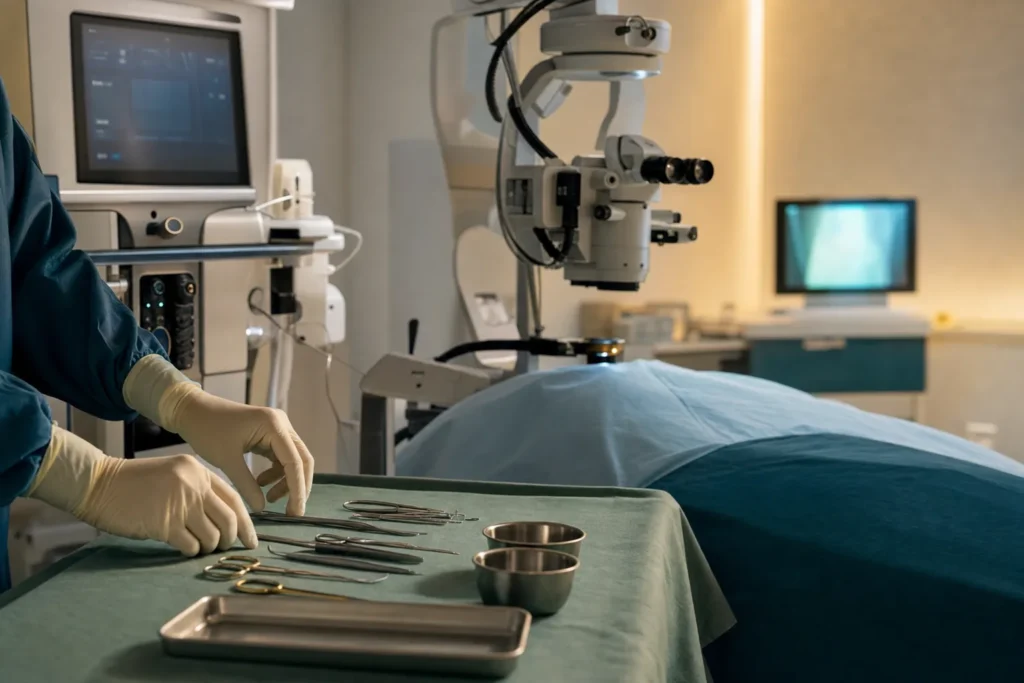
Cataract surgery
If colours look faded, headlights dazzle you at night, or reading feels like looking through a foggy window, a cataract may be the reason. Cataract surgery is one of the most common and well-studied operations in the world. This guide explains, in everyday language, what a cataract is, how the surgery works, what recovery really feels like, what it costs, and how to choose a safe clinic if you are thinking about treatment in Turkiye.
- Anaesthesia
- Local anaesthetic (numbing eye drops, sometimes an injection); you stay awake, often with a mild sedative
- Duration
- About 15 to 45 minutes per eye; the full clinic visit takes a few hours
- Recovery
- Vision often clears within days; full healing about 4 to 6 weeks; eye drops for around 4 weeks
- Hospital stay
- Day case (outpatient); no overnight stay; home the same day
What cataract surgery is
Inside your eye, just behind the coloured part (the iris), sits a clear, flexible structure called the lens. It works like the lens of a camera: it focuses light onto the retina, the light-sensitive layer at the back of the eye that sends pictures to your brain. When you are young, this lens is crystal clear.
A cataract is what happens when that lens becomes cloudy. Over time, the proteins that make up the lens break down and clump together, so light can no longer pass through cleanly. The result is vision that looks blurry, hazy, dim, or washed-out, as if you are looking through a misty or dirty window.
Here is the important part: a cloudy lens cannot be polished clear again, and no eye drop or medicine can reverse it. Surgery is the only way to treat a cataract. Cataract surgery means removing your cloudy natural lens and replacing it with a clear artificial one, called an intraocular lens (IOL). This new lens stays in your eye permanently and does not need to be replaced.
It is one of the most frequently performed operations anywhere, and one of the most successful. According to the Cleveland Clinic, surgery improves vision in about 97% of people who have it.
Who is a good candidate (and who should wait or avoid it)
Cataracts are mostly a natural part of getting older. Clouding often begins after age 40, and most people over 60 have at least some lens cloudiness, though it may be mild enough that they never notice it. Surgery becomes worth considering when the cataract starts to interfere with everyday life.
You may be a good candidate if you notice cataract symptoms such as:
- Blurred, dim, or hazy vision that glasses no longer fix
- Trouble driving at night, with headlights causing glare or halos
- Colours looking faded or yellowish
- Needing brighter light to read
- Double or 'ghosted' images in one eye
- Frequently changing your glasses prescription
Doctors generally recommend surgery once the cataract gets in the way of things you want to do, such as reading, driving, working, or hobbies. There is usually no need to rush: in most adults, waiting a few months while you decide does not harm the eye. Sometimes, though, an eye surgeon will suggest removing a cataract even if your vision is only mildly affected, because it is blocking their view of the back of the eye when they need to monitor another condition such as diabetic eye disease or macular degeneration.
Who should pause or take extra care. If you have another eye condition (such as glaucoma, advanced macular degeneration, or a previous retinal problem), your final vision may be limited by that condition, so it is important to have realistic expectations. Uncontrolled diabetes, infections around the eye, or certain other health problems may mean treatment should be delayed until they are stable. Your surgeon will weigh all of this up with you. Children can also be born with or develop cataracts, but their care is specialised and different from the adult procedure described here.
Types and techniques
There are two parts to think about: how the cloudy lens is removed, and which artificial lens goes in.
Removing the cataract
Phacoemulsification is by far the most common method today, and MedlinePlus describes it as the standard approach. The surgeon makes a tiny opening in the front of the eye, then uses a probe that delivers ultrasound (high-frequency sound waves) to gently break the cloudy lens into small pieces, which are suctioned out. Because the cut is very small, it usually seals itself without stitches.
Laser-assisted cataract surgery (sometimes called femtosecond laser-assisted, or FLACS) uses a laser to perform some of the early steps, such as the opening and softening the lens, before the surgeon completes the removal. It is an optional, usually more expensive approach, and for routine cataracts it has not been shown to be clearly better than standard phacoemulsification.
Extracapsular extraction removes the lens in one larger piece through a bigger incision. It is used less often now, mainly for very dense or advanced cataracts, and needs stitches and a longer recovery.
Choosing the artificial lens (IOL)
The lens implant is a big part of your result, because it also decides how much you will rely on glasses afterwards:
- Monofocal lens — the standard option. It gives sharp vision at one distance (usually far away), so most people still wear glasses for reading.
- Multifocal or trifocal lens — designed to give a range of vision (near, middle, and far), reducing the need for glasses. Some people notice more glare or halos at night with these.
- Extended depth-of-focus (EDOF) lens — aims for a smooth range from far to intermediate distance.
- Toric lens — corrects astigmatism (an uneven curve of the eye's surface) at the same time, available in both standard and premium versions.
- Monovision — one eye is set for distance and the other for near; not a lens type but a strategy some people choose.
There is no single 'best' lens. The right choice depends on your eyes, your lifestyle, and your budget, and is a decision to make together with your surgeon.
How it is done
Cataract surgery is an outpatient (day-case) procedure, meaning you go home the same day. Here is what typically happens.
Anaesthesia
The eye is numbed with local anaesthetic — usually numbing eye drops, sometimes a small injection around the eye, or both. You stay awake, but you should not feel pain. Many clinics also offer a mild sedative to help you relax. General anaesthesia (being fully asleep) is rarely needed for adults.
The steps
- Drops are used to widen (dilate) your pupil, and the area around the eye is cleaned and covered with a sterile sheet.
- The surgeon makes a very small opening in the cornea (the clear front window of the eye).
- Using ultrasound, the cloudy lens is broken up and gently suctioned out, while the thin natural 'bag' that held it (the capsule) is left in place.
- The folded artificial lens is inserted through the same tiny opening and settles into that capsule, where it unfolds into position.
- The opening usually seals itself, so stitches are often not needed. A protective shield may be taped over the eye.
How long it takes
The surgery itself is quick — commonly around 15 to 30 minutes, and generally under 45 minutes. The whole clinic visit, including preparation, dilation, and a short rest afterwards, takes a few hours. If you have cataracts in both eyes, surgeons normally treat them on separate days, often a week or two apart, so each eye can settle.
Recovery, step by step
Recovery is usually straightforward. Here is a realistic timeline, though everyone heals a little differently.
The first day
Your vision will likely be blurry for a few hours, partly because of the dilating drops. The eye may feel gritty, watery, or mildly sore, a bit like having an eyelash in it. You will need someone to take you home, as you cannot drive yourself. Most surgeons arrange a check-up the day after surgery.
The first week
Vision often starts to clear within a few days. You will use prescribed eye drops (typically antibiotic and anti-inflammatory) for around four weeks to prevent infection and calm swelling. Wearing the eye shield at night protects the eye while you sleep.
Weeks two to six
Most people feel largely back to normal within about two weeks, and the eye is generally considered fully healed at about four to six weeks. Any new glasses prescription is usually finalised once your vision has settled, towards the end of this period.
What to avoid while healing
- Rubbing or pressing on the eye
- Getting water, soap, or shampoo directly in the eye; no swimming until cleared
- Eye makeup until your surgeon says it is fine
- Heavy lifting, strenuous exercise, and contact sports
- Dusty or dirty environments
Driving can resume once your vision meets the legal standard and your surgeon agrees, which for many people is within a few days to a couple of weeks.
Risks and possible complications
Cataract surgery is considered very safe, and serious complications are uncommon. Still, no operation is risk-free, and it is fair to know what can occasionally happen.
- Posterior capsule opacification (PCO) — the most common after-effect. The thin capsule that holds the new lens can turn cloudy weeks, months, or years later, making vision hazy again. It is easily treated in a few minutes with a painless YAG laser procedure (a posterior capsulotomy) that clears the cloudiness. It does not mean the cataract has come back.
- Infection — rare. MedlinePlus notes infection occurs in fewer than 1 in 1,000 cases.
- Retinal detachment — when the light-sensitive layer at the back of the eye pulls away; MedlinePlus puts this at about 2 in 1,000. It needs prompt treatment.
- Swelling, inflammation, or raised eye pressure — usually temporary and managed with drops.
- The lens not sitting perfectly, or a small piece of cataract being left behind, occasionally needing a further procedure.
- Bleeding inside the eye — rare.
Warning signs to report straight away include increasing pain, worsening vision, a lot of redness, or sudden flashes, floaters, or a 'curtain' across your sight. These are uncommon but should be checked urgently. There are no guarantees with any surgery, and your individual risk depends on your eyes and general health.
Results and how long they last
For most people, the results are excellent and long-lasting. The Cleveland Clinic reports that vision improves in around 97% of people after cataract surgery. Many notice that colours look brighter and more vivid, glare improves, and everyday tasks become easier once the eye has settled.
The artificial lens is designed to last for the rest of your life and does not wear out or need replacing. In that sense, the result is permanent. With a standard monofocal lens you will probably still need reading glasses; with a multifocal or trifocal lens you may need glasses less often, though no lens guarantees you will be glasses-free.
It is worth being clear about one thing: a cataract does not 'grow back'. If vision becomes cloudy again later, it is almost always due to the capsule clouding (PCO described above), which is quickly fixed with the YAG laser. Your final vision can still be limited by any other eye conditions you have, such as macular degeneration, which is why honest expectations matter.
Costs: indicative ranges and what changes the price
Prices vary widely between countries, clinics, and lens choices, so treat the figures below as indicative ranges only — not a quote. The final cost varies by your case, the surgeon, the clinic, and the lens you choose, and should always be confirmed in writing.
As a rough guide for treatment in Turkiye, cataract surgery often falls in the region of around €1,300 to €5,000 per eye. A standard monofocal lens sits at the lower end, while premium multifocal, trifocal, or toric lenses sit at the higher end. By comparison, the same surgery in the UK, USA, or Germany privately commonly starts higher, which is one reason people compare options abroad.
What pushes the price up or down:
- The lens type — this is usually the biggest single factor; premium IOLs cost considerably more than standard ones.
- The technique — laser-assisted surgery typically costs more than standard phacoemulsification.
- One eye or both, and whether astigmatism correction is included.
- The surgeon's experience and the clinic's facilities and accreditation.
- Pre-operative tests, follow-up visits, and medications, and (for travellers) translation, transfers, and accommodation.
When comparing quotes, always ask exactly what is included so you are comparing like for like.
Why people travel to Turkiye, and how to choose a safe clinic
Turkiye has become a major destination for eye care because it combines modern hospitals, experienced surgeons, and prices that are often lower than in Western Europe or North America. There are more than 50 hospitals across the country accredited by Joint Commission International (JCI), a respected global standard for patient safety and quality of care.
Lower cost should never mean lower standards. Here is what to verify before you book:
- Accreditation. Check whether the hospital holds recognised accreditation such as JCI. You can confirm this independently using the official Joint Commission International 'find accredited organizations' database, rather than relying only on the clinic's own marketing.
- The surgeon's credentials. Confirm the specific ophthalmologist is board-certified, how many cataract operations they perform, and that they — not just 'the clinic' — will do your surgery.
- Local licensing. Turkiye requires clinics treating international patients to hold a Health Tourism Authorisation and proper Ministry of Health licensing; ask to see it.
- Clear, itemised pricing in writing, stating exactly which lens and which follow-up care is covered.
- Honest information. Be cautious of anyone promising a perfect outcome or 'guaranteed' glasses-free vision — reputable surgeons explain risks and realistic results.
- Aftercare and communication. Check who you contact if there is a problem after you return home, and whether reports are provided in your language.
How to prepare and what to ask at your consultation
Good preparation makes the day go smoothly. Before surgery, your eye will be measured carefully — using ultrasound or laser scans — to calculate the right power for your artificial lens. Tell your surgeon about all your medicines and any health conditions, as some blood thinners or other drugs may need to be reviewed. If you wear contact lenses, you will usually be asked to stop wearing them for some days beforehand, because they can temporarily change the shape of the eye and affect measurements.
Because the surgery is done under local anaesthetic, you can usually eat and drink normally, but follow your clinic's specific instructions. Arrange for someone to take you home, as you will not be able to drive afterwards.
Helpful questions to ask at your consultation:
- Which lens do you recommend for my eyes and lifestyle, and why?
- Realistically, will I still need glasses, and for what?
- Which technique will you use, and what does it cost?
- How many of these operations do you perform, and what are your complication rates?
- What exactly is included in the price, and what is extra?
- What does aftercare involve, and who do I contact if there is a problem?
- Do I have any other eye conditions that could limit my result?
Aftercare and travelling for treatment (including when it is safe to fly)
If you are travelling for cataract surgery, plan the trip around the healing timeline rather than the surgery alone. Surgeons almost always want to examine the eye the day after the operation, and often again around 5 to 8 days later, so build in enough time for those checks before you head home.
Is it safe to fly? For routine cataract surgery, flying is generally considered safe soon afterwards. The American Academy of Ophthalmology notes that the cabin pressure and altitude of normal air travel do not harm the eye after cataract surgery, and many people could fly within a few days. The main practical issue is that cabin air is dry, so carry lubricating (artificial tear) drops to stay comfortable. Always follow your own surgeon's advice on timing. (One important exception: flying is not safe after some other eye operations, such as retinal surgery where a gas bubble has been placed in the eye — but that is a different procedure.)
For a smooth recovery while away from home:
- Use your prescribed drops exactly as scheduled, and keep wearing the eye shield at night.
- Avoid rubbing the eye, swimming, dusty places, and heavy lifting.
- Wear sunglasses outdoors, as the eye can be light-sensitive at first.
- Keep your written surgical report, lens details, and clinic contact, and know who to call back home if anything worries you.
This article is general information, not medical advice. Always discuss your own situation with a qualified ophthalmologist before making decisions.
Frequently asked questions
Is cataract surgery painful?
How long does cataract surgery take?
Will I be awake during the operation?
How soon will my vision improve?
Can both eyes be done at the same time?
Will I still need glasses after cataract surgery?
Can a cataract come back after surgery?
How much does cataract surgery cost in Turkey?
How soon can I fly after cataract surgery?
What are the main risks of cataract surgery?
How do I check that a Turkish clinic is safe and accredited?
When is cataract surgery actually needed?
This article is for general information only and is not medical advice. Always consult a qualified doctor about your individual case.
Considering this procedure?
Send us your photos and questions. A BergemHealth coordinator and a department-head specialist will review your case and reply with honest, personalised guidance — no obligation.
Free consultation