Glaucoma
Glaucoma is often called the "silent thief of sight" because it can quietly damage your vision before you notice anything is wrong. The reassuring truth is that, with regular eye checks and steady treatment, most people who are diagnosed keep useful sight for life. This guide explains in plain language what glaucoma is, how it is found, the treatment choices available, and how to prepare if you are considering care abroad.
What glaucoma is
Glaucoma is the name for a group of eye conditions that damage the optic nerve — the cable of about a million tiny fibres that carries pictures from the back of your eye to your brain. When these fibres are harmed, the messages do not get through, and small patches of vision are lost. Over time, if the damage continues, those patches can grow and join up.
To understand why this happens, it helps to know how a healthy eye works. The front of your eye is constantly bathed in a clear fluid called aqueous humour. Your eye makes this fluid all the time to keep itself nourished, and an equal amount drains away through a spongy ring of tissue called the trabecular meshwork, sitting where the coloured part of your eye (the iris) meets the clear window at the front (the cornea). In most kinds of glaucoma, the fluid does not drain away fast enough, so pressure inside the eye slowly builds. This is called intraocular pressure, or IOP. Raised pressure can press on and gradually wear down the optic nerve.
Glaucoma is common and important: it is the second leading cause of blindness worldwide, and an estimated 80 million people live with it. Yet the early stages usually cause no pain and no obvious change in sight, which is why up to half of people who have it do not know. The encouraging part is that finding it early and treating it steadily can usually keep your sight safe.
Types and subtypes of glaucoma
Glaucoma is not one single disease. The main forms behave quite differently, and knowing which one you have shapes the treatment.
- Primary open-angle glaucoma is by far the most common type. The drainage angle stays open and looks normal, but the meshwork slowly becomes less efficient, like a sink that drains a little too slowly. Pressure creeps up over years, and sight is lost so gradually that most people notice nothing at first. This is the form often called the "silent thief of sight."
- Angle-closure glaucoma happens when the iris blocks the drainage angle, so fluid cannot escape. It can be chronic (slow) or acute. An acute angle-closure attack is a medical emergency: pressure shoots up suddenly, causing severe eye pain, a red eye, blurred vision, headache, feeling sick, and rainbow-coloured rings around lights. This needs urgent care the same day.
- Normal-tension glaucoma is a puzzle: the optic nerve is damaged even though eye pressure stays in the range usually considered normal (roughly 10 to 20 mmHg). It is thought to involve a nerve that is unusually sensitive to pressure, or reduced blood flow to it.
- Secondary glaucoma is caused by another problem — an eye injury, inflammation inside the eye (uveitis), advanced diabetes, certain medicines such as long-term steroids, or after some eye operations.
- Congenital (childhood) glaucoma is rare and is present from birth or early childhood because the drainage system did not form properly. Signs in a baby can include unusually large or cloudy eyes, watering, and sensitivity to light.
Causes and risk factors
For the most common types, scientists have not pinned down a single cause. What is clear is that the balance between fluid being made and fluid draining away goes wrong, and the optic nerve is damaged as a result. Raised eye pressure is the most important factor we can measure and treat — but, as normal-tension glaucoma shows, pressure is not the whole story.
You cannot change some of the things that raise your risk, but knowing them helps you decide how often to have your eyes checked. Risk is higher if you:
- are over 40, with risk rising with age — around one in ten people over 75 are affected;
- have a close blood relative (parent, brother or sister) with glaucoma;
- are of African, African-Caribbean, Hispanic or Asian heritage — for example, open-angle glaucoma tends to start earlier and progress faster in people of African ancestry, while angle-closure is more common in people of East Asian heritage;
- have diabetes or high blood pressure;
- are very short-sighted (myopia), which raises open-angle risk, or very long-sighted (hyperopia), which raises angle-closure risk;
- have thin corneas or have used steroid medicines for a long time;
- have had a serious eye injury in the past.
Having one or more risk factors does not mean you will get glaucoma — it simply means regular eye examinations are especially worthwhile for you.
Signs and symptoms (and when to see a doctor)
The most important thing to understand about the common form of glaucoma is that, in its early stages, there are usually no symptoms at all. There is no pain, and vision often seems perfectly normal because the brain fills in the small gaps. Damage typically begins with your peripheral (side) vision, often nearest the nose, and only much later moves toward the centre. By the time someone notices a problem, some sight may already have been permanently lost — which is exactly why eye checks matter so much.
As open-angle glaucoma advances, you may notice:
- patchy blind spots in your side vision;
- difficulty seeing in low light or while driving at night;
- bumping into things, or a sense of "tunnel vision" in late stages.
Seek urgent, same-day medical care if you suddenly develop any of the following, which can signal an acute angle-closure attack:
- severe pain in or around one eye;
- a red, hard-feeling eye with blurred vision;
- seeing rainbow-coloured halos around lights;
- headache, nausea or vomiting along with eye pain.
For anything gradual — slow vision changes, or simply because you are due a check — book a routine appointment with an optometrist (optician) or eye doctor rather than waiting for symptoms to appear.
Screening and early detection
There is no single national "glaucoma screening" programme in most countries that invites everyone for a test at a set age. Instead, glaucoma is most often picked up during a routine comprehensive eye examination — the kind you have when you get glasses checked. Because the early disease is silent, these regular checks are the single most effective way to catch it in time.
General guidance from eye-care bodies is that adults should have their eyes tested at least every two years, and more often if you are over 40, have a family history of glaucoma, or belong to one of the higher-risk groups above. A short eye-pressure test on its own is not enough to rule glaucoma in or out, because some people develop nerve damage at normal pressure and others tolerate higher pressure without harm. A proper check looks at the pressure, the optic nerve and your field of vision together.
If you have a parent, sibling or child with glaucoma, it is worth mentioning this to your optometrist; some health systems recommend earlier and more frequent testing for close relatives of people with the condition.
How glaucoma is diagnosed
Diagnosing glaucoma is not based on any one number. An eye specialist builds up a picture using several painless tests, usually during a dilated eye examination (drops widen your pupil so the doctor can see the optic nerve clearly). Common tests include:
- Tonometry — measures the pressure inside your eye, often with a gentle puff of air or a small probe after numbing drops.
- Ophthalmoscopy / optic nerve examination — the doctor looks directly at the optic nerve at the back of the eye for signs of damage or "cupping."
- Visual field test (perimetry) — you press a button when you see flashes of light in different positions; this maps any blind spots in your side vision.
- Gonioscopy — a special mirrored contact lens lets the doctor see whether the drainage angle is open or closed, which tells the type of glaucoma.
- Pachymetry — measures the thickness of your cornea, because a thin cornea is itself a risk factor and affects how pressure readings are interpreted.
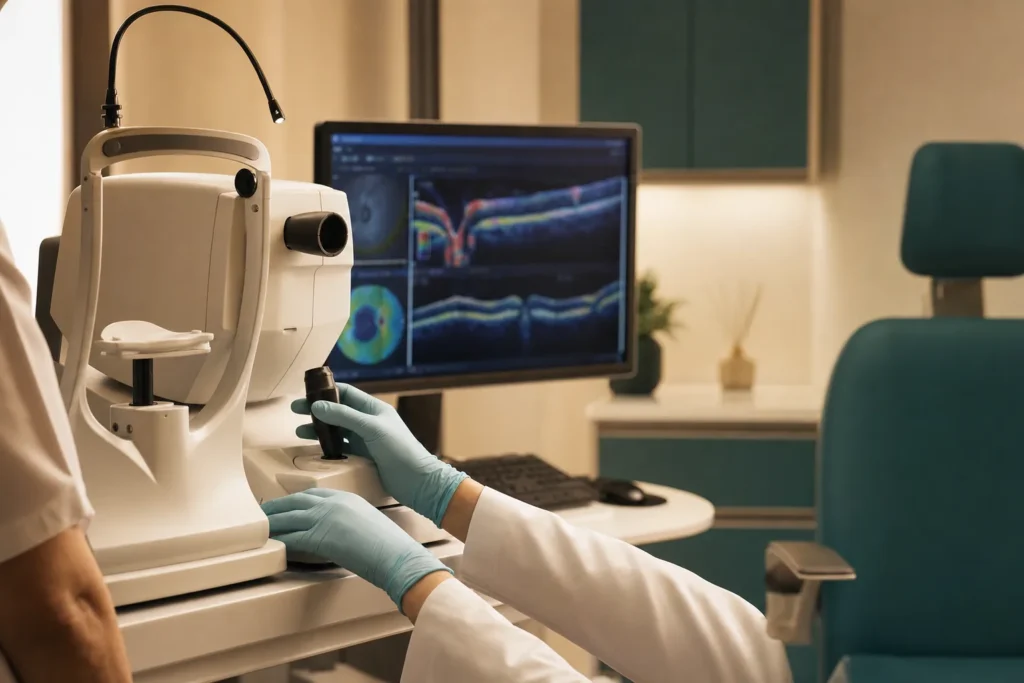
- Optical coherence tomography (OCT) — a quick, light-based scan that takes detailed cross-section images of the optic nerve fibres, helping detect very early thinning and track it over time.
Glaucoma is not given a "stage" the way cancers are. Instead, doctors describe it as early, moderate or advanced, based on how much of the optic nerve and visual field has been affected. These tests are repeated over time so the team can see whether the condition is stable or changing.
Treatment options
There is currently no way to reverse sight that has already been lost, and no cure that makes glaucoma go away. But treatment is genuinely effective at lowering eye pressure to protect the remaining nerve and slow or halt further loss. Care is usually led by an ophthalmologist (a medical eye doctor and surgeon), working alongside optometrists, glaucoma specialist nurses and, for children or complex cases, paediatric or other sub-specialists — a true multidisciplinary team.
Eye drops. For many people, daily pressure-lowering drops are the first step. Several families exist, and they work either by helping fluid drain away or by reducing how much the eye makes — for example prostaglandin analogues (often first choice, used once a day), beta-blockers, carbonic anhydrase inhibitors and alpha agonists. They are usually safe and effective, but they only help if used exactly as prescribed, every day.
Laser treatment. A short outpatient laser called selective laser trabeculoplasty (SLT) can improve drainage in open-angle glaucoma. A large randomised trial (the LiGHT study) found that offering SLT first allowed about three-quarters of patients to stay free of drops for at least three years, with good pressure control, and is now often offered as a first-line option. For angle-closure, a laser called iridotomy makes a tiny hole in the iris to let fluid pass and relieve or prevent an attack.
Surgery. If drops and laser do not control pressure enough, an operation may be advised. Trabeculectomy creates a new drainage channel so fluid can escape under the surface of the eye into a small reservoir (a "bleb"). Drainage (tube) implants are tiny devices that carry fluid away. A newer group called minimally invasive glaucoma surgery (MIGS) uses small stents or channels, often at the same time as cataract surgery, to gently lower pressure with quicker recovery. The right choice depends on the type and severity of glaucoma and your overall eye health.
Outlook: what to expect
A glaucoma diagnosis is understandably worrying, but it is rarely a sentence to blindness. The realistic picture, drawn from population studies rather than any one person's case, is reassuring: although sight already lost cannot be brought back, serious vision loss is largely preventable when glaucoma is found early and treated consistently. In developed countries, only a small minority of people with glaucoma — on the order of around 5 percent — ever lose enough sight to be registered as legally blind, and those cases are often linked to late diagnosis or treatment that was not kept up.
These figures describe groups of people, not individuals, and they are not a prediction for you. Your own outlook depends on the type of glaucoma, how early it was caught, how much nerve damage was already present, and — very importantly — how steadily you use your treatment and attend follow-up. Many people diagnosed in their 40s, 50s or 60s keep good, useful vision for the rest of their lives.
The most helpful way to think about it is as a long-term condition to be managed, much like high blood pressure — something you live alongside with regular monitoring, rather than a one-off event. Your eye team is the right place to discuss what your particular results mean for you.
Living with glaucoma and follow-up
Glaucoma is a lifelong condition, so the day-to-day reality is mostly about routine and consistency rather than dramatic change. The single most valuable thing you can do is use your drops or treatment exactly as prescribed and keep all your follow-up appointments — even when your eyes feel completely normal, because the disease is silent.
- Build drops into your daily routine. Linking them to a fixed habit, such as brushing your teeth, makes them easier to remember. If a drop irritates your eye or is hard to manage, tell your team — there are alternatives and techniques that can help.
- Attend regular reviews. Your doctor will repeat pressure checks, optic-nerve imaging and visual-field tests to make sure the condition is stable. How often varies from person to person.
- Report any change. New blind spots, worsening vision, or eye pain should prompt a call rather than a wait.
- Stay generally healthy. Keeping active, not smoking, and managing diabetes and blood pressure are good for your eyes as well as the rest of you.
If vision has already been affected, low-vision services, brighter lighting, larger-print options and practical aids can make everyday tasks easier. It is also sensible to ask your eye doctor about driving, as legal eyesight standards apply and your team can advise on testing.
Planning treatment abroad: what affects cost and preparing your records
Some people choose to have glaucoma care — particularly laser treatment or surgery — in another country such as Turkiye, often combined with a thorough assessment by an eye specialist. If you are considering this, it helps to understand what shapes the overall cost so you can ask informed questions and request a personalised estimate. We do not publish fixed prices here because every case is different; the only reliable figure is one based on your own records and examination.
Costs are typically influenced by:
- the type of treatment needed — drops and monitoring, a laser procedure such as SLT or iridotomy, or an operation like trabeculectomy, a drainage implant or MIGS;
- whether one or both eyes are treated, and whether glaucoma surgery is combined with cataract surgery;
- the tests and imaging required (visual fields, OCT, pachymetry, gonioscopy);
- the seniority of the surgeon and the hospital's facilities;
- follow-up needs, since glaucoma requires ongoing review — you will need a plan for monitoring once you return home;
- practical extras such as accommodation, translation and transfers.
To prepare, gather copies of your recent eye-pressure readings, visual-field printouts, OCT scans, a list of your current eye drops and other medicines, and a summary of your medical history. Sharing these in advance lets a specialist give realistic advice and a clear, personalised estimate. A free consultation is the best starting point to understand your options and what they would involve.
Why Turkiye, and how to choose a good centre
Turkiye has become a well-established destination for eye care, with modern hospitals, experienced ophthalmologists and dedicated international-patient services that handle language, appointments and logistics. As with any country, quality varies between centres, so it is worth checking a few things before you commit — rather than relying on advertising.
- Accreditation. Look for hospitals with recognised international quality accreditation such as Joint Commission International (JCI), and clinics that follow international standards for patient safety. Turkiye was an early adopter of JCI accreditation in its leading hospitals.
- A genuine glaucoma specialist. Ask whether your care will be led by an ophthalmologist with specific glaucoma expertise, and how complications would be handled.
- The full diagnostic picture. A good centre will want recent visual fields and OCT scans and will examine your optic nerve and drainage angle properly, not simply quote a procedure.
- A clear follow-up plan. Because glaucoma needs lifelong monitoring, confirm how your records will be shared with your eye-care team at home and who to contact if problems arise after you travel back.
- Transparent, written information. Reputable providers explain the proposed treatment, alternatives, realistic expectations and a personalised estimate in writing, and they do not make promises of a "cure."
A concierge service can help coordinate these checks, gather your records and arrange a specialist opinion so that you can make a calm, informed decision.
Prevention and self-care
There is currently no proven way to prevent glaucoma altogether, because we cannot change the main risk factors of age, family history and ancestry. But there is a great deal you can do to protect your sight, and most of it is straightforward.
- Have regular eye examinations. This is the closest thing to prevention, because catching glaucoma early — before symptoms appear — is what keeps vision safe. If you are over 40 or in a higher-risk group, do not skip your checks.
- Know your family history. Tell your optometrist if a close relative has glaucoma, and encourage relatives to get tested.
- Use treatment faithfully. If you are already diagnosed, the most powerful "self-care" is taking your drops every day and attending follow-up.
- Protect your eyes. Wear suitable eye protection during sport, DIY or hazardous work to avoid injuries that can lead to secondary glaucoma.
- Look after your general health. Regular physical activity, not smoking, and good control of diabetes and blood pressure support healthy eyes.
- Seek a second opinion when you want one. If a treatment decision feels rushed or unclear, it is completely reasonable to ask another qualified eye specialist to review your records before proceeding.
Above all, do not let fear delay action. Glaucoma is one of the conditions where steady, ordinary care — checks, drops, follow-up — quietly does the most good over many years.
Frequently asked questions
Will glaucoma make me go blind?
Can glaucoma be cured?
What are the early warning signs of glaucoma?
How is glaucoma diagnosed?
Do I have to use eye drops for the rest of my life?
Is glaucoma hereditary?
Can you have glaucoma with normal eye pressure?
What happens during an acute angle-closure glaucoma attack?
What treatments for glaucoma are available in Turkiye?
How much does glaucoma treatment in Turkiye cost?
How do I choose a safe hospital abroad for glaucoma care?
Can I still drive if I have glaucoma?
This article is for general information only and is not medical advice. Always consult a qualified doctor about your individual case.
Considering this procedure?
Send us your photos and questions. A BergemHealth coordinator and a department-head specialist will review your case and reply with honest, personalised guidance — no obligation.
Free consultation