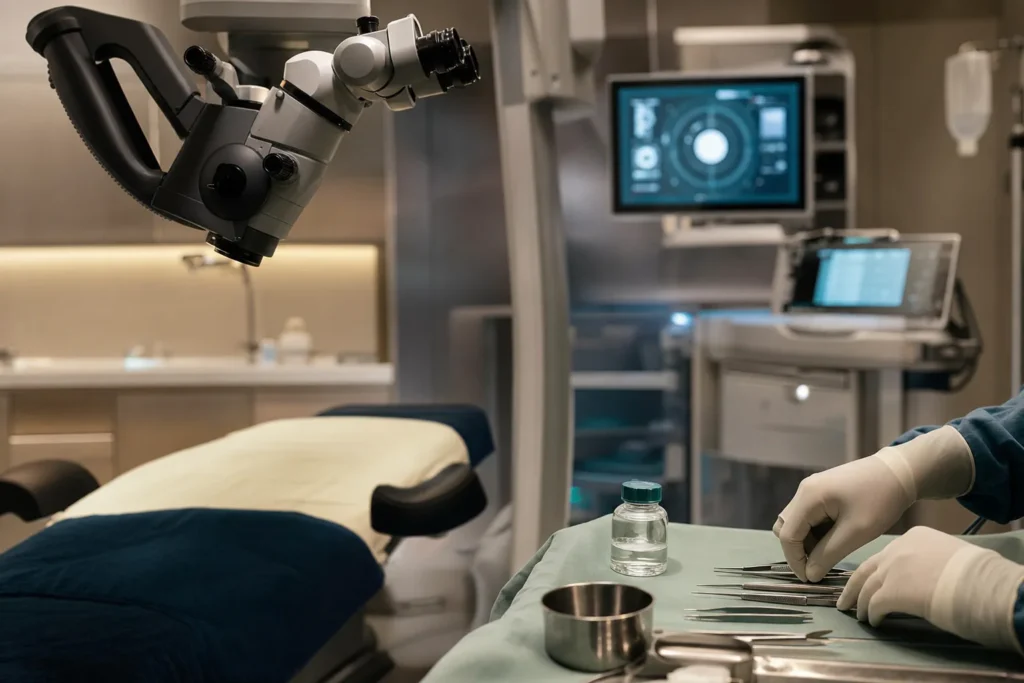
Corneal transplant
A corneal transplant replaces a cloudy or damaged cornea with healthy donor tissue to restore clear sight. This guide explains, in plain words, who needs one, the different types, what surgery and recovery involve, and how to choose a safe clinic if you are considering treatment abroad.
- Anaesthesia
- Local anaesthetic with numbing drops; sometimes sedation or general anaesthetic
- Duration
- About 1 to 2 hours, depending on the type
- Recovery
- Roughly 2 weeks off work; full vision can take 3 months to 2 years to settle
- Hospital stay
- Often day-case (home the same day); occasionally 1 to 2 nights
What a corneal transplant is
The cornea is the clear, dome-shaped front window of your eye. It sits over the coloured part (the iris) and does two big jobs: it lets light into the eye and it bends that light so it lands in focus at the back. Because the cornea has no blood vessels of its own and stays perfectly clear in a healthy eye, even small amounts of clouding, scarring or swelling can blur your sight noticeably.
A corneal transplant (the medical name is keratoplasty) is an operation to replace all or part of a damaged cornea with healthy tissue from a person who has died and donated their corneas. The aim is to restore clearer vision, relieve pain, or both. It is one of the most common and longest-established transplant operations in the world, partly because the cornea has no blood supply, which lowers the chance of the body rejecting donor tissue compared with organs like kidneys.
The cornea is made of several layers. From front to back, the ones that matter most for surgery are the outer surface (epithelium), the thick middle layer (stroma), and the innermost cell layer (the endothelium), which acts like a pump that keeps the cornea clear by drawing out excess fluid. Knowing which layer is damaged is the key to which type of transplant a surgeon recommends.
Who is a good candidate (and who should think twice)
A corneal transplant is usually considered when glasses, contact lenses or simpler treatments no longer give you useful vision, or when the cornea is painful. Common reasons include:
- Keratoconus — the cornea gradually thins and bulges into a cone shape, distorting vision. This is one of the most frequent reasons younger people need surgery.
- Fuchs' dystrophy — the inner pump cells slowly fail, so the cornea swells and turns cloudy, often worse in the morning.
- Scarring from past infections (such as herpes or bacterial ulcers) or injuries.
- Bullous keratopathy — painful swelling, sometimes after previous eye surgery such as a cataract operation.
- A failed earlier transplant that has become cloudy.
Not everyone is a good candidate straight away. Surgeons are more cautious if you have very dry eyes, uncontrolled glaucoma (raised pressure inside the eye), active eye infection or inflammation, or a cornea with many new blood vessels growing into it, because these raise the risk of rejection or poor healing. Conditions affecting the eyelids or tear film may need treating first. A transplant is also less likely to help if the back of the eye (the retina or optic nerve) is the real cause of the sight loss. A full eye examination decides whether surgery is the right step for you.
Types and techniques
Modern surgery often replaces only the damaged layers rather than the whole cornea. Replacing less tissue usually means faster healing and a lower chance of rejection. Your surgeon chooses the technique based on which layers are affected.
- Penetrating keratoplasty (PK) — a full-thickness transplant. A circular button of cornea (roughly 8 mm across) is removed and a matching donor button is stitched in. PK is used when both the front and inner layers are damaged, or for deep scarring. It gives the most complete vision but takes the longest to settle and carries a slightly higher rejection risk.
- Deep anterior lamellar keratoplasty (DALK) — replaces the outer and middle layers while keeping your own healthy inner pump cells. Because the most rejection-prone layer is left in place, DALK lowers the risk of rejection and is a common choice for keratoconus and front-of-cornea scarring.
- Endothelial keratoplasty (DSAEK and DMEK) — replaces only the failing inner cell layer through a tiny incision, used for Fuchs' dystrophy and similar swelling problems. DSAEK uses a slightly thicker sheet of donor tissue that is easier to position; DMEK uses an ultra-thin layer that is trickier to handle but tends to give the quickest, sharpest recovery. Both use an air or gas bubble to hold the new tissue against the back of your cornea while it sticks down.
For a small group of people in whom a standard transplant has failed repeatedly or is unlikely to work, an artificial cornea (keratoprosthesis) may be discussed. This is specialist territory and far less common.
How the operation is done
Most corneal transplants are day surgery: you arrive, have the operation and usually go home the same day. Some people stay one to two nights, especially after a full-thickness graft or if both eyes need care.
Anaesthesia. Many transplants are done under local anaesthetic — numbing drops and an injection around the eye so you feel no pain, often with a sedative to help you relax. A general anaesthetic (fully asleep) may be used for longer or more complex operations, for children, or if you would simply prefer it. You will not see the surgery happening.
The steps. In a full-thickness transplant (PK), the surgeon uses a precise circular cutting tool to remove the damaged central cornea, then places the donor button and secures it with very fine stitches, usually too small to feel. In layer-only operations, the surgeon removes just the affected layers through a small opening and slides the donor tissue into place; for endothelial transplants an air or gas bubble is injected to press the new layer against the inside of your cornea, so you may be asked to lie flat looking at the ceiling for a while afterwards.
How long it takes. Most operations take about one to two hours. Afterwards your eye is covered with a pad or a clear shield to protect it, which is usually removed the next day at your first check-up.
Recovery, step by step
Recovery is gradual, and vision often blurs before it improves. Here is the general path — your surgeon's instructions always come first.
- The first day. Your eye may feel gritty, watery, sensitive to light and a little sore. Mild painkillers usually handle this. Keep the shield on, especially at night, to stop you rubbing the eye in your sleep.
- The first two weeks. Expect some redness, swelling and watering. Many people take around two weeks off work. You will start eye drops — typically a steroid to calm inflammation and lower rejection risk, plus an antibiotic to prevent infection.
- Drops and follow-up. Drops, particularly the steroid, often continue for many months and sometimes longer, tapering slowly. You will have several check-ups — frequent at first, then spaced out over the first year or two.
- Vision settling. This is the part that needs patience. After an endothelial (inner-layer) transplant, useful vision can come within about three months. After a full-thickness graft it can take up to a year or more for vision to stabilise, partly because stitches change the cornea's shape as it heals.
- Glasses or lenses. Once healing settles, you will usually need an updated glasses or contact lens prescription, because the new cornea rarely focuses perfectly on its own.
For the first weeks, avoid rubbing or pressing the eye, heavy lifting, swimming and dusty or dirty environments, and follow advice on returning to driving and exercise.
Risks and possible complications
A corneal transplant is generally safe and frequently successful, but, like any operation, it carries risks. Knowing the warning signs helps you act quickly if something is wrong.
- Rejection — your immune system recognises the donor tissue as foreign and attacks it. This is the main long-term risk; studies suggest it affects roughly one in three people within the first five years, and the risk is lower with layer-only techniques such as DALK. The good news is that, caught early, many rejection episodes can be reversed with intensive drops.
- Graft failure or clouding — the new cornea may not stay clear, sometimes needing a repeat transplant.
- Astigmatism — an uneven curve to the cornea that blurs vision and often needs glasses, contact lenses or stitch adjustment.
- Raised eye pressure (glaucoma), cataract, infection, bleeding, or a detached retina — less common but possible.
- Wound or stitch problems — loose stitches can let in infection and may need removing.
Memorise this simple rule and contact your eye team urgently if you notice any of them: R-S-V-P — Redness, Sensitivity to light, Vision that drops, or Pain. These can be early signs of rejection or infection, and prompt treatment makes a real difference.
Results and how long they last
Most people who have a successful corneal transplant enjoy good vision for many years. How sharp that vision becomes depends on why you needed surgery in the first place, the type of transplant, and the health of the rest of your eye.
Grafts do not always last forever. Full-thickness transplants commonly stay clear and working for many years, and a large share remain functional five years after surgery; long-term survival is often quoted in the region of a decade or more, though it varies widely with the original diagnosis. Layer-only techniques such as DALK and endothelial keratoplasty can offer favourable survival and a lower rejection risk because less foreign tissue is transplanted.
If a graft eventually clouds or fails, a repeat transplant is often possible, although each subsequent graft can carry a somewhat higher rejection risk. Using your drops as prescribed, attending follow-ups, protecting the eye from injury and reporting warning signs early all help your transplant last as long as possible. No surgeon can promise a specific level of vision or a guaranteed lifespan for a graft — honest clinics will talk in ranges and probabilities, not certainties.
Costs and what changes the price
The cost of a corneal transplant varies a great deal between countries, hospitals and the exact technique used, so it is best to ask each clinic for a written, itemised quote rather than rely on a single headline figure. Prices abroad are often lower than in the UK, US or Western Europe, which is one reason people travel for treatment.
When comparing quotes, check what is and is not included:
- The donor tissue and eye-bank fees, which can be a significant part of the total.
- Surgeon and hospital fees, anaesthesia, and the operating theatre.
- The type of surgery — full-thickness, DALK or endothelial transplants differ in complexity and cost.
- Pre-operative tests and consultations, and the all-important follow-up appointments and medications afterwards.
- Whether one or both eyes are being treated, and whether it is a first graft or a repeat.
- For medical travel, flights, accommodation, airport transfers and translation — some packages bundle these in.
Be cautious of unusually cheap, all-in figures that seem too good to be true. The cheapest quote is rarely the right measure; what matters is the total cost of safe care, including the long tail of follow-up that every corneal transplant needs.
Why people travel to Turkiye, and how to choose a safe clinic
Turkiye has become a major destination for eye and other surgery, treating large numbers of international patients each year. The draws are typically lower prices, short waiting times, experienced high-volume surgeons and organised packages that handle travel and translation. The trade-off is that you are further from home for follow-up, so choosing carefully matters even more for an operation like this that needs months of aftercare.
Before you commit, verify the following:
- Hospital accreditation. Look for recognised quality marks such as JCI (Joint Commission International) accreditation, which signals that a hospital meets international standards for safety and quality. Turkiye has many JCI-accredited hospitals.
- Surgeon credentials. Confirm the surgeon is a qualified ophthalmologist with specific corneal and transplant experience. Ask how many of your particular procedure they perform each year and what their results and complication rates are.
- Donor tissue source. Ask where the donor cornea comes from and that it is supplied through a properly regulated eye bank with screening and traceability.
- Aftercare plan. Get in writing who manages your drops, stitch removal and check-ups once you fly home, and how complications would be handled.
- Clear, honest communication. A trustworthy clinic explains risks plainly, avoids guarantees of perfect vision, and gives you time to ask questions in a language you understand.
How to prepare and what to ask at your consultation
Good preparation makes surgery safer and recovery smoother. Before the operation your team will examine your eye in detail, scan and measure the cornea, and review your general health and medicines. Tell them about blood thinners, diabetes, any history of eye infections such as herpes, and any allergies. You may be asked to pause certain medicines and to arrange someone to travel home with you, since you will not be able to drive immediately afterwards.
Useful questions to bring to your consultation include:
- Which type of transplant do you recommend for me, and why?
- What realistic level of vision can I expect, and how long will it take to settle?
- What are the chances of rejection or graft failure in my case, and what would we do about it?
- How long will I need eye drops, and when are stitches removed?
- How many follow-up visits will I need, and who provides them after I return home?
- What does the quoted price include, and what happens (and what is the cost) if there is a complication?
- When can I fly, drive, work, exercise and swim again?
Bring your medical records and a list of medicines, and consider getting a second opinion from an eye doctor in your home country, especially before travelling abroad.
Aftercare and travelling for treatment (including when it is safe to fly)
The cornea heals slowly, so aftercare runs for months, not days. Use your drops exactly as prescribed, never skip the steroid drops suddenly, wear your eye shield at night for the advised period, and avoid rubbing the eye, swimming and dusty work until cleared. Protect the eye from knocks — sunglasses outdoors help with both glare and protection. Keep every follow-up appointment, because problems such as early rejection are far easier to treat when caught quickly.
If you travel abroad for surgery, plan your stay around the early check-ups rather than booking the earliest flight home. A practical point that surprises many travellers: if you have had an endothelial transplant with an air or gas bubble placed inside the eye, you must not fly until your surgeon confirms the bubble has cleared. At altitude the bubble can expand and dangerously raise the pressure inside the eye. The bubble typically reabsorbs over about two days to two weeks, depending on how much was used. For full-thickness and front-layer transplants without a gas bubble there is no bubble-related flying risk, but you should still get your surgeon's go-ahead before travelling, keep the eye protected on the journey, and know how to reach an eye doctor for follow-up once you are home.
Before you leave, make sure you have a clear written aftercare plan, your full medication list, contact details for urgent problems, and an arrangement with an eye doctor near home to take over your follow-up care.
Frequently asked questions
Is a corneal transplant painful?
How long does it take to see clearly again?
Will my body reject the new cornea?
How long does a corneal transplant last?
Where does the donor cornea come from?
Can I have both eyes done at the same time?
When can I fly after the surgery?
Do I need to use eye drops forever?
How soon can I go back to work and normal activities?
Is a corneal transplant the only option for keratoconus?
Why do people travel to Turkiye for a corneal transplant?
This article is for general information only and is not medical advice. Always consult a qualified doctor about your individual case.
Considering this procedure?
Send us your photos and questions. A BergemHealth coordinator and a department-head specialist will review your case and reply with honest, personalised guidance — no obligation.
Free consultation