Total knee replacement
If knee pain wakes you at night, makes stairs a battle, or has slowly shrunk your world to the rooms you can reach without wincing, a total knee replacement may have come up in conversation with your doctor. It is one of the most common and well-studied operations in modern orthopedics, and for many people it brings real, lasting relief. This guide explains, in everyday language, exactly what the surgery involves, who it suits, how recovery actually unfolds week by week, what it tends to cost, and what to check before travelling to Turkey for treatment.
- Anaesthesia
- General anaesthesia (fully asleep) or regional/spinal (awake but numb below the waist), often with a nerve block
- Duration
- Roughly 1 to 2 hours of surgery
- Recovery
- Walking aids for a few weeks; back to most daily activities in about 6 weeks; full recovery up to a year
- Hospital stay
- Typically 1 to 3 nights (sometimes same-day or overnight)
What a total knee replacement is
A total knee replacement, which doctors call total knee arthroplasty, is an operation to resurface a worn-out knee joint. The knee is where your thigh bone (femur) meets your shin bone (tibia), with the kneecap (patella) sitting at the front. Healthy joints are lined with smooth cartilage, a slippery cushioning layer that lets the bones glide painlessly. When that cartilage wears away, bone grinds on bone, and the result is pain, stiffness, swelling, and a knee that no longer bends or straightens the way it should.
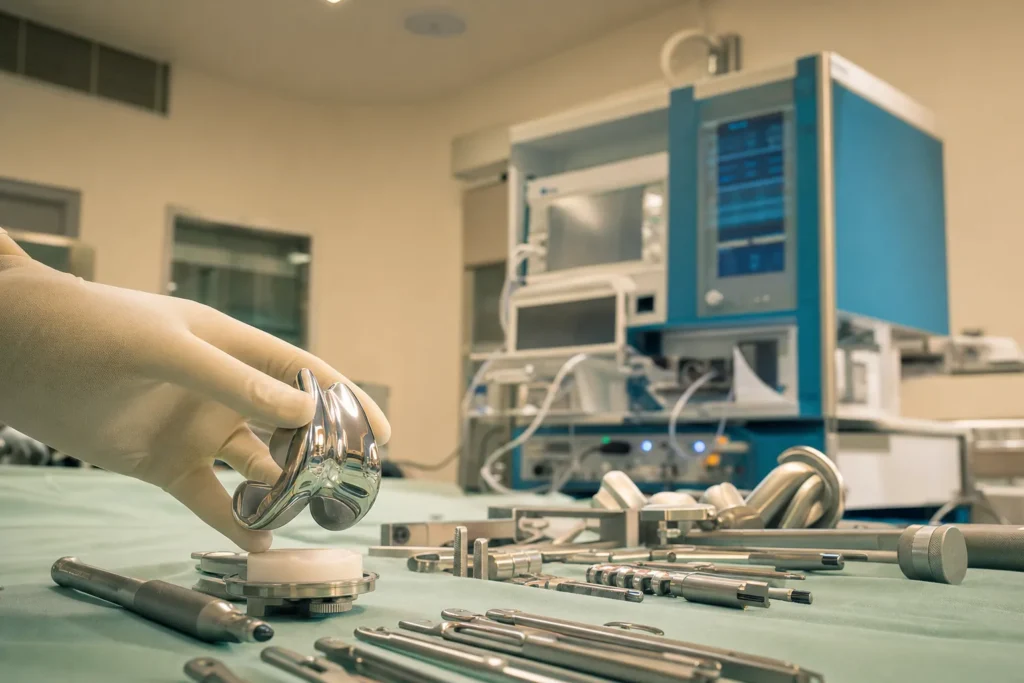
Rather than removing the whole knee, the surgeon shaves off only the damaged surfaces of the bone and caps them with new parts. As the American Academy of Orthopaedic Surgeons (AAOS) puts it, it is really a resurfacing procedure. The new joint is built from three or four pieces: a metal cap on the end of the thigh bone, a metal plate on top of the shin bone, a hard-wearing medical-grade plastic spacer that sits between them to act as the new cartilage, and sometimes a plastic button on the back of the kneecap.
The goal is simple and specific: to take away the bone-on-bone pain and give you back a knee that bends, straightens, and carries your weight comfortably. It does not turn back the clock to a teenage knee, but for the right person it can transform daily life.
Who is a good candidate, and who should wait
Knee replacement is usually recommended when knee pain is having a serious effect on your life and gentler treatments have stopped helping. The most common reason is osteoarthritis, the age-related wear-and-tear arthritis that thins the cartilage over many years. Two other common causes are rheumatoid arthritis, where the body's own immune system inflames and damages the joint lining, and post-traumatic arthritis, which can develop years after a serious knee fracture or ligament injury.
According to AAOS, signs that point toward surgery include severe pain that limits everyday activities like walking, climbing stairs, or getting out of a chair; pain that bothers you even at rest, day or night; ongoing swelling and stiffness that does not settle; and a knee that has started to bow or deform. Crucially, the decision is based on your pain and disability, not your age on paper. Most people who have the operation are between 50 and 80, but AAOS notes there are no strict age or weight limits, and the surgery has been done successfully in patients far younger and older.
Before agreeing to surgery, doctors expect you to have tried the alternatives first: weight management, physiotherapy and muscle-strengthening exercises, walking aids, simple pain relievers and anti-inflammatory medicines, and sometimes joint injections. The NHS is clear that a knee replacement should only be considered once these have not worked.
Some people should pause or rethink. If you have an active infection anywhere in the body, surgery is usually delayed until it clears, because bacteria can settle on the new implant. Poorly controlled diabetes, heart or lung disease, a very high body weight, or smoking all raise the risk of complications and slower healing, so doctors often ask you to get these under better control first. And if your pain is mild or only flares occasionally, the sensible move is to keep treating it without surgery for now.
Types and techniques
Not every worn knee needs a full replacement, and not every implant is fixed in the same way. Understanding the main options helps you ask better questions.
Total knee replacement resurfaces all three compartments of the joint (the inner side, the outer side, and the area behind the kneecap). It is the most common version and suits knees with widespread arthritis.
Partial (unicompartmental) knee replacement replaces only the one damaged side of the joint, leaving the healthy parts alone. The incision is smaller and healing is often quicker, but it is only suitable when arthritis is limited to one compartment. It tends to be offered to younger or more active patients with localized damage.
Surgeons also choose how to anchor the implant to the bone. Cemented fixation uses a fast-setting bone cement to lock the parts in place immediately, which is reassuringly stable and is often preferred for older patients or those with softer, lower-density bone. Uncemented (cementless) implants have a textured surface that the patient's own bone gradually grows into over time, an option sometimes chosen for younger patients with strong bone. Many surgeons use a hybrid of the two.
You may also hear about minimally invasive approaches, which use a smaller incision and aim to disturb less tissue, and robotic-assisted or computer-navigated surgery, where technology helps the surgeon plan the cuts and position the implant precisely. These can be useful tools, but the evidence on whether they meaningfully change long-term results is still developing, and the surgeon's experience matters more than any single gadget.
How the operation is done
On the day, you will meet the anaesthetist to decide how you will be kept comfortable. There are two main choices. General anaesthesia sends you fully to sleep with a breathing tube to support you. Regional (spinal or epidural) anaesthesia numbs you from the waist down so you feel nothing, while you stay awake or lightly sedated; Mayo Clinic notes that many knee-replacement patients have spinal anaesthesia with light sedation. A nerve block, an injection that numbs the specific nerves to the leg, is often added to keep the knee pain-free in the first hours after surgery.
The operation itself usually takes 1 to 2 hours. AAOS describes four basic steps. First, the surgeon makes an incision at the front of the knee and removes the damaged cartilage and a thin slice of bone from the ends of the thigh and shin bones. Second, the metal femoral and tibial components are positioned and fixed (with cement or as a press-fit cementless implant). Third, the back surface of the kneecap may be resurfaced with a plastic button if needed. Fourth, a smooth plastic spacer is inserted between the two metal parts so the new joint glides freely. The incision is then closed with stitches or clips, and you are moved to recovery to wake up and start pain control.
Recovery, step by step
Recovery is a gradual climb, and knowing the milestones makes it far less daunting.
The hospital. Most people stay in hospital for 1 to 3 days, and some now go home the same day or after one night. Remarkably, physiotherapy usually begins within hours of surgery: once the anaesthetic wears off, you will be helped to stand and take your first steps with a walking frame or crutches.
The first weeks. Early exercises matter enormously. Simple movements like ankle pumps, tightening the thigh muscle, straight-leg raises, and gentle knee bends keep blood moving (lowering clot risk), rebuild strength, and restore the bend in the joint. AAOS suggests several short exercise sessions a day plus regular short walks. You will progress from a frame to crutches, then to a single crutch or a walking stick, often around 2 to 3 weeks in. Keeping the leg raised and icing the knee helps the swelling settle.
Returning to life. The NHS notes that people usually drive again after about 6 weeks for a total knee replacement (around 3 weeks for a partial), and return to work somewhere between 6 and 12 weeks depending on how physical the job is. Most return to their normal daily activities within about 6 weeks.
The longer haul. Strength, stamina, and the last of the swelling continue to improve for many months. Mayo Clinic and Cleveland Clinic describe full recovery taking up to about a year. Sticking with your prescribed exercises through this whole period is the single biggest thing you control.
Risks and possible complications
Knee replacement is a well-established operation, and the NHS notes that most people have no complications at all. But it is major surgery, and being informed lets you spot problems early.
Blood clots are the risk doctors guard against most. A clot in a leg vein (deep vein thrombosis, or DVT) can form because blood flows more slowly after surgery; if a piece breaks off and travels to the lungs (a pulmonary embolism), it can be serious. To prevent this, you may be given blood-thinning medicine, compression stockings, and early movement and ankle exercises. Sudden calf swelling and pain, or chest pain and breathlessness, are emergencies that need immediate care.
Infection is uncommon. AAOS reports it occurs in fewer than 2% of patients. A surface wound infection is usually cleared with antibiotics, but a deep infection around the implant may need further surgery.
Other less common problems include damage to a nearby nerve, blood vessel, or ligament; ongoing pain or stiffness; difficulty bending the knee fully (the average range achieved is around 115 degrees); a feeling of instability; and, over the long term, wear or loosening of the implant. There are also the general risks of any operation and anaesthetic, such as reactions to medicines. Your surgeon will weigh these against your personal health before recommending surgery.
Results and how long they last
For the right candidate, the results are genuinely life-changing. Most people experience a dramatic drop in pain and a real improvement in movement and quality of life, finally able to sleep through the night, walk further, and climb stairs without dread.
The hardware is durable. AAOS reports that more than 90% of modern total knee replacements are still working well 15 years after surgery, and the NHS says most last around 20 years or more. Cleveland Clinic notes almost everyone enjoys improved knee function for at least 10 to 15 years. A small number of people will eventually need a second operation (a revision) if the implant wears or loosens, which is more likely in younger, heavier, or very active patients.
It helps to set expectations honestly. A replaced knee feels and behaves like an excellent artificial joint, not a brand-new natural one. You can expect to walk, swim, cycle, golf, and dance comfortably. AAOS advises avoiding high-impact activities like running, jogging, and jumping, which wear the implant out faster. Some people notice mild numbness around the scar or a slight clicking from the implant, both of which are normal.
Costs and what changes the price
In Turkey, an all-inclusive total knee replacement package is commonly offered in the region of €7,000 to €14,000. These packages typically bundle the surgeon's fee, the implant, anaesthesia, the hospital stay, and initial physiotherapy, and often add airport transfers, an interpreter, and hotel nights. By comparison, the same surgery paid for privately in Western Europe or the United States frequently runs several times higher, which is a large part of why patients travel.
Several things move the price within that range. The type of implant and its brand, whether it is partial or total, and whether robotic assistance is used all matter. So do the surgeon's experience and reputation, the hospital's accreditation and facilities, the city (Istanbul tends to differ from smaller centres), the length of your hospital stay, and whether you need both knees done. Existing health conditions that require extra monitoring can also add cost.
Please treat these figures as indicative only. They vary by case, surgeon, and clinic, and are not a quote. The only accurate price is a written, itemized quotation prepared after a clinic reviews your scans and medical history.
Why people travel to Turkiye, and how to choose a safe clinic
Turkiye has become a leading destination for joint surgery for a few practical reasons: high-volume, experienced orthopedic teams; modern private hospitals; short or non-existent waiting lists compared with some public health systems at home; and prices that are a fraction of those in many Western countries, even after you add flights and a hotel.
That said, the responsibility to choose well sits with you, and a few concrete checks protect you.
- Hospital accreditation. Look for accreditation by Joint Commission International (JCI), widely regarded as a global gold standard for hospital quality and patient safety. Turkiye is one of the leading countries worldwide for the number of JCI-accredited hospitals, so you have real choice. You can verify a hospital's status on the JCI website rather than taking a clinic's word for it.
- Surgeon credentials. Confirm the surgeon is a board-certified orthopedic specialist, ideally one who focuses on knee and joint replacement and performs them in high numbers. Ask how many of these specific operations they do each year.
- Their own results. A reputable team can talk openly about their infection rates, complication rates, and revision rates, and how those compare with published benchmarks.
- Clear, written terms. Insist on an itemized quote, a named surgeon, the implant brand, and a written plan for what happens if a complication arises after you fly home.
- Communication and reviews. Check that there is a clear point of contact in your language, and look for independent patient reviews rather than only testimonials on the clinic's own site.
How to prepare and what to ask at your consultation
Good preparation, sometimes called prehabilitation, genuinely speeds recovery. In the weeks before surgery, your team may ask you to strengthen the muscles around the knee with physiotherapy, reach a healthier weight if needed, stop smoking, and get conditions like diabetes or high blood pressure well controlled. You will usually have pre-operative checks such as blood tests, an ECG (a heart trace), and X-rays. Sort out practical things at home too: a clear path to walk, a firm chair, and help for the first week or two.
Bring a written list of questions to your consultation. Useful ones include:
- Am I a good candidate, or should I try non-surgical treatments for longer first?
- Would a partial replacement work for me, or do I need a total one?
- What type of implant will you use, and will it be cemented or cementless?
- How many of these operations do you perform each year, and what are your complication and revision rates?
- What type of anaesthesia do you recommend for me, and why?
- How long will I be in hospital, and what does the rehabilitation plan look like?
- What are the specific risks given my age, weight, and health?
- What is included in the written, itemized price, and what is not?
- Who do I contact, and what is the plan, if I have a problem after returning home?
Aftercare and travelling for treatment, including when it is safe to fly
Aftercare does not end when you leave the hospital. You will likely take blood-thinning medication for a set period, wear compression stockings, keep the wound clean and dry, and follow your exercise programme closely. Watch for warning signs that need urgent attention: increasing redness, heat, or discharge from the wound; a fever; a hot, swollen, painful calf; or sudden chest pain or breathlessness.
The most important travel point is the timing of your flight home, because the same surgery that puts you at risk of blood clots is made riskier by long periods of sitting still on a plane. UK guidance, including from NICE, advises avoiding short-haul flights for around 6 weeks and long-haul flights for about 12 weeks (3 months) after a knee replacement, as the clot risk stays elevated during this window. This is why many patients plan an extended stay in Turkiye for early rehabilitation rather than flying home immediately, and why your discharge timing should be agreed with your surgeon, not the calendar of your return ticket.
If you do fly, take precautions: tell your airline and travel insurer about the recent surgery, keep moving your ankles and walk the aisle regularly, stay well hydrated, wear your compression stockings, and follow any blood-thinning advice. Arrange a follow-up plan before you leave so a doctor at home can check the wound, review your progress, and, if needed, liaise with your Turkish surgeon. A little planning here keeps the savings from coming at the cost of your safety.
Frequently asked questions
How long does a knee replacement last?
Is the surgery done under general anaesthetic?
How long is the operation and the hospital stay?
When will I be able to walk again?
When can I drive and go back to work?
How soon can I fly home after surgery in Turkey?
What are the main risks I should know about?
Will my new knee feel completely normal?
How much does a total knee replacement cost in Turkey?
Do I need a total replacement, or could a partial one work?
How long until I am fully recovered?
What should I try before agreeing to surgery?
This article is for general information only and is not medical advice. Always consult a qualified doctor about your individual case.
Considering this procedure?
Send us your photos and questions. A BergemHealth coordinator and a department-head specialist will review your case and reply with honest, personalised guidance — no obligation.
Free consultation