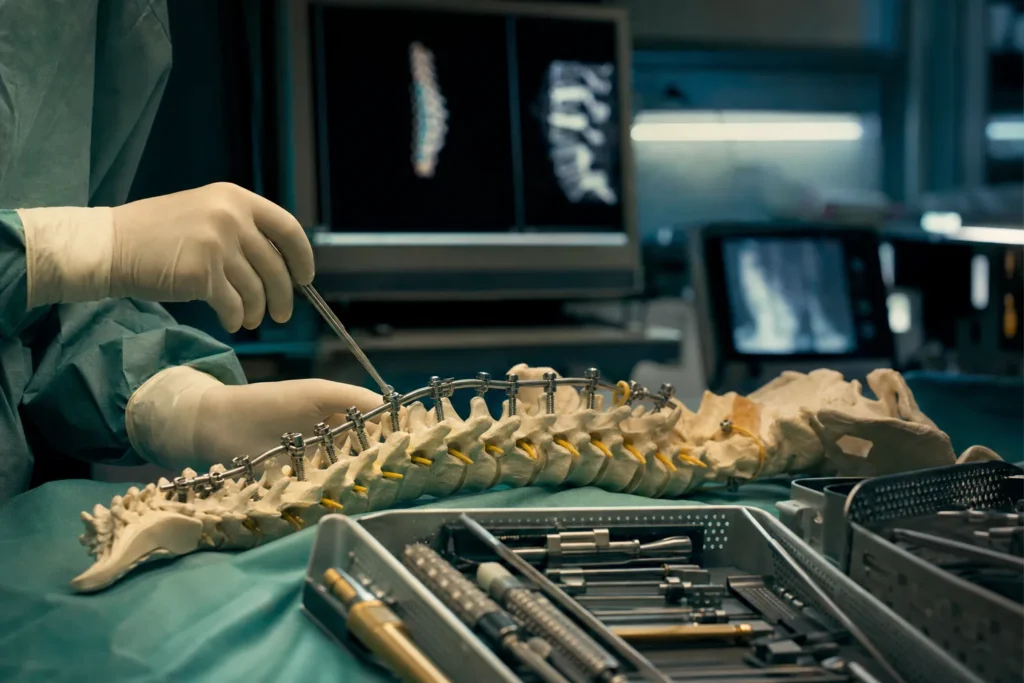
Scoliosis correction
Scoliosis is a sideways curve of the spine. Most curves are mild and never need an operation, but a smaller number keep growing and may need surgery to straighten and steady the spine. This guide explains, in plain words, what scoliosis correction surgery is, who it helps, how it is done, what recovery feels like, what it costs, and how to choose a safe clinic if you are thinking about travelling to Turkiye for treatment.
- Anaesthesia
- General anaesthesia (you are fully asleep)
- Duration
- Usually around 4-8 hours, depending on the curve
- Recovery
- Walking within days; full recovery 6-12 months
- Hospital stay
- About 3-7 days in hospital
What scoliosis correction surgery is
Scoliosis is an abnormal side-to-side curve of the spine. Seen from behind, a healthy spine runs roughly straight down the middle of the back. A spine with scoliosis bends to one side in a C shape, or twice in an S shape, and it usually has a degree of rotation (twist) as well.
Doctors measure how big the curve is in degrees, using a method called the Cobb angle (a measurement taken from an X-ray). As a general guide, a curve under 10 degrees is not classed as scoliosis, 10-24 degrees is mild, 25-39 degrees is moderate, and 40 degrees or more is severe. Scoliosis affects roughly 2 in every 100 people, and most curves are small and stable.
Scoliosis correction surgery is an operation to straighten the spine as much as is safely possible and to stop the curve from getting worse. The most common operation is called spinal fusion. The surgeon attaches metal anchors (small screws and hooks) to the bones of the spine, connects them to one or two metal rods, and gently uses those rods to bring the spine into a straighter position. Small pieces of bone graft are then placed along the spine so that, over several months, the treated bones grow together into one solid block that can no longer bend at those levels. In other words, the rods hold the spine in its new position while the body fuses the bones permanently.
It is important to understand what surgery does and does not do. It is not a cosmetic procedure done for appearance alone; it is done to protect the spine, ease symptoms, and prevent a curve from worsening over a lifetime. It also does not make you taller in a dramatic way, and it does not "cure" the underlying tendency to curve. What it does is give the spine a stable, straighter, lasting shape.
Who is a good candidate (and who should avoid it)
Surgery is only one part of scoliosis treatment, and most people never reach it. Mild curves are usually just monitored with regular check-ups and X-rays every few months. Growing children with moderate curves are often treated with a rigid back brace worn for many hours a day (commonly around 18-23 hours) to slow or stop the curve while they grow. Bracing and physiotherapy do not straighten an existing curve, but they can prevent it from getting worse.
Surgery is generally considered when:
- The curve is large, often around 45-50 degrees or more, because very large curves tend to keep progressing even after a person stops growing.
- The curve is clearly getting worse despite bracing or other measures.
- The curve causes ongoing pain, visible deformity, or, in severe cases, presses on the lungs and affects breathing.
- In adults, the curve causes nerve compression with leg pain, numbness or weakness that does not settle with non-surgical care.
Decisions are always individual. For "grey-zone" curves of about 40-45 degrees, the patient's own goals and symptoms matter a great deal.
Who should think carefully or avoid surgery: people whose curve is small and stable, those whose symptoms can be managed without an operation, and anyone whose general health makes a long operation and anaesthetic too risky. Active infection, poorly controlled diabetes, heavy smoking, very low bone density, and significant heart or lung disease can all raise the risks and may need to be addressed first or may rule surgery out. A thorough pre-operative assessment is essential, and a second opinion is reasonable for such a major decision.
Types and techniques
There is no single "scoliosis operation". The right technique depends on your age, how much growing you have left, the size and location of the curve, and its cause. The main options are:
- Posterior spinal fusion. The most common operation for adolescents and adults. The surgeon works through an incision down the back, places screws and hooks into the vertebrae, connects them to rods, straightens the spine and adds bone graft to fuse it.
- Anterior spinal fusion. The spine is reached from the front or side, sometimes through the chest or via the rib cage. This can suit certain single curves and may be combined with the posterior approach.
- Growing rods. Used mainly in younger children (often under 10) who still have a lot of growing to do. Rods are attached above and below the curve and lengthened periodically as the child grows, either through small repeat procedures or, with magnetically controlled growing rods, by a non-surgical adjustment in the clinic. The aim is to control the curve while allowing the spine and chest to keep growing.
- Vertebral body tethering (VBT). A newer, growth-friendly technique for selected young patients who are still growing. A flexible cord is anchored along the curve so that ongoing growth gradually straightens the spine, often without a full fusion. It is not suitable for everyone and is offered in specialist centres.
- Hemivertebra removal. For some congenital curves caused by a single abnormally shaped vertebra, removing that bone can correct the curve at its source.
Many centres now use computer navigation or robotic assistance to place screws more precisely, and continuous neuromonitoring (which checks the nerves and spinal cord throughout the operation) to protect spinal cord function.
How it is done: anaesthesia, steps and how long
Spinal fusion for scoliosis is a major operation done under general anaesthesia, meaning you are completely asleep and feel nothing during surgery. An anaesthetist monitors you throughout.
A typical posterior fusion follows these steps:
- You are positioned, usually face down, and the surgical team places sensors for neuromonitoring to watch the spinal cord and nerves.
- The surgeon makes an incision over the spine and carefully exposes the bones of the curve.
- Screws and hooks are anchored into the vertebrae at the planned levels.
- One or two contoured rods are attached, and the surgeon gently rotates and straightens the spine into its corrected position.
- Bone graft (often taken from the hip or supplemented with graft material) is laid along the spine to encourage fusion.
- The wound is closed in layers, and you are woken up and moved to recovery.
The operation commonly takes around 4 to 8 hours, though larger or more complex curves can take longer. Most people then stay in hospital for about 3 to 7 days. The rods and screws stay in your body permanently; they do not normally need to be removed.
Recovery, step by step
Recovery from scoliosis surgery is gradual and measured in months, not days. Here is roughly what to expect:
- The first days in hospital. Pain is managed with medication. The care team will usually get you up to stand and take a few steps within a day or two, because gentle movement helps prevent complications such as blood clots. You will learn how to roll, sit and stand safely while protecting your back.
- First 1-2 weeks at home. Most people are off strong pain medicine within about 10-14 days. You walk a little more each day and avoid bending, lifting and twisting.
- 3-6 weeks. Energy returns and the wound heals. Children and teenagers often go back to school after a few weeks. Many adults return to light, non-physical work in this window.
- 2-6 months. The bones are steadily fusing. Physiotherapy and walking build strength and stamina. Activity is increased step by step under your surgeon's guidance.
- 6-12 months. The fusion becomes solid and most people return to fuller activity, including many sports. Full recovery from such a major operation can take up to a year, and sometimes longer in adults.
Throughout recovery, follow your team's specific instructions on lifting limits, driving, and when to resume each activity. These restrictions exist to protect the fusion while it heals.
Risks and possible complications
Scoliosis correction is generally effective, but it is a big operation and, like all major surgery, it carries risks. Your surgeon should explain these clearly before you consent. Possible complications include:
- Bleeding, sometimes enough to need a blood transfusion.
- Infection of the wound or deeper tissues, which may need antibiotics or further surgery.
- Blood clots in the legs (deep vein thrombosis) or lungs, which is why early movement and sometimes preventive measures are used.
- Nerve or spinal cord injury. This is rare, but because the surgery is on the spine it can, in the worst cases, cause numbness, weakness or, very rarely, paralysis. Neuromonitoring during surgery is used to reduce this risk.
- Hardware problems, such as a screw or rod loosening, shifting or breaking, which can sometimes need a further operation.
- Failure of fusion (pseudarthrosis), where the bones do not fully join, which may need revision surgery.
- Risks of general anaesthesia, and ongoing or new back pain in some people.
The chance of a serious complication is low in experienced hands, but it is never zero. Smoking, diabetes and poor general health raise the risks, so optimising your health beforehand genuinely helps.
Results and how long they last
The main goals of surgery are to stop the curve from getting worse and to make the spine significantly straighter and more balanced. Most people achieve a meaningful correction of the curve, a more level appearance of the shoulders, waist and hips, and a stable spine.
Because fusion permanently joins the treated vertebrae into a solid block of bone, the result is designed to be lasting. The corrected segment cannot curve again at those levels. For many adolescents who have a posterior spinal fusion, the aim is for no further spinal surgery for the rest of their life, although fusing part of the spine does mean that section no longer bends, so some flexibility in that area is traded for stability.
It is honest to say that surgery cannot promise a perfectly straight spine or guarantee that all symptoms disappear. In adults having surgery for nerve pain, leg symptoms often improve more reliably than long-standing back pain. Over many years, the segments of spine just above or below a fusion can occasionally wear faster, and a small number of people eventually need additional surgery. Regular follow-up helps catch any issues early.
Costs: indicative ranges and what changes the price
Scoliosis surgery is one of the more expensive orthopaedic operations because it is long, complex, and uses specialised implants. In high-cost countries the total can run into tens of thousands of euros and beyond. In Turkiye, indicative package prices for scoliosis correction commonly fall in the region of around 12,000 to 30,000 EUR, and sometimes higher for the most complex cases.
These figures are indicative ranges, not a quote. The real price varies by case, surgeon and clinic. Several things move the number up or down:
- How many vertebrae are fused and how big and rigid the curve is.
- The technique and implants used (number of screws and rods, navigation or robotic assistance, magnetic growing rods or tethering systems).
- Length of hospital stay and level of intensive-care monitoring needed.
- Surgeon and hospital reputation and accreditation.
- What the package includes, such as scans and tests, anaesthesia, implants, the operation, hospital stay, medicines, physiotherapy, airport transfers, interpreter and hotel nights.
When you compare quotes, always check exactly what is and is not included, and ask in writing what happens (and who pays) if you need extra days in hospital or treatment for a complication.
Why people travel to Turkiye, and how to choose a safe clinic
People consider Turkiye for spine surgery mainly because reputable hospitals there offer modern equipment and experienced surgeons at prices well below those in many Western countries, often with all-inclusive packages that handle the logistics of travelling for treatment. Turkiye also has a large number of internationally accredited hospitals.
That said, scoliosis surgery is too serious to choose on price alone. To protect yourself, verify the following before you commit:
- Hospital accreditation. Look for international accreditation such as JCI (Joint Commission International), which sets recognised standards for patient safety and quality of care.
- Surgeon credentials. Confirm the operating surgeon is a qualified, board-certified orthopaedic spine surgeon or neurosurgeon who performs scoliosis correction regularly. Ask how many of these operations they do each year.
- Neuromonitoring and facilities. Check that spinal cord neuromonitoring is used and that the hospital has a proper intensive-care unit and blood bank, since these are essential safety nets for spinal surgery.
- Clear, written plan. You should receive a written treatment plan, a transparent price breakdown, and a clear answer on follow-up and complication cover.
- Honest communication. Be cautious of anyone promising a "perfect" result or guaranteeing outcomes. Good surgeons explain risks as well as benefits.
- Continuity of care. Arrange how your X-rays, notes and any aftercare will be shared with a doctor back home.
A trustworthy clinic or concierge will welcome these questions and give you time and documentation to make your decision.
How to prepare and what to ask in your consultation
Good preparation makes surgery safer and recovery smoother. In the weeks before the operation your team may ask you to:
- Have up-to-date X-rays and any scans (such as MRI or CT) and routine blood tests.
- Stop smoking, because smoking interferes with bone fusion and healing.
- Improve general fitness and nutrition, and manage conditions such as diabetes or anaemia.
- Review your medicines, as some blood thinners and anti-inflammatories may need to be paused.
- Arrange help at home for the first weeks, since bending and lifting will be limited.
Useful questions to ask at your consultation include:
- How big is my curve, and why do you recommend surgery rather than continued monitoring or bracing?
- Which technique do you advise, and how many spinal levels would be fused?
- How many of these operations do you perform each year, and what are your results and complication rates?
- What are the specific risks in my case, and what is the plan if a complication happens?
- How long is the operation, the hospital stay, and the expected recovery for someone like me?
- What will the total cost cover, and what is the plan for follow-up and aftercare?
Aftercare and travelling for treatment (including when it is safe to fly)
After scoliosis surgery you will have wound care, pain relief and a structured plan to gradually rebuild movement and strength, usually with physiotherapy. You will be given clear limits on bending, twisting and lifting to protect the fusion while it heals, plus a schedule of follow-up X-rays to confirm the bones are joining as expected.
If you travel abroad for surgery, the journey home needs planning, because long periods of sitting still after major surgery raise the risk of blood clots, and clot risk is highest in the first weeks. There is no single rule that fits everyone, but guidance for fusion surgery often suggests waiting several weeks before flying, with longer waits for long-haul flights, and many surgeons advise allowing roughly 6 weeks or more before a long flight after a fusion. The safest approach is to fly only when your own surgeon confirms your wound healing, sitting tolerance and clot risk are acceptable.
To reduce risk on the journey, plan to: get written flight clearance from your surgeon; choose an aisle seat so you can stand and walk regularly; do gentle ankle and leg movements; stay well hydrated; and wear compression stockings if advised. Build extra recovery time into your stay rather than rushing the flight home, and make sure you know who to contact, and where to go locally, if a problem develops before you leave.
This article is general information and not medical advice. Always rely on the specific guidance of the surgeon and team who assess you in person.
Frequently asked questions
At what curve size is scoliosis surgery usually recommended?
Will surgery make my spine completely straight?
How long does scoliosis surgery take?
How long will I stay in hospital?
How long is the full recovery?
Do the metal rods and screws have to be removed later?
What are the main risks of the operation?
Are there alternatives to surgery?
How much does scoliosis surgery cost in Turkiye?
When is it safe to fly home after spinal fusion?
How do I check that a clinic and surgeon are safe?
Can adults have scoliosis surgery, or is it only for children?
This article is for general information only and is not medical advice. Always consult a qualified doctor about your individual case.
Considering this procedure?
Send us your photos and questions. A BergemHealth coordinator and a department-head specialist will review your case and reply with honest, personalised guidance — no obligation.
Free consultation