Sports knee injury (ACL/meniscus)
A twisted knee on the football pitch, a "pop" on the ski slope, a swollen joint after a bad landing — sports knee injuries to the ACL and meniscus are some of the most common reasons active people end up in front of an orthopaedic surgeon. This guide explains, in plain words, what these injuries are, how they are treated (with and without surgery), what recovery really looks like, and what to think about if you are considering treatment in Turkiye.
- Anaesthesia
- General anaesthesia, or regional (spinal/nerve block) with sedation
- Duration
- About 1-2.5 hours, depending on whether the ACL, meniscus, or both are treated
- Recovery
- Meniscus trim: a few weeks. Meniscus repair: 3-6 months. ACL reconstruction: 6-12 months back to sport
- Hospital stay
- Often day-case (same-day discharge) or 1 night
What a sports knee injury is
The knee is a hinge joint where your thighbone (femur) meets your shinbone (tibia). Holding it together and keeping it stable are tough bands called ligaments, and cushioning it are two C-shaped pieces of rubbery cartilage called the menisci (one meniscus on each side). "Sports knee injury" usually refers to damage to one or both of these structures during physical activity.
The two most common are:
- An ACL tear. The anterior cruciate ligament (ACL) runs diagonally through the centre of the knee. It stops the shinbone from sliding forward and gives the knee its rotational stability — the steadiness you rely on when you change direction. The ACL is one of the most commonly injured knee ligaments; in the United States alone, more than 200,000 ACL injuries happen each year. Most occur without any contact, when the knee twists, pivots, or lands awkwardly.
- A meniscus tear. The meniscus is the shock absorber between the bones. A sudden twist of a weight-bearing knee can tear it. In older adults, the meniscus can also tear from everyday movements because the cartilage weakens with age (a "degenerative" tear).
These two injuries often travel together: roughly half of ACL tears come with damage to the meniscus or other structures, which is why surgeons examine the whole knee, not just one part.
Who is a good candidate (and who should think twice)
Not every knee injury needs surgery, and not everyone is a good surgical candidate. The right choice depends on which structure is torn, how badly, how active you are, and your overall health.
Surgery is more often recommended when:
- You have a complete ACL tear and you play pivoting or cutting sports (football, basketball, skiing, tennis) or your knee keeps "giving way" in daily life.
- A meniscus tear causes the knee to lock or catch (a fragment physically blocks movement), or symptoms continue despite rest and physiotherapy.
- A meniscus tear is in a repairable position with a good blood supply, especially in a younger, active person.
Non-surgical treatment may be enough when:
- The tear is partial, the knee feels stable, and you do not need to return to high-demand sport.
- You lead a less active lifestyle, or do light work, and physiotherapy controls the symptoms.
- A meniscus tear is small, degenerative, and improving with rehab.
Who should be cautious or avoid elective surgery: people with an active infection in or near the knee, poorly controlled diabetes, significant heart or lung disease, or those who cannot commit to months of rehabilitation. Surgery without doing the rehab afterwards rarely gives a good result. Children who are still growing need a surgeon experienced in techniques that protect the growth plates. Always discuss your full medical history, smoking, and any blood-clotting risks with the surgeon.
Types and techniques
ACL and meniscus problems are treated differently, and the plan is tailored to the exact injury.
For the ACL
A stretched but intact ACL (a grade 1 or 2 sprain) is usually managed without surgery. A complete tear (grade 3) does not heal back together on its own, so when surgery is chosen it is a reconstruction — the torn ligament is replaced with a graft, a strip of tendon that becomes the new ligament. Graft options include:
- Patellar tendon autograft (a strip from your own kneecap tendon) — long considered a reliable choice with low failure rates, but it can cause kneecap-area pain and discomfort when kneeling.
- Hamstring tendon autograft (from the back of your thigh) — often a quicker, less painful harvest, sometimes with slightly more looseness over time.
- Quadriceps tendon autograft — a larger graft sometimes chosen for bigger patients or revision surgery.
- Allograft (donor tissue) — avoids a second incision and shortens surgery, but tends to have higher failure rates in young, active athletes.
For the meniscus
What is possible depends on where the tear sits, because blood supply drives healing:
- Meniscus repair (stitching the torn edges together) — possible in the outer "red zone," which has a good blood supply and can heal. Preferred when feasible because it preserves the cushion.
- Partial meniscectomy (trimming away the torn, unstable piece) — used in the inner "white zone," which has little blood supply and cannot heal. Surgeons remove as little as possible to keep the joint protected.
Most of this work is done by arthroscopy — keyhole surgery through tiny incisions — described in the next section.
How it is done (anaesthesia, steps, timing)
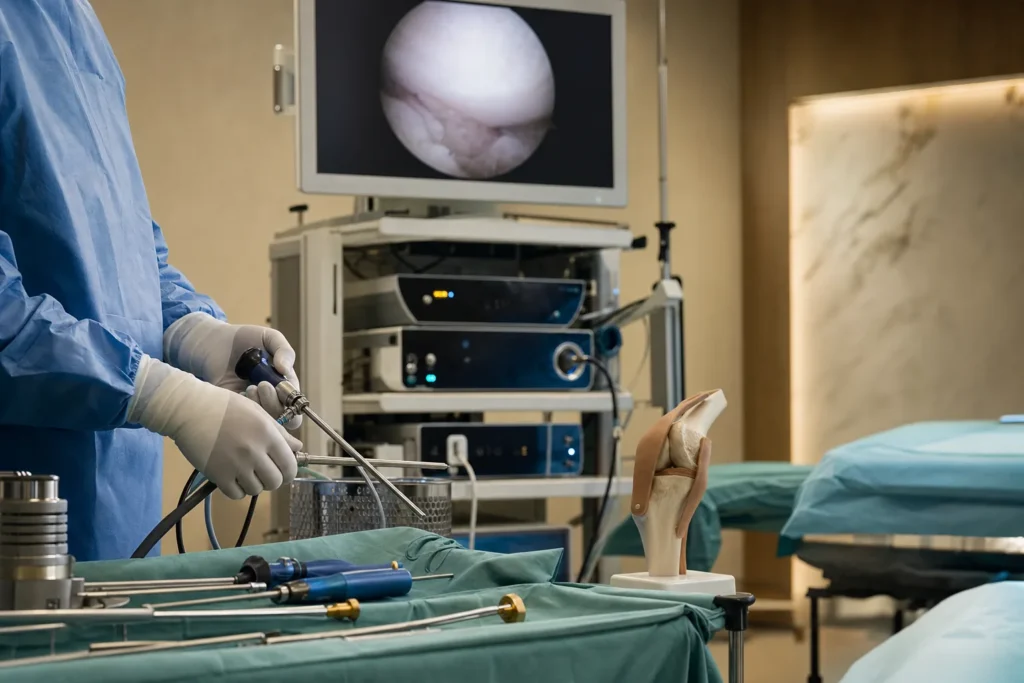
ACL and meniscus operations are almost always arthroscopic. The surgeon makes two or three small cuts (each under a centimetre), inserts a thin camera called an arthroscope, and works with miniature instruments while watching a screen. Keyhole surgery means less tissue damage, smaller scars, and a faster early recovery than open surgery.
Anaesthesia. You will usually have either general anaesthesia (fully asleep) or regional anaesthesia — a spinal injection or a nerve block that numbs the leg — often combined with sedation so you are relaxed. Nerve blocks also help control pain in the first hours after surgery. Your anaesthetist will choose based on your health and preferences.
The steps, broadly:
- The surgeon inspects the whole joint through the camera and confirms the damage.
- For a meniscus, they either stitch the tear (repair) or trim the loose fragment (partial meniscectomy).
- For an ACL, they remove the torn ligament, harvest or prepare the graft, drill small tunnels in the shinbone and thighbone, thread the graft through, and fix it with screws or buttons. The graft is set at the correct tension so the knee is stable.
How long it takes. A straightforward meniscus procedure may take under an hour; an ACL reconstruction commonly takes around two to two and a half hours; doing both adds time. Most patients go home the same day, though some stay one night. Before discharge you will practise walking with crutches and may be fitted with a brace.
Recovery, step by step
Recovery is a staged process, and physiotherapy is the part that determines your result. Timelines vary by person and procedure, so treat these as general guides, not promises.
Partial meniscectomy (trimming)
The fastest recovery. Many people walk fairly comfortably within days and return to normal activity in roughly 3 to 6 weeks, depending on the job and sport.
Meniscus repair (stitching)
Slower, because the stitched cartilage must heal. You may need to limit weight-bearing or bending for several weeks, with full recovery typically 3 to 6 months.
ACL reconstruction
- First days to 2 weeks: manage swelling and pain (ice, elevation, prescribed pain relief), start gentle movement, and walk with crutches. Wound care and watching for blood-clot warning signs matter here.
- Weeks 2-6: physiotherapy focuses on restoring full straightening, reducing swelling, and rebuilding the quadriceps muscle. Crutches are gradually phased out as your gait normalises.
- Months 2-4: strengthening and balance work; many people return to office work much sooner, and to light gym activity in this window.
- Months 4-9: running, agility, and sport-specific drills are introduced once strength and control allow.
- Months 6-12: return to full sport, but only after passing strength and movement tests — not just because enough time has passed.
Skipping rehabilitation is the most common reason results disappoint. The graft needs time to mature, and your muscles need to be retrained to protect it.
Risks and possible complications
These are generally safe, well-established operations, but no surgery is risk-free. Possible complications include:
- Infection in the wound or joint (uncommon, but it needs prompt treatment).
- Bleeding and blood clots (deep vein thrombosis) in the leg, which can rarely travel to the lungs. The clot risk is highest in the first few weeks.
- Stiffness or loss of full movement, sometimes needing extra physiotherapy.
- Persistent pain, including kneecap-area pain or discomfort kneeling (more associated with patellar tendon grafts).
- Graft failure or re-tear of the ACL. Long-term, chronic instability from graft problems is reported in roughly 5 to 10% of patients, and studies show re-injury (to either knee) occurs in a meaningful share of athletes — up to around 30% within two years in higher-risk young, returning-to-sport groups. Passing return-to-play testing before going back to sport lowers that risk.
- Numbness around the incisions from small skin nerves.
- Growth-plate injury in children who are still growing — a reason to choose a surgeon experienced in paediatric techniques.
Call your surgeon promptly if you have spreading redness, fever, a calf that is hot, swollen, or painful, or sudden breathlessness or chest pain.
Results and how long they last
For most people, the goal is a stable, pain-free knee that lets them return to the activities they enjoy. After successful ACL reconstruction with good rehabilitation, the large majority regain a stable knee and return to sport, usually within 6 to 12 months. A repaired meniscus that heals preserves the joint's natural cushioning, which is good for the knee over the long term.
That said, results are not guaranteed and depend heavily on the rehab you do, the quality of the graft and surgery, and how you manage your return to sport. A reconstructed ACL is a graft, not a brand-new original ligament, and it can re-tear — particularly if you return to pivoting sports before you are physically ready.
There is also a longer-term picture worth knowing: a serious knee injury, especially when meniscus tissue has to be removed, modestly raises the chance of developing osteoarthritis (wear-and-tear joint changes) years down the line. Preserving meniscus tissue when possible and keeping the surrounding muscles strong are the best ways to protect the joint over time.
Costs (indicative ranges and what changes the price)
Prices vary widely between countries, hospitals, and surgeons. As a rough guide for self-pay treatment in Turkiye, arthroscopic knee surgery often falls in the region of EUR 2,500 to EUR 7,000. A meniscus-only arthroscopy sits toward the lower end; an ACL reconstruction (with graft and fixation hardware) sits higher; treating the ACL and meniscus together costs more again.
These figures are indicative ranges, not a quote. The real price varies by case, surgeon, and clinic, and depends on factors such as:
- Which procedure is done (trim vs repair vs reconstruction, and whether both are needed).
- Graft type and the fixation devices (screws, buttons) used.
- Anaesthesia type and length of theatre time.
- Whether you stay overnight, and the hospital's accreditation and location.
- Pre-operative scans (such as MRI) and the post-operative physiotherapy package — rehab is essential and is sometimes priced separately.
- Any concierge extras: airport transfers, interpreter, and accommodation.
When comparing quotes, always ask exactly what is and is not included, especially follow-up consultations, the brace, and physiotherapy sessions, so you are comparing like for like.
Why people travel to Turkiye, and how to choose a safe clinic
Turkiye has become a popular destination for orthopaedic surgery because of its modern private hospitals, experienced sports-medicine surgeons, short waiting times, and prices that are often lower than in Western Europe — frequently bundled with transfers, interpreting, and accommodation. The savings can be real, but safety should come first. A poor result on a knee is expensive to fix from abroad.
What to verify before you book:
- Hospital accreditation. Look for international accreditation such as JCI (Joint Commission International), which signals the hospital meets recognised standards for safety and quality. You can check accredited organisations on JCI's own website.
- Surgeon board certification and specialty. Confirm the surgeon is a qualified orthopaedic specialist with specific experience in knee arthroscopy and ACL reconstruction — not a generalist. Ask how many of these procedures they do each year.
- Clear, written plan. A reputable clinic reviews your MRI, gives a written treatment plan and itemised quote, and is honest about whether you even need surgery.
- Realistic claims. Be wary of guarantees, "best in the world" marketing, or promises of a specific outcome. Good clinics talk about risks, not just results.
- Aftercare and rehab. Since rehabilitation runs for months, ask how follow-up and physiotherapy will work once you are home, and who you contact if there is a problem.
- Reviews and references. Independent patient reviews and the option to speak to the surgeon directly (by video) before travelling are good signs.
How to prepare and what to ask at your consultation
Good preparation makes surgery safer and recovery smoother.
Before you travel or operate:
- Have a recent MRI scan and any X-rays ready to share — they confirm the diagnosis and the surgical plan.
- List your medicines, allergies, and past surgeries. Tell the team about blood thinners, the contraceptive pill, or any clotting history.
- Stop smoking if you can — it slows healing — and follow fasting instructions before anaesthesia.
- Arrange help at home and time off work; you will be on crutches early on.
- Some surgeons recommend "prehab" — physiotherapy before surgery to reduce swelling and strengthen the leg, which can improve recovery.
Questions worth asking the surgeon:
- Do I actually need surgery, or could I try rehabilitation first?
- Is my meniscus repairable, or will part of it be removed — and why?
- Which graft do you recommend for me, and what are its trade-offs?
- How many of these operations do you perform each year, and what are your complication rates?
- Will it be day-case or an overnight stay? What anaesthesia will I have?
- What does the rehab plan look like, and is physiotherapy included in the price?
- When can I safely fly home, and what follow-up will I have?
Aftercare and travelling for treatment (including when it is safe to fly)
If you travel abroad for knee surgery, planning the journey home is as important as planning the operation. Surgery and long flights both raise the risk of deep vein thrombosis (DVT) — a blood clot in the leg — and that risk is generally raised for about four to six weeks after surgery. Sitting still for hours on a plane adds to it.
When is it safe to fly? There is no single rule, and you must follow your own surgeon's advice, but for major knee surgery a cautious approach often suggests waiting around 6 weeks before a short-haul flight and up to about 12 weeks before a long-haul flight. After a small arthroscopic meniscus trim, surgeons may clear you sooner. Many medical-tourism patients stay locally for a short period after surgery for the first wound check before flying — confirm the expected stay with your clinic in advance.
To reduce clot risk on the journey:
- Get up and walk along the aisle when it is safe to do so, and do calf exercises (pumping your ankles) roughly every half hour.
- Drink plenty of water and avoid alcohol.
- Wear below-the-knee compression stockings if your surgeon recommends them.
- Take any prescribed clot-prevention medication exactly as directed.
Ongoing aftercare: keep up your physiotherapy, attend follow-up appointments (in person or by video), look after the wound, and watch for warning signs of infection or clots. The single biggest factor in a good long-term result is doing your rehabilitation consistently for the full programme — months, not weeks.
Frequently asked questions
How do I know if I have torn my ACL or my meniscus?
Do I definitely need surgery?
Is the surgery done with keyhole technique?
Will I be asleep during the operation?
How long does recovery take?
When can I walk and drive again?
What are the main risks?
How long will the result last?
How much does ACL or meniscus surgery cost in Turkiye?
When is it safe to fly home after knee surgery?
What should I look for when choosing a clinic abroad?
Why does physiotherapy matter so much?
This article is for general information only and is not medical advice. Always consult a qualified doctor about your individual case.
Considering this procedure?
Send us your photos and questions. A BergemHealth coordinator and a department-head specialist will review your case and reply with honest, personalised guidance — no obligation.
Free consultation