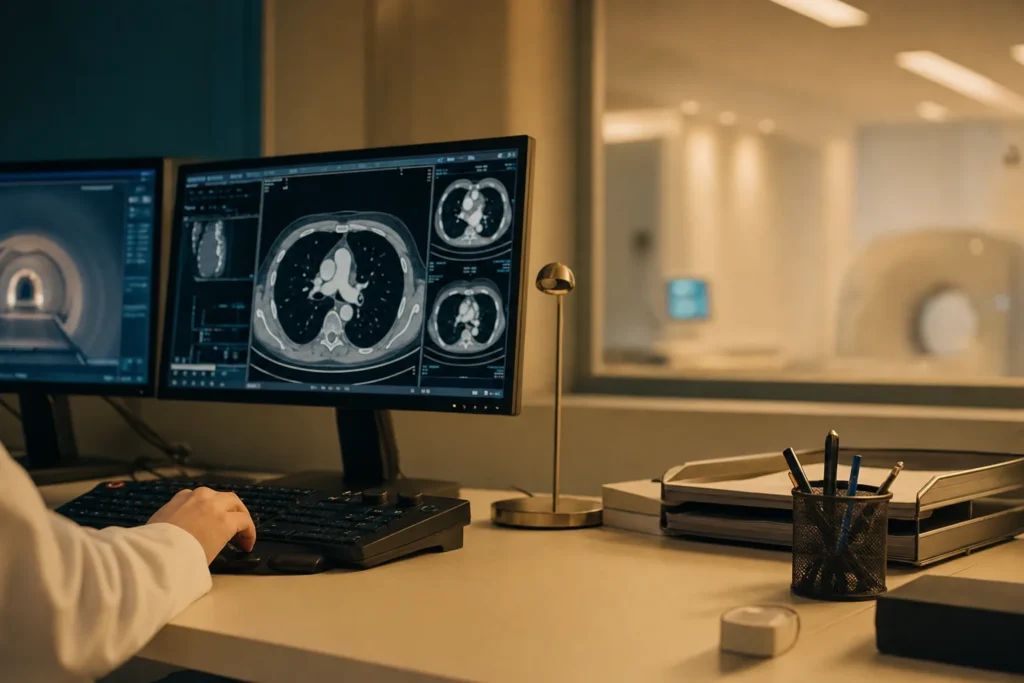
Lung cancer diagnosis
If you or someone you love is facing questions about lung cancer, the days around testing can feel overwhelming and uncertain. This guide walks you calmly through how lung cancer is found and diagnosed, what each test does, how doctors decide on a stage, the treatment paths that may follow, and how to prepare if you are considering care abroad. We explain medical terms in plain words, base the facts on trusted health authorities, and aim to help you ask good questions, not to frighten you. A diagnosis is the start of a plan, and a plan is something you and a specialist team can build together.
What lung cancer is
Lung cancer is a disease in which cells in the lungs begin to grow and divide in a way the body can no longer control. Normally, cells grow, do their job, and die off in an orderly cycle. In cancer, that orderly process breaks down, and abnormal cells build up and can form a lump called a tumour. Over time, some of these cells may spread to nearby tissue or to other parts of the body.
The lungs are the two spongy organs in your chest that take in oxygen when you breathe in and release carbon dioxide when you breathe out. Most lung cancers begin in the cells lining the airways, the branching tubes that carry air deep into the lungs.
It helps to know that finding lung cancer is a step-by-step process. Doctors rarely rely on a single test. Instead, they combine your symptoms, imaging scans, and a tissue sample to build a complete picture. This article focuses on that journey, what each test is for, and what the results mean, so the process feels less like a mystery.
One important and hopeful point from the start: lung cancer is not one single disease. There are different types that behave differently and are treated differently, and the treatments available today are broader than they were even a decade ago.
Types and subtypes of lung cancer
Doctors divide lung cancer into two main groups based on how the cells look under a microscope. Knowing which type you have shapes every treatment decision that follows.
Non-small cell lung cancer (NSCLC) is by far the most common group. According to the American Cancer Society, about 80 to 85 percent of lung cancers are non-small cell. It tends to grow and spread more slowly than the other main type. NSCLC has several subtypes:
- Adenocarcinoma is the most common subtype. It starts in cells that make mucus and is the type most often seen in people who have never smoked, as well as in former and current smokers. It is more common in women than in men.
- Squamous cell carcinoma begins in the flat cells lining the airways and is often linked to a history of smoking. It usually develops in the central part of the lungs.
- Large cell carcinoma can appear in any part of the lung and tends to grow more quickly.
- Less common subtypes include adenosquamous carcinoma and sarcomatoid carcinoma.
Small cell lung cancer (SCLC) makes up about 10 to 15 percent of lung cancers, per the American Cancer Society. It is a faster-growing cancer that tends to spread early to other parts of the body, and it is strongly linked to smoking. Because of how it behaves, it is staged and treated differently from NSCLC. It is usually grouped into limited stage (confined to one side of the chest) or extensive stage (spread more widely).
Causes and risk factors
It is natural to wonder why this has happened. In many cases there is no single, simple answer, and a diagnosis is never a person's fault. What we do know is that certain things raise the risk.
Smoking tobacco is the single biggest risk factor. The Cleveland Clinic notes that smoking, including cigarettes, cigars and pipes, is linked to roughly 80 percent of lung cancer deaths. The risk rises with how much and how long a person has smoked.
It is also important to know that people who have never smoked can develop lung cancer too. The Cleveland Clinic notes that up to 20 percent of people diagnosed have never smoked. Other recognised risk factors include:
- Secondhand smoke, meaning breathing in other people's tobacco smoke.
- Radon, a colourless, odourless radioactive gas that can build up indoors.
- Workplace and environmental exposures such as asbestos, diesel exhaust, silica, uranium and certain other industrial substances.
- Air pollution.
- Previous radiation therapy to the chest, for example for breast cancer or lymphoma.
- A family history of lung cancer.
Having one or more risk factors does not mean a person will develop lung cancer, and some people with the disease have no obvious risk factors at all. Stopping smoking at any age lowers risk over time and is one of the most valuable steps a person can take for their lungs.
Signs and symptoms, and when to see a doctor
One of the challenges with lung cancer is that, as the NHS explains, there are usually no signs or symptoms in the early stages. Symptoms tend to appear as the disease progresses, which is one reason screening matters for higher-risk people (covered in the next section).
The NHS lists the main symptoms as:
- A cough that does not go away after three weeks, or a long-standing cough that gets worse.
- Repeated chest infections.
- Coughing up blood.
- An ache or pain when breathing or coughing.
- Persistent breathlessness.
- Persistent tiredness or lack of energy.
- Loss of appetite or unexplained weight loss.
Less common symptoms can include changes in the shape of the fingers (called finger clubbing), difficulty or pain when swallowing, wheezing, a hoarse voice, swelling of the face or neck, and ongoing chest or shoulder pain.
When to see a doctor: the NHS advises seeing a GP if you have any of the main symptoms or any of the less common ones. Most of these symptoms are caused by something other than cancer, such as an infection, but they should always be checked. Coughing up blood, in particular, deserves prompt medical attention. Getting checked early gives you the most options, whatever the cause turns out to be.
Screening and early detection
Screening means testing for a disease in people who feel well, before symptoms appear, with the aim of finding it early when it may be easier to treat. For lung cancer, screening is targeted at people at higher risk rather than the whole population.
The recommended test is a low-dose CT scan (LDCT), a special computed tomography scan that uses a lower dose of radiation. In the United States, the US Preventive Services Task Force recommends annual LDCT screening for adults aged 50 to 80 who have a 20 pack-year smoking history and who currently smoke or have quit within the past 15 years. (A pack-year means smoking one pack a day for one year.) The Task Force gives this a grade B recommendation, meaning there is moderate net benefit. Screening can stop once a person has not smoked for 15 years, or if they develop another health problem that limits life expectancy.
Screening has clear benefits and real trade-offs. The National Cancer Institute reports that LDCT screening in higher-risk people reduced lung cancer deaths by around 20 percent compared with chest X-ray in a large trial. The trade-offs include false alarms (scans that look abnormal but turn out not to be cancer), the possibility of finding slow-growing cancers that may never have caused harm, and a small radiation dose. A doctor can help you weigh these.
One key point: screening programmes vary by country, and eligibility rules differ. Importantly, the National Cancer Institute states that screening with chest X-ray and/or sputum (phlegm) tests does not reduce deaths from lung cancer, so these are not used for screening. If you think you may be eligible for LDCT screening, ask your doctor about local programmes.
How lung cancer is diagnosed
Diagnosing lung cancer usually unfolds in stages, moving from broad pictures of the chest to a precise tissue sample. Here is what each step involves.
History and examination. A doctor asks about your symptoms, smoking history and other risk factors, and examines you. They may use a spirometer (a device you breathe into) to measure your lung function, and order blood tests to check your general health and rule out other causes.
Imaging tests create pictures of the inside of the chest:
- Chest X-ray is often the first test. Most lung tumours show up as a grey-white area, though an X-ray alone cannot confirm cancer.
- CT scan uses X-rays and a computer to build detailed cross-sectional images, often with an injection of contrast dye to highlight tissues. It shows tumours far more clearly than a plain X-ray.
- PET-CT scan uses a small amount of a radioactive sugar that collects in active cancer cells, helping show where cancer is active and whether it has spread.
- MRI or bone scans may be used to check whether cancer has reached the brain, spine or bones.
Taking a tissue sample (biopsy) is the only way to confirm cancer for certain. A pathologist examines the cells under a microscope. Methods include:
- Bronchoscopy, where a thin flexible tube with a camera is passed into the airways to look and take samples, usually under sedation. An ultrasound version (endobronchial ultrasound) helps sample lymph nodes.
- Needle biopsy through the skin, guided by a scan, to reach a tumour in the outer part of the lung.
- Mediastinoscopy, a small operation to sample lymph nodes between the lungs.
- Thoracoscopy or video-assisted surgery to look at and sample the lung surface and chest lining.
- Thoracentesis, drawing off fluid from around the lung to test for cancer cells.
Biomarker (molecular) testing is now a routine and important part of diagnosis for non-small cell lung cancer. The laboratory examines the tumour's genes and proteins for specific changes, such as EGFR, ALK, ROS1, KRAS, BRAF, RET, MET, HER2 and NTRK, and measures a protein called PD-L1. The National Cancer Institute notes these markers help determine treatment and, in some cases, prognosis, because particular changes can be matched to specific targeted drugs or immunotherapy.
Staging. Once testing is complete, doctors assign a stage that describes how far the cancer has spread. NSCLC uses the TNM system, looking at the size and position of the Tumour, whether nearby lymph Nodes are involved, and whether there is Metastasis (spread to distant organs). These combine into stages 0 through IV. Small cell lung cancer is often described more simply as limited or extensive stage. Staging guides which treatments are likely to help.
Treatment options
Treatment is chosen by a multidisciplinary team, a group of specialists who discuss each person's case together. This typically includes a chest (thoracic) surgeon, a medical oncologist (cancer drug specialist), a radiation oncologist, a respiratory physician, a radiologist, a pathologist and specialist nurses. They consider the cancer type, its stage, your biomarker results and your overall health, and they involve you in the decisions.
Surgery aims to remove the cancer and is often used for earlier-stage NSCLC. Depending on size and location, a surgeon may remove a small wedge of lung, a segment, an entire lobe (lobectomy), or a whole lung (pneumonectomy). Many operations can be done using keyhole (minimally invasive) techniques.
Radiation therapy uses high-energy beams to destroy cancer cells. It may be used to try to cure earlier cancers (sometimes as precise high-dose treatment for people who cannot have surgery), to shrink tumours, or to ease symptoms.
Chemotherapy uses drugs that travel through the body to kill cancer cells. It can be given before or after surgery, alongside radiation, or as a main treatment for more advanced disease, and it is a backbone of small cell lung cancer treatment.
Targeted therapy uses drugs that home in on specific gene changes found through biomarker testing, such as EGFR or ALK alterations. When a matching target is present, these can be a key part of treatment.
Immunotherapy helps your own immune system recognise and attack cancer cells, and PD-L1 testing helps predict who may benefit.
Other approaches include techniques such as radiofrequency ablation for small tumours in selected cases.
Supportive (palliative) care runs alongside other treatments and focuses on relieving symptoms such as pain, breathlessness and fatigue, and on supporting quality of life. It is helpful at any stage, not only late on.
Outlook and what to expect
It is very human to want to know what a diagnosis means for the future. Survival statistics can give a sense of the bigger picture, but it is essential to understand what they are, and what they are not.
The American Cancer Society reports five-year relative survival figures by how far the cancer had spread when found. For non-small cell lung cancer these are about 67 percent when the cancer is localised (still in the lung), about 40 percent when it has spread to nearby areas (regional), and about 12 percent when it has spread to distant parts of the body. For small cell lung cancer the corresponding figures are about 34 percent, 20 percent and 4 percent. Cancer Research UK similarly reports that five-year survival is highest at the earliest stage and lower at later stages.
These are population-level averages, not a prediction for any one person. The American Cancer Society stresses that survival rates cannot tell you how long you will live, and that your individual outlook depends on the subtype, the gene changes in your cancer, your age and overall health, and how well the cancer responds to treatment. Both the American Cancer Society and Cancer Research UK also note that these figures come from people diagnosed years ago, so people diagnosed now may do better as treatments improve. Your own specialist is the best person to discuss what the numbers mean for your situation.
What you can expect day to day is a structured plan, regular contact with your care team, and treatment that is adjusted based on how you respond.
Living with lung cancer and follow-up
Living with lung cancer is about more than treatment appointments. After treatment, you will usually enter a programme of follow-up, with regular check-ups and scans to watch for any sign that the cancer has returned and to manage any lasting effects of treatment. Always tell your team about new or changing symptoms between visits, rather than waiting.
Practical steps that many people find helpful include:
- Stopping smoking if you smoke. It can improve how you cope with treatment and your overall health, and support is available to help.
- Staying as active as you reasonably can, within the limits your team advises, which can help energy and mood.
- Looking after breathing, with techniques and, where offered, pulmonary rehabilitation programmes.
- Eating well to maintain strength, with support from a dietitian if appetite or weight is a problem.
- Caring for your emotional health. Anxiety and low mood are common and understandable. Counselling, support groups and talking with your team can all help.
Lean on the people and services around you, including your specialist nurses, who can answer questions, coordinate care and point you to financial and practical support.
Planning treatment abroad: what affects cost and how to prepare your records
Some people choose to have part of their diagnosis or treatment in another country, often to access a particular specialist team or to reduce waiting. If you are considering this, planning carefully makes everything smoother. We do not list prices here, because every person's situation is genuinely different and a meaningful estimate can only be made once a specialist has reviewed your case.
What affects the cost of diagnosis and treatment typically includes:
- The exact tests needed (for example CT, PET-CT, bronchoscopy, biopsy and biomarker testing).
- The cancer type and stage, which determine which treatments are involved.
- The treatment plan itself, such as surgery, radiation, chemotherapy, targeted therapy or immunotherapy, often in combination.
- Length of hospital stay and any intensive care.
- Follow-up appointments, scans and medications.
- Travel, accommodation, translation and local support during your stay.
How to prepare your records so a team can advise you accurately:
- Gather copies of all imaging (CT, PET-CT, MRI) on disc or in digital form, not just the written reports.
- Collect pathology and biopsy reports, including any biomarker or molecular testing results.
- List your medicines, allergies, other health conditions and previous operations.
- Keep a clear summary of your diagnosis and any treatment so far, ideally with dates.
- Have your reports translated where needed.
With these in hand, you can request a personalised assessment and a written estimate through a free consultation, and ask exactly what is and is not included before you commit to anything.
Why Turkiye, and how to choose a good centre
Turkiye (Turkey) has become a well-known destination for international patients, with many large private hospital groups that treat people from abroad and offer support such as interpreters and help with logistics. The country has a notable number of hospitals accredited by Joint Commission International (JCI), an independent body that assesses hospitals against international standards for quality and patient safety.
Rather than relying on reputation alone, it is wise to verify a few specific things before choosing any centre, in Turkiye or anywhere else:
- Accreditation. Check whether the hospital holds current JCI accreditation, and confirm validity dates, since accreditation status can change over time.
- The specialist team. Confirm that your care will be led by appropriately qualified specialists, such as a thoracic surgeon, medical oncologist and radiation oncologist, working as a multidisciplinary team, and ask about their experience with your specific type of lung cancer.
- The full pathway. Ask how biomarker testing, staging and treatment decisions are made, and whether cases are discussed by a tumour board (a meeting of specialists).
- Clear documentation. Expect written, plain-language information about your proposed plan, the realistic outcomes and risks, informed consent, and a written aftercare plan covering medication, follow-up and the timing of travel home.
- Continuity of care. Clarify how results and records will be shared with your doctors back home so your follow-up continues seamlessly.
A trustworthy centre will welcome these questions and answer them clearly. Take your time, and do not feel pressured to decide quickly.
Second opinions and clinical trials
Because lung cancer treatment is advancing quickly and decisions are important, two options are worth knowing about.
Getting a second opinion is a normal and accepted part of cancer care. Asking another qualified specialist to review your scans, pathology and proposed plan can confirm the diagnosis, suggest additional options, or simply give you confidence in the path ahead. A good team will not be offended by this; many actively encourage it. Make sure the second team has your complete records, including the original imaging and biomarker results, so they can give a fully informed view.
Clinical trials are carefully designed research studies that test new treatments or new ways of using existing ones. Taking part may give access to approaches not yet widely available, while contributing to knowledge that helps future patients. Trials have strict eligibility criteria and are not right for everyone, and they carry their own potential benefits and risks. If you are interested, ask your oncologist whether any trials might suit your type and stage of lung cancer.
Whatever you decide, keep asking questions until you understand your options. You are a partner in these decisions, and there is no such thing as a question that is too small.
Frequently asked questions
Can lung cancer be diagnosed from a chest X-ray alone?
What is the only test that can confirm lung cancer for certain?
How long does it take to get a lung cancer diagnosis?
What is biomarker testing and why does it matter?
Who should be screened for lung cancer?
Can people who have never smoked get lung cancer?
What is the difference between small cell and non-small cell lung cancer?
What does the stage of lung cancer mean?
Do survival statistics tell me how long I will live?
Should I get a second opinion?
What records should I prepare before seeking treatment abroad?
What should I check before choosing a hospital in Turkiye?
This article is for general information only and is not medical advice. Always consult a qualified doctor about your individual case.
Considering this procedure?
Send us your photos and questions. A BergemHealth coordinator and a department-head specialist will review your case and reply with honest, personalised guidance — no obligation.
Free consultation