Skin cancer (melanoma & BCC)
Skin cancer is one of the most common cancers in the world, and most types are highly treatable when found early. This calm, plain-language guide explains the two forms people ask about most: melanoma and basal cell carcinoma (BCC). You will learn what they are, the warning signs to watch for, how doctors diagnose and treat them, what the outlook tends to be, and how to prepare if you are considering treatment abroad in Turkiye. Wherever a fact matters, it is drawn from trusted sources such as the NHS, the American Cancer Society, the US National Cancer Institute and Cancer Research UK.
What skin cancer is
Skin cancer happens when cells in the skin start to grow in an uncontrolled way. The skin is the body's largest organ, and it is made of several types of cells. The kind of cell that becomes abnormal decides which type of skin cancer a person has, and how that cancer is likely to behave.
Two forms come up most often in everyday conversation, and they are quite different from each other:
- Melanoma starts in melanocytes — the cells that make pigment (the substance that gives skin, hair and eyes their colour). Melanoma is less common than other skin cancers but is taken seriously because it is more likely to spread to other parts of the body if it is not found and treated early.
- Basal cell carcinoma (BCC) starts in basal cells in the lower part of the outer skin layer. It is the most common skin cancer of all. According to the American Cancer Society, BCC makes up about 8 out of 10 skin cancers. It usually grows slowly and rarely spreads to distant parts of the body.
BCC belongs to a group called non-melanoma skin cancer, which also includes squamous cell carcinoma (SCC). This guide focuses on melanoma and BCC, the two terms people search for most, but it mentions SCC where helpful. The most important message up front is a reassuring one: most skin cancers, and especially BCC, can be treated successfully, and melanoma found early is highly treatable.
Types and subtypes
Knowing the type helps you understand how a particular skin cancer tends to behave. Your specialist will always confirm the exact type with a biopsy (a small sample of skin examined under a microscope).
Melanoma subtypes
- Superficial spreading melanoma — the most common form. It tends to grow outward across the skin before growing deeper.
- Nodular melanoma — often appears as a raised lump and can grow downward into the skin more quickly, so it is important to act promptly.
- Lentigo maligna melanoma — usually seen on sun-damaged skin in older adults, often on the face.
- Acral lentiginous melanoma — appears on the palms, soles or under the nails. It is not linked to sun exposure and is the type more often seen in people with darker skin tones, which is why any unusual spot in these places deserves a check.
Basal cell carcinoma subtypes
BCC also comes in several patterns, such as nodular (a shiny bump), superficial (a flat reddish patch) and morphoeic or infiltrative (a scar-like area with less clear edges). The pattern affects which treatment a dermatologist recommends, but nearly all BCCs share the same generally favourable outlook.
Causes and risk factors
The single biggest cause of skin cancer is ultraviolet (UV) light — from the sun and from sunbeds (tanning beds). UV light damages the DNA inside skin cells over time, and that damage can eventually lead to cancer. The NHS names UV exposure as the main cause of both melanoma and non-melanoma skin cancer.
You do not control all risk factors, but understanding them helps you protect yourself. Common ones include:
- Fair skin that burns rather than tans, especially with red or blonde hair and blue or green eyes.
- A history of sunburn, particularly blistering sunburns, and especially during childhood.
- Use of sunbeds. The American Cancer Society notes that tanning lamp use before age 30 is linked to higher melanoma risk.
- Many moles, or unusual (atypical) moles.
- A personal or family history of skin cancer.
- Older age, more years of accumulated sun exposure, and a weakened immune system (for example after an organ transplant).
It is worth saying clearly: having a risk factor does not mean you will get skin cancer, and people with none of these can still develop it. Skin cancer can affect any skin tone, so everyone benefits from knowing the warning signs.
Signs and symptoms (and when to see a doctor)
The most useful tool for spotting melanoma is the ABCDE rule, used by dermatology bodies including the American Academy of Dermatology. Check moles and spots for:
- A — Asymmetry: one half does not match the other.
- B — Border: edges are ragged, blurred or irregular.
- C — Colour: more than one colour, or uneven colour.
- D — Diameter: larger than about 6 mm (roughly the size of a pencil eraser), though melanomas can be smaller.
- E — Evolving: changing in size, shape, colour or feel over weeks or months.
Other warning signs include a mole that itches, bleeds, oozes or becomes crusty, or a new spot that looks different from your others.
Basal cell carcinoma often looks less dramatic. It may appear as a small shiny or pearly bump, a flat reddish or scaly patch, a sore that does not heal or that heals and comes back, or an area that looks like a scar without any injury. These usually appear on sun-exposed skin such as the face, head, neck, ears and arms.
When should you see a doctor? The NHS advises getting any possible symptom checked as soon as possible. You do not need to wait until you are certain something is wrong. A new or changing mole, a sore that will not heal, or any spot that worries you is a good reason to book an appointment. Catching skin cancer early makes treatment simpler and outcomes better.
Screening and early detection
For most people there is no national, routine skin-cancer screening programme in the way there is for some other cancers. Instead, early detection relies on two practical habits.
Skin self-examination. Once a month, look over your whole body in good light, using a mirror or a partner's help for hard-to-see areas such as the back, scalp, soles of the feet and between the toes. Get to know your own moles so you notice when one changes. The ABCDE rule above is your checklist.
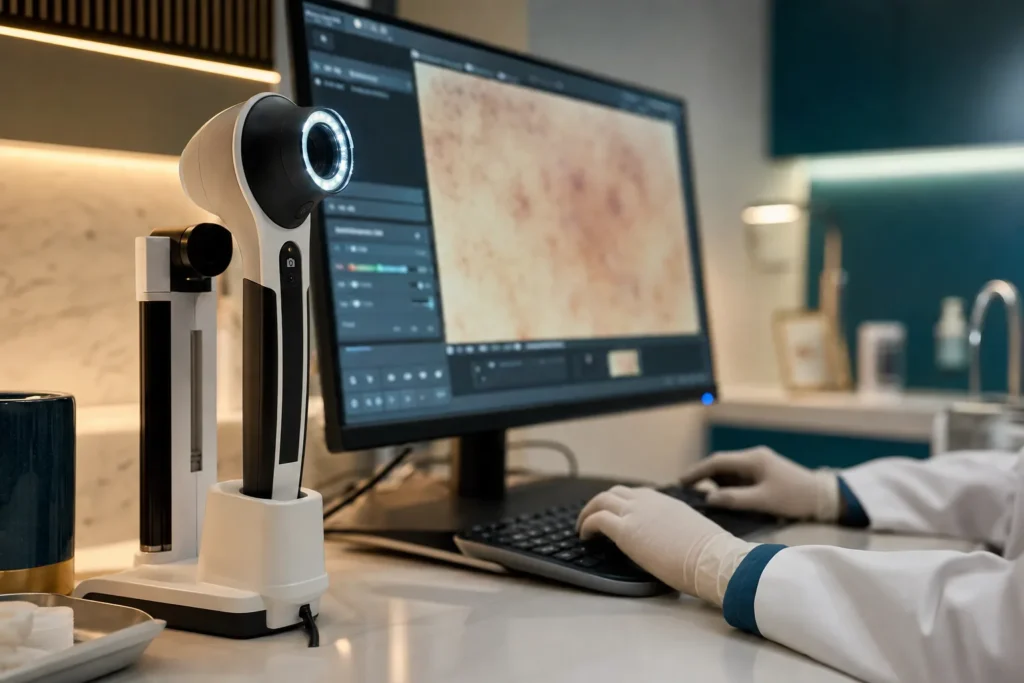
Professional skin checks. A dermatologist (a skin specialist) can examine your skin and use a dermatoscope — a special magnifying light that shows detail the naked eye cannot. People at higher risk, such as those with many atypical moles or a personal or family history of melanoma, may be advised to have regular professional checks. If that describes you, ask your doctor how often you should be seen.
The reason these habits matter so much is simple: when melanoma is found early, it is highly treatable, and the great majority of BCCs can be cured with straightforward treatment.
How it is diagnosed
The only way to confirm skin cancer is a biopsy, where a sample of the suspicious area is removed and examined under a microscope. The National Cancer Institute describes several biopsy types — shave, punch, incisional and excisional — chosen according to the size and location of the spot. For some melanomas, the tissue is also tested for gene changes such as BRAF, because these can guide treatment.
If melanoma is confirmed, the next step is staging — working out how far it has progressed. Melanoma stages run from 0 to IV and take account of how thick the melanoma is, whether the surface is broken (ulcerated), whether nearby lymph nodes are involved, and whether it has reached other parts of the body. Thickness, measured in millimetres, is especially important.
One test you may hear about is a sentinel lymph node biopsy. The sentinel node is the first lymph gland that fluid from the tumour area drains to; checking it helps show whether melanoma cells have begun to travel. Imaging scans (such as CT, MRI or PET) are used mainly for thicker melanomas or when there is concern about spread.
BCC is usually diagnosed by examination and a biopsy. Because it rarely spreads, complex staging and scans are seldom needed.
Treatment options
Treatment is tailored to the type of skin cancer, its stage, where it is on the body, and your general health. Care is often delivered by a multidisciplinary team — a group that may include a dermatologist, a surgeon, a pathologist, and for advanced cases medical and radiation oncologists, plus specialist nurses.
Treating melanoma
- Surgery is the main treatment. The NHS and the National Cancer Institute describe wide local excision, which removes the melanoma together with a margin of healthy skin around it to reduce the chance of any cells being left behind.
- Immunotherapy uses medicines that help the body's own immune system attack cancer cells. Drugs in this group include pembrolizumab, nivolumab and ipilimumab.
- Targeted therapy uses drugs aimed at specific gene changes, such as BRAF inhibitors (for example dabrafenib, trametinib, vemurafenib) when the melanoma carries that mutation.
- Radiation therapy and chemotherapy are used in selected situations, including to relieve symptoms.
Treating basal cell carcinoma
Most BCCs are cured with local treatment. Options the American Cancer Society lists include surgical removal (excision), Mohs surgery (a precise technique that removes the cancer layer by layer while checking margins, often used on the face), curettage and electrodesiccation (scraping and sealing), cryotherapy (freezing), topical creams such as imiquimod or 5-fluorouracil, photodynamic therapy, and radiation. As the American Cancer Society puts it, most of these cancers and pre-cancers can be cured with minor surgery or other local treatments.
Outlook and what to expect
The outlook for skin cancer is generally encouraging, particularly when it is found early. BCC very rarely spreads to distant organs, and the large majority are cured with local treatment, although a new BCC can appear elsewhere later, which is why ongoing skin checks matter.
For melanoma, outlook depends heavily on stage. Cancer Research UK publishes population-level five-year survival figures for the UK: around 100% of people with stage 1, around 85% with stage 2, and almost 75% with stage 3 melanoma survive their cancer for five years or more. Across all stages combined, around 95% survive for five years or more. For stage 4, Cancer Research UK notes that figures from newer immunotherapy treatments are not yet fully available because these treatments are recent.
An important caveat: these numbers describe large groups of people, not any single person. As Cancer Research UK states plainly, they cannot tell you what will happen in your individual case. Your own outlook depends on many factors — the exact features of your cancer, your treatment, your age and general health — and only your own specialist can discuss what they mean for you. The figures here are background information, not a prediction.
Living with it and follow-up
After treatment, follow-up care is a normal and important part of the journey. Because a person who has had one skin cancer has a higher chance of developing another, regular skin checks — both your own monthly self-exams and scheduled appointments with your specialist — help catch anything new at an early, easily treatable stage.
For melanoma, the schedule of follow-up visits depends on the stage. Early-stage melanoma usually means periodic skin examinations; higher stages may involve more frequent visits and sometimes imaging scans for a number of years. Your team will set out a plan that fits your situation.
Living with a skin-cancer diagnosis is not only physical. It is completely normal to feel anxious, especially before check-ups. Many people find it helps to lean on family, to ask their care team questions, and to use support services or patient organisations. Practical sun-protection habits (covered below) become part of everyday life and give many people a reassuring sense of taking active care of their health.
Planning treatment abroad: what affects cost and how to prepare your records
If you are considering treatment in another country, it helps to understand what shapes the overall cost — without quoting figures, since every case is different and an accurate number can only come from a personalised assessment. The main factors include:
- The type and stage of the skin cancer, which determines whether you need a simple excision, Mohs surgery, sentinel lymph node biopsy, or systemic treatments such as immunotherapy.
- The complexity of surgery and whether reconstruction (for example a skin graft or flap, common after facial BCC removal) is needed.
- Diagnostic work already done versus tests that must be repeated, including biopsy review and any imaging.
- Length of stay and any follow-up or repeat visits.
- Medicines, especially the newer targeted and immunotherapy drugs used in advanced melanoma.
To prepare, gather your records before you travel: biopsy and pathology reports, any imaging and scan results (ideally on a disc or in digital form), a list of your medicines and allergies, and a short written history of your diagnosis so far. Clear records let the receiving team plan accurately and avoid unnecessary repeat tests. Because the right plan depends on these details, the sensible next step is to request a personalised estimate through a free consultation rather than relying on a generic price.
Why Turkiye and how to choose a good centre
Turkiye has become a well-known destination for medical travel, with modern hospitals, experienced dermatology and oncology teams, and services geared toward international patients. As with any country, quality varies between centres, so the goal is to choose carefully rather than to assume any single hospital is automatically the right one.
Here is a practical checklist to verify before committing:
- Accreditation. Look for international accreditation such as Joint Commission International (JCI), alongside the hospital's national licensing. Accreditation signals that a centre meets recognised safety and quality standards.
- The specialist team. Confirm that a qualified dermatologist leads skin-cancer care and that a full multidisciplinary team — surgery, pathology, and medical and radiation oncology — is available for more advanced cases.
- On-site pathology. Reliable, prompt pathology is essential for accurate diagnosis and for techniques such as Mohs surgery.
- Clear communication. Check that you can get information in a language you understand, and that you will receive a written treatment plan.
- Continuity of care. Ask how follow-up will work once you return home, and how your records will be shared with your local doctor.
A trustworthy centre will welcome these questions and give you straightforward answers. Taking time to verify these points is the best way to feel confident in your choice.
Prevention, self-care and getting a second opinion
Because UV light is the main cause, sun protection is the most effective everyday step you can take. The American Cancer Society sums it up as Slip, Slop, Slap and Wrap: slip on a shirt, slop on sunscreen, slap on a hat, and wrap on sunglasses. In practice that means:
- Seek shade, especially in the middle of the day when UV is strongest — the American Cancer Society calls shade one of the best ways to limit UV exposure.
- Use a broad-spectrum sunscreen, apply it generously, and reapply regularly, particularly after swimming or sweating.
- Wear protective clothing, a wide-brimmed hat and UV-blocking sunglasses.
- Avoid sunbeds and tanning lamps, which give off the same harmful UV that contributes to skin cancer.
- Take extra care with children, who burn more easily and spend more time outdoors.
Combine this with monthly self-examinations and professional checks if you are at higher risk. None of this guarantees you will never develop skin cancer, but it meaningfully lowers the risk and helps you catch any problem early.
Finally, you are entitled to a second opinion. If you want more confidence in a diagnosis or a proposed treatment plan, asking another qualified specialist to review your case is a normal and reasonable thing to do. For advanced melanoma, you can also ask whether a clinical trial — a carefully run study of newer treatments — might be an option for you. A good care team will support both of these choices.
Frequently asked questions
What is the difference between melanoma and basal cell carcinoma?
What does the ABCDE rule mean?
When should I see a doctor about a mole or spot?
Is there a routine screening test for skin cancer?
How is skin cancer diagnosed?
Can skin cancer be cured?
What is the survival rate for melanoma?
Does skin cancer only affect people with fair skin?
How can I lower my risk of skin cancer?
What should I prepare before seeking treatment abroad?
Can I get a second opinion or join a clinical trial?
This article is for general information only and is not medical advice. Always consult a qualified doctor about your individual case.
Considering this procedure?
Send us your photos and questions. A BergemHealth coordinator and a department-head specialist will review your case and reply with honest, personalised guidance — no obligation.
Free consultation