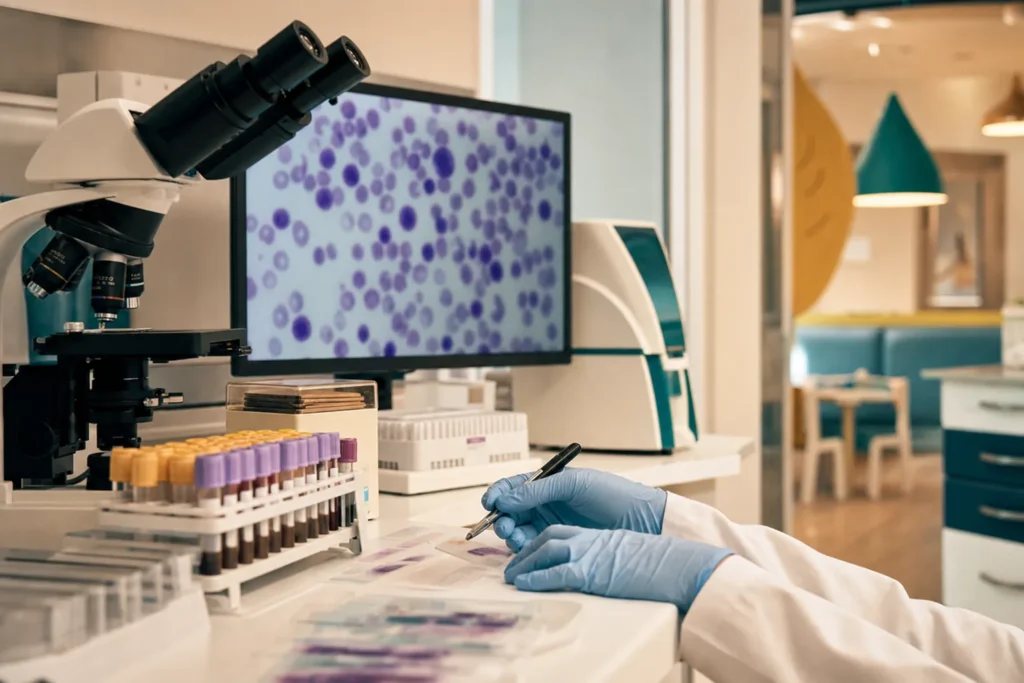
Childhood leukaemia & lymphoma
Hearing that a child may have leukaemia or lymphoma is frightening for any family. This calm, plain-language guide explains what these blood and lymph cancers are, how doctors find and treat them, and what to expect. These are among the most studied and most treatable of childhood cancers, and most children diagnosed today do well. Wherever you are in the world, this page is here to help you understand the journey and ask good questions of your child's specialist team.
What childhood leukaemia and lymphoma are
Leukaemia and lymphoma are both cancers of the body's blood-forming and immune systems. They are grouped together here because they are closely related, they often cause similar early symptoms, and they are treated by the same kind of specialist team. Understanding the basics can make the rest of the journey feel a little less overwhelming.
Leukaemia is a cancer of the blood and bone marrow. Bone marrow is the soft, spongy centre of bones where blood cells are made. In leukaemia, the marrow makes large numbers of abnormal white blood cells that do not work properly and do not mature as they should. These crowd out the healthy red cells (which carry oxygen), platelets (which help blood clot), and normal white cells (which fight infection). That crowding explains many of the symptoms families notice.
Lymphoma is a cancer of the lymph system, which is part of the body's immune defences. The lymph system includes lymph nodes (small glands in the neck, armpits, groin, chest, and abdomen), the spleen, and channels that carry a fluid called lymph. In lymphoma, certain immune cells called lymphocytes grow out of control and collect in lymph nodes or other tissues, often forming a lump or swelling.
The word "cancer" is heavy, but it helps to know that childhood leukaemia and lymphoma are very different from many adult cancers. They tend to respond well to treatment, and care for children is highly specialised. According to Cancer Research UK, childhood cancer overall is rare, and around 400 children are diagnosed with acute lymphoblastic leukaemia in the UK each year.
Types and subtypes
Knowing the type matters because it shapes the treatment plan. Your child's doctors will explain exactly which one they are dealing with.
Types of childhood leukaemia
- Acute lymphoblastic leukaemia (ALL) is the most common childhood leukaemia. The Cleveland Clinic notes it affects about 3 in 4 children with leukaemia, and the National Cancer Institute (NCI) states it makes up about 25% of all childhood cancers in the United States, occurring most often in children aged 1 to 4 years. "Acute" means it can develop quickly, so it is treated promptly.
- Acute myeloid leukaemia (AML) is the second most common type. It starts in a different group of blood-forming cells.
- Chronic leukaemias (such as chronic myeloid leukaemia) are far less common in children than in adults.
Types of childhood lymphoma
Lymphoma is divided into two broad families:
- Hodgkin lymphoma is identified by a particular abnormal cell called the Reed-Sternberg cell, seen under the microscope. The NCI notes it occurs most often in adolescents aged 15 to 19. The main form is classic Hodgkin lymphoma (with subtypes including nodular-sclerosing and mixed cellularity); a separate form, nodular lymphocyte-predominant Hodgkin lymphoma, occurs most often in children younger than 10.
- Non-Hodgkin lymphoma (NHL) is a larger group. The NCI describes three main childhood categories: aggressive mature B-cell NHL (including Burkitt lymphoma, diffuse large B-cell lymphoma, and primary mediastinal B-cell lymphoma); lymphoblastic lymphoma; and anaplastic large cell lymphoma.
Causes and risk factors
One of the most important things for any parent to hear is this: in the great majority of cases, nothing you did or did not do caused your child's cancer. There is usually no identifiable cause, and these illnesses are not something a child "catches" from someone or passes on to others.
Cancer begins when changes (mutations) occur in the DNA of a cell, telling it to grow out of control. Why these changes happen is usually unknown. Doctors have, however, identified some factors that can raise the risk:
- Certain inherited conditions. The NCI and Cleveland Clinic list genetic syndromes such as Down syndrome, neurofibromatosis type 1, Bloom syndrome, Fanconi anaemia, ataxia-telangiectasia, and Li-Fraumeni syndrome as raising leukaemia risk. Most children with leukaemia do not have any of these.
- Previous cancer treatment. Earlier chemotherapy or radiation can slightly raise later risk.
- Radiation exposure. Significant radiation exposure is a recognised factor; the American Cancer Society notes that avoiding unnecessary x-rays and CT scans may reduce risk, while acknowledging these tests are sometimes important and appropriate.
- Certain viruses and immune conditions (mainly for lymphoma). The NCI links Epstein-Barr virus (the virus that causes glandular fever), HIV infection, and a weakened immune system (for example after an organ transplant) to a higher risk of lymphoma.
Having a risk factor does not mean a child will develop these cancers, and most affected children have no known risk factor at all.
Signs and symptoms, and when to see a doctor
Early symptoms can be vague and easy to mistake for ordinary childhood illnesses, which is completely understandable. Many of these signs are far more often caused by common infections than by cancer. Still, it helps to know what to look for.
Symptoms of leukaemia reported by the NCI and Cancer Research UK include:
- Looking pale, and being unusually tired or weak
- Easy bruising or bleeding, frequent nosebleeds, or a rash of tiny red or purple spots (petechiae)
- Fever and frequent or lingering infections
- Bone or joint pain (a child may limp or not want to walk)
- Swollen lymph nodes in the neck, armpit, or groin
- Loss of appetite, tummy swelling or pain, and unexplained weight loss
Symptoms of lymphoma reported by the NCI include:
- Painless swelling of lymph nodes, often in the neck, chest, armpit, or groin
- So-called "B symptoms": unexplained fever, drenching night sweats, and unexplained weight loss
- Breathing difficulty, wheezing, or a cough (if a node in the chest is involved)
- Abdominal pain or swelling
When to see a doctor: Cancer Research UK advises taking your child to a doctor if you notice a change that is not normal for them, or any of these signs. Trust your instincts as a parent. If your child has sudden difficulty breathing, severe drowsiness, or a seizure, seek emergency care immediately.
Screening and early detection
It is worth being clear and honest here: there is no routine screening test for childhood leukaemia or lymphoma. Unlike some adult cancers, where healthy people are screened on a schedule, these childhood cancers are too uncommon, and there is no reliable test that would help by being given to all children. The American Cancer Society's information reflects this, focusing on recognising symptoms rather than screening healthy children.
In practice, "early detection" means paying attention to symptoms and seeking medical advice when something is not right. Because these cancers can develop over weeks, getting unexplained or persistent symptoms checked promptly is the most useful thing a family can do.
There is one exception. Children with certain inherited syndromes that raise their risk (such as Down syndrome or Li-Fraumeni syndrome) may be offered closer medical monitoring by their specialists. This is decided case by case and is not the same as population screening.
How it is diagnosed
Getting a clear diagnosis takes several tests. This stage can feel slow and stressful, but each test gives doctors information they need to choose the safest, most effective plan. Here is what is commonly involved, based on the NCI and Cleveland Clinic.
- Physical examination and history. The doctor feels for swollen lymph nodes, an enlarged liver or spleen, and checks general health.
- Blood tests. A full (complete) blood count measures red cells, white cells, and platelets, and can show abnormal cells. Blood chemistry tests check how organs are working.
- Bone marrow aspiration and biopsy (for leukaemia). A small sample of marrow, usually from the hip bone, is taken with a needle and examined under a microscope. Children are given medicine so they are comfortable during this.
- Lymph node biopsy (for lymphoma). A swollen node, or part of it, is removed and examined. For Hodgkin lymphoma, finding Reed-Sternberg cells confirms the diagnosis.
- Lumbar puncture. A small sample of the fluid around the spinal cord is checked to see whether cancer cells have reached the brain and spinal cord.
- Imaging. Chest x-rays, CT, MRI, or PET scans show where disease is and how widely it has spread.
- Genetic and laboratory tests. Specialised tests look for specific gene and chromosome changes in the cancer cells, which guide treatment and predict how well it may respond.
For lymphoma, doctors then assign a stage (I to IV) describing how far the disease has spread. For leukaemia, doctors instead group children into risk groups. The NCI describes standard-risk, high-risk, and very-high-risk groups for ALL, based on age, white blood cell count at diagnosis, genetic changes, and how quickly the leukaemia responds to early treatment.
Treatment options
Treatment is planned and delivered by a multidisciplinary team, a group of specialists working together. This usually includes a paediatric oncologist or haematologist (children's cancer or blood doctor), specialist nurses, a pharmacist, a radiologist, a pathologist, a psychologist or social worker, a dietitian, and often a play specialist who helps children cope. Care is centred on the whole child and family, not just the disease.
The main treatments, as described by the NCI and Cleveland Clinic, include:
- Chemotherapy. Medicines that kill cancer cells, given by mouth, into a vein, or sometimes into the fluid around the spine. This is the backbone of treatment for most childhood leukaemia and lymphoma. For ALL, the NCI describes treatment in phases: remission induction (to clear the leukaemia), consolidation or intensification (to destroy remaining cells), and maintenance (lower-dose treatment over a longer period to prevent it returning).
- Radiation therapy. Carefully targeted high-energy beams, used in selected situations, for example certain lymphomas or to treat or prevent spread to the brain.
- Targeted therapy and immunotherapy. Newer medicines that home in on specific features of cancer cells or harness the immune system. The NCI lists agents such as rituximab and brentuximab vedotin for some lymphomas.
- Stem cell (bone marrow) transplant. Used in higher-risk or relapsed disease, this replaces diseased marrow with healthy blood-forming cells.
- CAR T-cell therapy. A specialised treatment that reprogrammes the child's own immune cells, used for certain leukaemias and lymphomas that have come back or not responded.
- Supportive care. Just as important: managing infection, anaemia, nausea, nutrition, pain, and emotional wellbeing, so the child stays as well as possible throughout treatment.
Outlook: what to expect
This is often the first thing families want to know. The reassuring news is that childhood leukaemia and lymphoma are among the most treatable childhood cancers, and treatments have improved enormously over the decades.
To give a sense of scale, these are population-level statistics from major cancer authorities. They describe groups of children diagnosed in the past and treated then; they cannot predict what will happen for any one child, and your child's own team is the right source for their situation:
- For childhood ALL, the American Cancer Society reports an overall 5-year survival rate of about 90%.
- For childhood AML, the American Cancer Society gives an overall 5-year survival rate in the range of about 65 to 70%.
- For childhood non-Hodgkin lymphoma, the American Cancer Society reports overall survival of around 90%, varying by type and stage.
- For classic Hodgkin lymphoma, the American Cancer Society notes that more than 95% of children are cured with current treatments.
- The Cleveland Clinic states that about 86 of every 100 children diagnosed with leukaemia are alive five years later.
The American Cancer Society stresses that survival rates are, at best, rough estimates, and that because they are based on children treated more than five years ago, improvements since then may mean a better outlook for children diagnosed today. "Five-year survival" is simply a standard measuring point, not a limit on a child's life. Your child's specialist can explain what their specific type, stage or risk group, and response to treatment mean for them.
Living with it and follow-up
Treatment for childhood blood cancers can last from several months to a few years, especially for ALL where maintenance therapy continues for some time. Life during treatment becomes a rhythm of hospital visits, medicines, blood tests, and recovery days at home. Families often find that schools, charities, and the hospital's support staff can help with the practical and emotional load.
After treatment ends, children move into long-term follow-up. Regular check-ups watch for any sign that the cancer has returned and, just as importantly, monitor for late effects, which are health issues that can appear months or years after treatment. Because children are still growing, treatments that save lives can sometimes affect the heart, hormones, growth, fertility, learning, or raise the small risk of a second cancer later in life. Knowing about late effects is not meant to alarm you; it is precisely why follow-up exists, so that anything can be picked up early and managed.
Day to day, families are usually advised to keep vaccinations up to date as guided by the team, watch for fever and infection during treatment, support good nutrition, and look after the child's and family's emotional wellbeing. Many children return fully to school, sport, and ordinary childhood. Ask the team for a written survivorship plan summarising the treatment given and what follow-up is recommended, especially useful if you move or change hospitals.
Planning treatment abroad: what affects cost and how to prepare records
Some families choose to seek treatment in another country, whether for access to specialist children's cancer centres, shorter waiting times, or a particular team's expertise. If you are considering arranging your child's care abroad, it helps to understand what shapes the overall cost and how to prepare, so you can plan calmly and avoid surprises.
Several factors influence the cost of treatment, and no honest figure can be given without first reviewing your child's case:
- The exact diagnosis, type, and risk group or stage
- The treatment plan, for example chemotherapy alone versus chemotherapy plus radiation, a stem cell transplant, or advanced therapies such as CAR T-cell treatment
- The length of treatment and the number of hospital stays
- Supportive care needs (transfusions, treatment of infections, intensive care if required)
- Diagnostic and monitoring tests over time
- Accommodation for the family and length of stay in the country
To prepare your child's records, gather: the full medical history, all blood test and bone marrow results, biopsy and pathology reports, imaging scans (ideally on disc or digital file, not just reports), a list of current medicines and doses, and any genetic test results. Having these translated and organised lets a centre give an accurate assessment and a personalised estimate. Because every child's plan is different, the most reliable next step is to request a personalised estimate through a free consultation, where the team can review the records before discussing anything.
Why Turkiye, and how to choose a good centre
Turkiye has become a well-known destination for international patients, including families seeking children's cancer care, thanks to modern hospitals, experienced specialists, and established services for overseas patients such as interpreters and travel support. As a concierge, BergemHealth helps families navigate this process; the goal here is to help you choose wisely, not to push any single hospital.
When evaluating any centre, in Turkiye or anywhere, it is sensible to verify the following:
- Accreditation. Look for internationally recognised quality accreditation (for example Joint Commission International, JCI) and proper national licensing.
- A dedicated paediatric oncology/haematology service. Children's cancer should be treated by specialists in children's cancer, with a true multidisciplinary team and child-friendly facilities, not in a general adult unit.
- Experience with the specific diagnosis. Ask how often the centre treats your child's type of leukaemia or lymphoma, and whether they offer the therapies that may be needed, such as stem cell transplant or CAR T-cell therapy.
- Clear communication. Confirm that you will receive a written treatment plan, that records and consent are properly explained, and that interpretation is available so you fully understand every step.
- Continuity of care. Ask how follow-up and any late-effects monitoring will be coordinated with doctors back home once you return.
A good centre will welcome your questions, review records before quoting anything, and never pressure you. Seeking a second opinion is always reasonable.
Clinical trials and getting a second opinion
Because there is no proven way to prevent most childhood leukaemia and lymphoma, attention rightly turns to making the most of today's treatments and tomorrow's research, and to making sure families feel confident in the plan.
Clinical trials are research studies that test new treatments or new ways of using existing ones. A great deal of the progress in childhood cancer survival has come from children taking part in carefully run trials. Many children's cancer centres treat patients within these studies. Joining a trial is always voluntary, fully explained, and closely monitored for safety. It is worth asking your child's team whether a suitable trial is available, what it would involve, and what the alternatives are.
Getting a second opinion is a normal and accepted part of cancer care, not a sign of distrust. Another specialist reviewing the diagnosis and proposed plan can give reassurance, confirm the approach, or occasionally suggest an option you had not considered. Reputable doctors expect and respect this. If you are arranging care abroad, a second opinion can be a sensible first step, and your child's medical records (described in the planning section) are what make a meaningful second opinion possible.
Finally, look after yourselves as a family. Reliable information, a trusted specialist team, and good emotional support are powerful tools through what is undeniably a hard time, and most children with these cancers go on to do well.
Frequently asked questions
Is childhood leukaemia or lymphoma curable?
What is the difference between leukaemia and lymphoma?
What are the first signs of leukaemia in a child?
Did I do something to cause my child's cancer?
Can childhood leukaemia or lymphoma be prevented?
Is there a screening test for these cancers in children?
How are these cancers diagnosed?
What does treatment involve?
How long does treatment last?
What are 'late effects' and why does follow-up matter?
Should we consider a second opinion or a clinical trial?
How do we plan treatment in Turkiye, and what affects the cost?
This article is for general information only and is not medical advice. Always consult a qualified doctor about your individual case.
Considering this procedure?
Send us your photos and questions. A BergemHealth coordinator and a department-head specialist will review your case and reply with honest, personalised guidance — no obligation.
Free consultation