Sleeve gastrectomy
Sleeve gastrectomy, often called gastric sleeve surgery, is today the most common weight-loss operation in the world. It permanently removes most of the stomach, leaving a slim tube that holds far less food and quietens the hormones that drive hunger. This guide explains, in everyday language, what the procedure involves, who it suits, what recovery really looks like, and what to check before having it done abroad.
- Anaesthesia
- General anaesthesia (you are fully asleep)
- Duration
- About 60 to 90 minutes
- Recovery
- Back to light activity in 1-2 weeks; full recovery and diet progression over about 4-6 weeks
- Hospital stay
- Usually 1 to 3 nights
Minimum price, for reference only — the final cost is calculated individually after your records are reviewed. You pay the hospital’s price; our service is free for you.
What sleeve gastrectomy actually is
Sleeve gastrectomy is a type of bariatric surgery (weight-loss surgery, sometimes called metabolic surgery because it also improves conditions like diabetes). In the operation, a surgeon removes roughly 80% of your stomach. What is left is a narrow, tube-shaped pouch about the size and shape of a banana, which is where the everyday name gastric sleeve comes from. The removed part is taken out of the body for good, so this is a permanent change to your anatomy.
It works in two ways. First, the smaller stomach simply holds much less food, so you feel full after a small meal. Second, the part of the stomach that is removed produces most of a hunger hormone called ghrelin. With less of that hormone, many people notice their appetite and food cravings drop. This combination of a smaller stomach and lower hunger is what helps weight come off.
According to the American Society for Metabolic and Bariatric Surgery, the sleeve and gastric bypass together make up about 90% of all weight-loss operations performed worldwide, and the sleeve has become the single most common choice. It is usually done as keyhole (laparoscopic) surgery, meaning through a few small cuts rather than one large incision.
Who is a good candidate, and who should think twice
Sleeve gastrectomy is not a quick cosmetic fix. It is offered to people whose weight is high enough to threaten their health and who have struggled to lose it and keep it off with diet, exercise and medication alone.
Doctors use body mass index (BMI), a number based on your weight and height, to help decide. The 2022 guidelines from the American Society for Metabolic and Bariatric Surgery and the International Federation for the Surgery of Obesity set out two groups:
- Surgery is recommended for people with a BMI of 35 or above, whether or not they have weight-related illnesses.
- Surgery should be considered for people with a BMI of 30 to 34.9 who also have a metabolic disease such as type 2 diabetes that is not controlled by other treatments.
These thresholds are set lower for people of Asian background, where health risks appear at a lower BMI. The same guidelines stress that age alone is not a barrier: carefully selected teenagers and older adults can be considered too. The NHS uses similar criteria, generally a BMI of 40 or more, or 35 to 40 with a serious weight-related condition.
Surgery may not be suitable, or may need to wait, if you have an untreated eating disorder, an active alcohol or drug problem, certain mental-health conditions that are not stable, or a medical problem that makes general anaesthesia too risky. Pregnancy is a reason to postpone. Crucially, every good programme expects you to be ready to change how you eat and live for the rest of your life. The surgery is a powerful tool, not a substitute for those changes.
Types and techniques
The standard operation is the same in principle everywhere: remove most of the stomach and create a sleeve. But there are some variations in how it is performed and how it fits with other procedures.
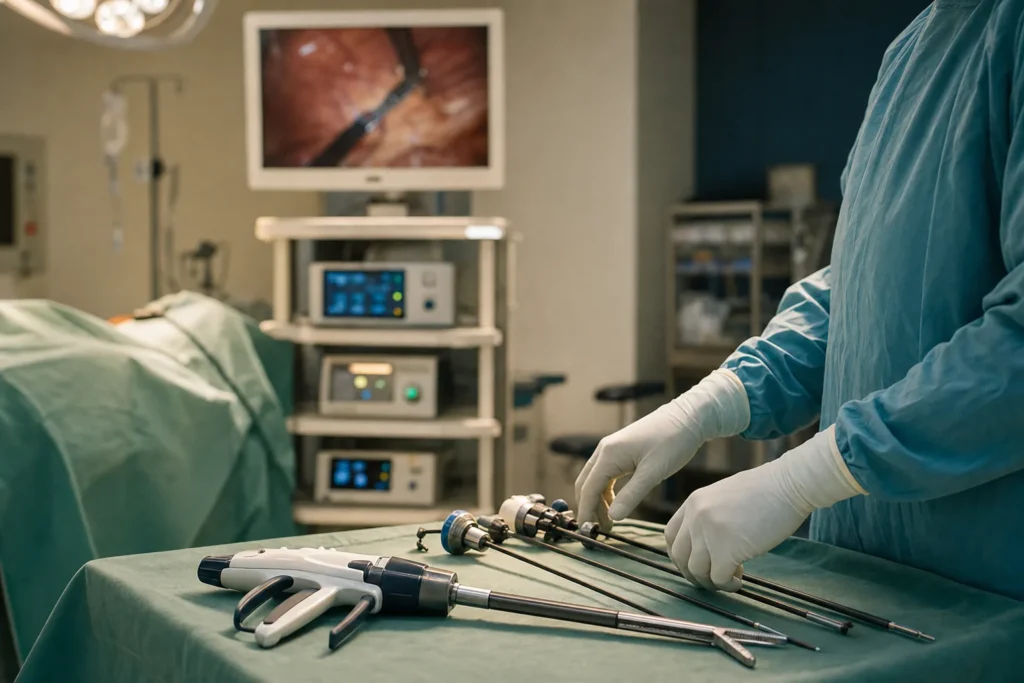
- Laparoscopic sleeve gastrectomy. The usual approach. The surgeon makes a few small cuts (often two to five) in the abdomen, inflates it with gas to create space, and uses a tiny camera and long instruments to do the work on a screen. Small cuts mean less pain and a faster recovery than open surgery.
- Robot-assisted sleeve gastrectomy. The same keyhole operation, but the surgeon controls robotic arms that hold the instruments. It can give a very stable, precise view. Outcomes are broadly similar to standard laparoscopy.
- The sleeve as a first step. For some people with very high BMI, the sleeve is done first, and a second, more complex operation may be added later if needed.
During the operation, the surgeon usually passes a flexible tube called a bougie down through the mouth into the stomach. It acts like a guide so the new sleeve is made to a consistent, safe width. The stomach is then cut and sealed with a surgical stapler that lays down rows of tiny titanium staples along the new edge.
It helps to know how the sleeve differs from its main alternative, gastric bypass. The bypass also re-routes part of the intestine so fewer calories are absorbed, while the sleeve only changes the stomach. The sleeve is simpler, leaves no re-routed gut and no implanted band, but bypass tends to produce slightly more weight loss and is often preferred when severe acid reflux is already a problem.
How the operation is done, step by step
On the day of surgery you will not eat or drink for several hours beforehand. In the operating room you are given general anaesthesia, which means you are completely asleep and feel nothing. A breathing tube supports you while you sleep, and the anaesthesia team monitors you throughout.
The main steps are:
- The surgeon makes the small keyhole cuts and gently inflates the abdomen with carbon dioxide gas to create working room.
- The camera and instruments go in. The surgeon frees the stomach from surrounding tissue.
- A bougie tube is placed to guide the size of the sleeve.
- Using the stapler, the surgeon divides the stomach lengthwise, removing the large curved outer portion and leaving the slim tube.
- The staple line is checked carefully for leaks or bleeding. The removed stomach is taken out through one of the small cuts.
- The gas is released and the small incisions are closed.
The procedure itself usually takes about 60 to 90 minutes, though the total time in the operating area is longer once anaesthesia and preparation are included. You then wake up in a recovery area before going to your room.
Recovery, step by step
Recovery happens in stages, and your team will give you a precise plan. The general pattern looks like this.
In hospital (about 1 to 3 nights). You will be encouraged to get up and walk within hours, which helps prevent blood clots and speeds healing. Pain is managed with medication. You usually start sipping clear liquids within a day, once the team is satisfied the sleeve is healing well. Sometimes a scan or dye test checks the staple line before you progress.
The first weeks: a staged diet. Because your stomach is small and healing, you cannot jump straight back to normal meals. The typical progression is:
- Clear liquids for the first days (water, broth, sugar-free drinks).
- Full liquids and purees over the next week or two (protein shakes, smooth yoghurt, blended soups).
- Soft foods for a couple of weeks after that.
- Regular textures reintroduced slowly, usually by around six to eight weeks, in small portions and chewed thoroughly.
Activity and work. Most people return to a desk job within one to two weeks. Heavy lifting and strenuous exercise are usually avoided for about four to six weeks. Gentle walking is encouraged from the start.
Throughout recovery you take prescribed vitamin and mineral supplements and aim to drink enough fluid and protein. Eating too fast or too much too soon can cause discomfort or nausea, so slow, mindful eating becomes a lasting habit.
Risks and possible complications
Sleeve gastrectomy is generally considered safe, and serious complications are uncommon. Across bariatric surgery, the risk of dying around the time of the operation is very low, reported in the range of about 0.03% to 0.2%. Still, it is real surgery under general anaesthesia, so it is important to understand what can go wrong.
Early risks (around the operation):
- Staple-line leak. A small leak where the stomach was sealed. It is uncommon but serious, and may need antibiotics, drainage or further surgery.
- Bleeding and infection at the incisions or inside the abdomen.
- Blood clots in the legs (deep vein thrombosis) that can travel to the lungs. Early walking and sometimes blood-thinning medication reduce this risk.
- Reactions to anaesthesia.
Later risks:
- Acid reflux (GERD). Heartburn and reflux can appear or worsen after a sleeve, more so than with some other operations. For some people this is the main drawback.
- Stricture. Narrowing of the sleeve from scar tissue, which can make swallowing difficult and may need a stretching procedure.
- Nutritional deficiencies. Because you eat less, you can run low on vitamins and minerals such as B12, iron, calcium and vitamin D. Lifelong supplements and blood tests prevent this.
- Gallstones during rapid weight loss.
- Weight regain if eating habits drift back over the years.
Contact your team urgently if you develop a fast heartbeat, fever, severe or worsening abdominal pain, breathlessness, chest pain, or persistent vomiting, as these can signal a complication.
Results and how long they last
Weight loss after a sleeve is gradual and steadiest in the first one to two years. Cleveland Clinic reports that people lose, on average, around 25% to 30% of their total body weight in that period; many sources describe this as roughly 60% of excess weight. Results vary a lot from person to person and depend heavily on sticking to the new eating and activity habits.
The health benefits are often as important as the number on the scales. Many people see big improvements in type 2 diabetes (it goes into remission in a large share of patients), high blood pressure, sleep apnoea, joint pain and cholesterol. Long-term studies of bariatric surgery show these benefits can be durable over five, ten and even twenty years.
That said, the sleeve is not a guarantee. Some weight regain after the first couple of years is common, and a minority of people regain a significant amount, usually when old habits return or the sleeve stretches over time. Lifelong follow-up, supplements and support give the best chance of keeping the results.
Costs and what changes the price
The cost of a gastric sleeve varies widely by country, hospital and what is included. In western Europe and the UK, private prices commonly run into many thousands of euros or pounds; in the United States the figure is higher again. Turkey has become a popular destination partly because all-inclusive packages are typically advertised in the region of 2,500 to 5,000 euros, often bundling the surgery, hospital stay, hotel nights, airport transfers and aftercare support.
The price depends on factors such as:
- The surgeon's experience and the hospital's accreditation and facilities.
- Whether the operation is standard laparoscopic or robot-assisted.
- How many nights you stay in hospital and hotel.
- Pre-operative tests, medications, post-op supplements and follow-up.
- Your individual health, BMI and any extra care you may need.
Please treat any figure here as an indicative range, not a quote. Real prices vary by case, surgeon and clinic. Always ask for a written, itemised quotation that spells out exactly what is and is not included, including what happens (and who pays) if a complication needs extra treatment.
Why people travel to Turkiye, and how to choose safely
Turkiye has built a large medical-tourism sector around bariatric surgery. People are drawn by lower prices, the high surgical volumes at some centres, modern hospitals and convenient all-in packages with translators and transfers. Lower running costs and favourable exchange rates explain much of the price difference, not lower-quality medicine in itself. The key is choosing a genuinely good clinic and surgeon, because standards do vary.
Before you commit, verify the following:
- Hospital accreditation. Look for international accreditation such as JCI (Joint Commission International), alongside Turkish Ministry of Health authorisation for international patients.
- Surgeon's credentials. Confirm the surgeon is board-certified in general surgery with specific bariatric training and experience, and ask how many sleeve operations they perform each year.
- Named surgeon and team. Make sure you know exactly who will operate, not just the brand of an agency.
- Honest screening. A reputable clinic assesses whether you are truly a suitable candidate and may say no, rather than approving everyone.
- Complication plan. Ask what happens if something goes wrong while you are still in the country, and how follow-up works once you are home.
- Clear contract. Get everything in writing, including the price breakdown and aftercare.
Be cautious of prices that look too good to be true, pressure to decide instantly, or anyone promising specific results. As a medical-tourism concierge, a good partner helps you check exactly these points.
How to prepare and what to ask at your consultation
Good preparation makes surgery safer and recovery smoother. In the weeks before, your team may ask you to follow a special pre-operative diet (sometimes a lower-calorie or liquid diet) to shrink the liver and make the operation safer. You will usually have blood tests, heart and lung checks, and sometimes an endoscopy (a camera test of the stomach). If you smoke, stopping well in advance lowers your risk; you may also be asked to pause certain medications.
Come to your consultation with questions written down. Useful ones include:
- Am I a suitable candidate, and is the sleeve the best option for me compared with a bypass?
- How many of these operations do you perform, and what are your complication and reoperation rates?
- Is the hospital accredited, and who exactly will perform my surgery?
- What does the price include, and what happens if I have a complication?
- What will my diet, supplements and follow-up look like over the first year and beyond?
- How will reflux or vitamin deficiencies be monitored and managed?
- What support is there for the lifestyle changes I will need to make?
It is also wise to arrange your support at home: someone to help in the first days, time off work, and a plan for the staged diet and supplements.
Aftercare and travelling for treatment, including flying
Aftercare is lifelong, not a one-off appointment. Plan on regular check-ups, blood tests to catch any vitamin shortfalls early, and ongoing support with diet and habits. Take your prescribed supplements every day, eat slowly, prioritise protein and fluids, and stay active. Many people find that joining a support group or working with a dietitian makes a lasting difference.
If you travel abroad for surgery, the journey home deserves care because long flights raise the risk of blood clots, and that risk is higher just after an operation. There is no single rule, but many bariatric surgeons advise waiting around a week to two weeks after keyhole surgery before flying, while some prefer longer; open surgery requires more time. Always get personal clearance from your own surgeon before booking your return flight.
To lower clot risk on the flight, your team may recommend:
- Staying well hydrated and avoiding alcohol.
- Wearing graduated compression stockings.
- Walking the aisle and flexing your legs regularly.
- Sometimes a short course of a blood-thinning injection, if your surgeon advises it.
Plan to stay near the clinic for several days after surgery so your team can check the staple line and start your diet safely before you set off. Make sure you leave with written discharge notes, a medication and supplement list, and a clear contact for any concerns once you are home.
This article is general information, not medical advice. Decisions about sleeve gastrectomy should always be made with a qualified surgeon who has assessed your individual health.
Frequently asked questions
Is sleeve gastrectomy reversible?
How much weight will I lose after a gastric sleeve?
How painful is the recovery?
What can I eat after the surgery?
Will I have to take vitamins forever?
Does the gastric sleeve cause acid reflux?
How long do I need to stay in Turkey for the surgery?
When is it safe to fly home after the operation?
How do I know if a clinic in Turkey is safe?
Can the weight come back after a sleeve gastrectomy?
Is sleeve gastrectomy better than gastric bypass?
Sources
- Cleveland Clinic - Gastric Sleeve Surgery (Sleeve Gastrectomy)
- Yale Medicine - Gastric Sleeve Surgery (Sleeve Gastrectomy)
- 2022 ASMBS/IFSO Indications for Metabolic and Bariatric Surgery (PMC)
- American Society for Metabolic and Bariatric Surgery - Metabolic and Bariatric Surgery Fact Sheet
- NHS - Weight loss surgery (overview)
- Mayo Clinic - Sleeve gastrectomy
- WebMD - Gastric Sleeve Surgery for Weight Loss
- Columbia Surgery - Guide to Sleeve Gastrectomy
This article is for general information only and is not medical advice. Always consult a qualified doctor about your individual case.
Specialists in Bariatric Surgery
Doctors of the department we work with directly. Which doctor takes your case is decided after the specialists have reviewed your records — your coordinator confirms it, not this page.


Considering this procedure?
Send us your photos and questions. A BergemHealth coordinator and a senior specialist will review your case and reply with honest, personalised guidance — no obligation.
Free consultation