HER2-positive & HER2-negative breast cancer
If you or someone you love has just heard the words "HER2-positive" or "HER2-negative," it can feel like a new language has been dropped into your lap at the worst possible moment. The good news is that HER2 status is simply one piece of information about your breast cancer, and it is one that helps your medical team choose treatments that work. This guide explains, in plain words, what HER2 means, how it is tested, what the different results mean, and what to expect from diagnosis through treatment and follow-up.
What HER2-positive and HER2-negative breast cancer mean
HER2 stands for human epidermal growth factor receptor 2. It is a protein found on the surface of breast cells that helps control how those cells grow and divide. Everyone has some HER2; it is a normal part of healthy cells.
In some breast cancers, the cells make far too much HER2 protein (often because the gene that controls it has made extra copies of itself). When that happens, the cancer cells receive a constant "grow and divide" signal. These cancers are called HER2-positive. They tend to grow more quickly than cancers with normal HER2 levels. About 15 to 20 percent of invasive breast cancers are HER2-positive.
When the cancer cells have normal or low amounts of HER2, the cancer is called HER2-negative. This is the most common situation. HER2-negative breast cancer is not a single disease but a large family that includes hormone-driven cancers and triple-negative cancers (explained below).
HER2 status matters for one simple, hopeful reason: it tells your doctors whether HER2-targeted medicines are likely to help. These drugs were designed to switch off the HER2 "grow" signal. So while a HER2-positive result describes a faster-growing cancer, it also points to a powerful set of treatments that HER2-negative cancers cannot use.
Types and subtypes: how HER2 fits with the bigger picture
Breast cancer is sorted into subtypes using two main pieces of laboratory information: HER2 status and hormone receptor status. Hormone receptors are proteins (for estrogen and progesterone) that let those hormones fuel the cancer's growth. A cancer that has them is called hormone receptor-positive (HR-positive); one that does not is hormone receptor-negative (HR-negative).
Combining these gives the everyday subtypes:
- Hormone receptor-positive, HER2-negative — the most common subtype. Often slower-growing and treated with hormone-blocking therapy.
- HER2-positive (which can also be hormone receptor-positive or negative) — treated with HER2-targeted drugs, usually alongside other treatments.
- Triple-negative — hormone receptor-negative and HER2-negative. Because it lacks all three targets, it is treated mainly with chemotherapy and, in some cases, newer targeted or immune medicines.
A newer category is HER2-low. These cancers were once simply called HER2-negative, but laboratories can now detect that they carry a small amount of HER2 protein. This matters because a class of medicine called an antibody-drug conjugate can help certain HER2-low cancers. There is also an even fainter category some labs now describe, sometimes called HER2-ultralow. The take-home message is that HER2 is not just an on/off switch; it is a scale, and where your cancer sits on that scale can open up extra treatment options.
Causes and risk factors
Breast cancer develops when changes (mutations) build up in the genes that control how breast cells grow. In HER2-positive cancer, one of those changes causes the cells to make too much HER2 protein. Importantly, this is something that happens within the tumour; in the large majority of people it is not an inherited fault passed down through families.
No one can say exactly why one person develops breast cancer and another does not, and it is never your fault. That said, researchers have identified factors that raise the average risk across large groups of people:
- Being a woman and getting older (breast cancer becomes more common with age, though it can occur at any age and rarely in men).
- Inherited gene changes such as BRCA1 and BRCA2, or a strong family history of breast or ovarian cancer.
- Starting periods early or reaching menopause late, which lengthens lifetime exposure to estrogen.
- Previous breast cancer or certain non-cancerous breast conditions.
- Previous radiation treatment to the chest, especially at a young age.
- Use of some hormone replacement therapy, drinking alcohol regularly, and being overweight after menopause.
Having one or more risk factors does not mean you will get breast cancer, and many people with breast cancer have no obvious risk factors at all. HER2-positive disease in particular tends to appear without any clear inherited cause.
Signs and symptoms (and when to see a doctor)
HER2-positive and HER2-negative cancers cause the same kinds of symptoms; the HER2 result is something the laboratory finds later, not something you can feel. Possible signs include:
- A new lump or thickening in the breast or armpit, which may be as small as a pea and is often (but not always) painless.
- A change in the size, shape or outline of a breast.
- Dimpling, puckering or scaling of the skin, or skin that looks red or inflamed.
- A nipple that turns inward, or discharge from the nipple (which may be clear or blood-stained).
- Persistent change in how the breast or nipple looks or feels.
When to see a doctor: most breast changes are not cancer, but it is always sensible to have a new or persistent change checked promptly. Make an appointment with a doctor if you notice any of the symptoms above, especially a lump that does not go away. Getting checked early gives the widest range of options if treatment is needed, and brings reassurance if it is not.
Screening and early detection
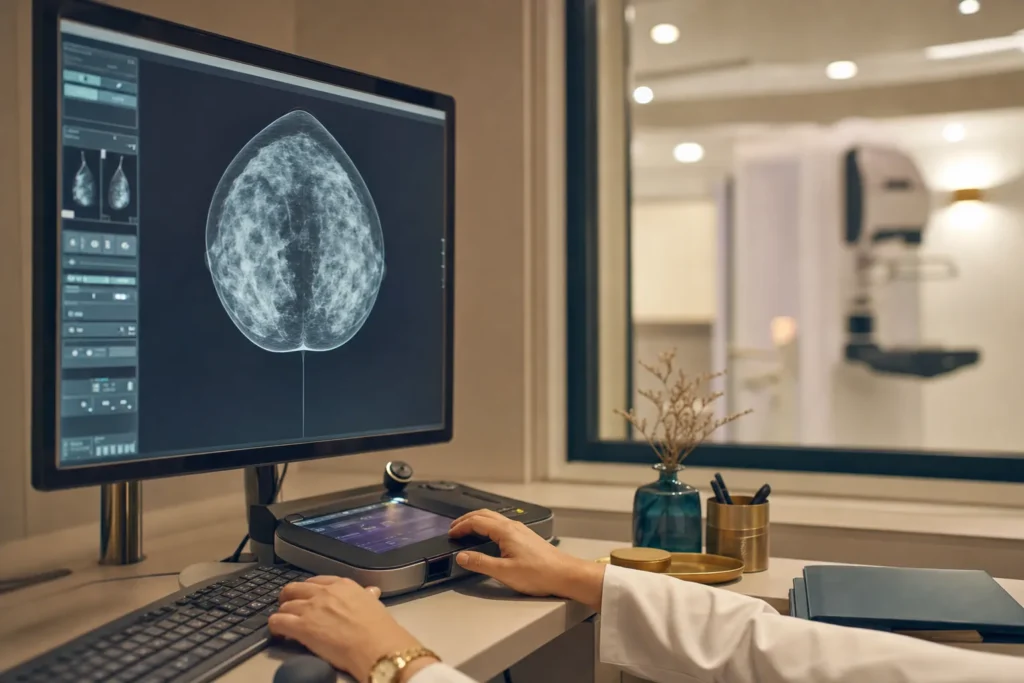
Screening means looking for cancer before it causes symptoms, usually with a mammogram (a low-dose X-ray of the breast). There is no separate screening test for "HER2 cancer" specifically; HER2 status is only worked out after a cancer has been found and a tissue sample examined. So screening for HER2-positive and HER2-negative cancer is the same: regular mammography.
Recommendations vary by country and by your personal risk. As a general guide from the American Cancer Society for women at average risk:
- Ages 40 to 44: you may choose to start yearly mammograms.
- Ages 45 to 54: yearly mammograms are recommended.
- Age 55 and over: you can switch to every two years or continue yearly, as long as you are in good health.
Women at high risk — for example those with a BRCA1 or BRCA2 gene change, a strong family history, or previous chest radiation at a young age — are often advised to start earlier (around age 30) and to add breast MRI to their yearly mammogram. National programmes (such as in the UK and Turkey) use their own age ranges, so ask a local doctor what applies to you. Knowing your own breasts and reporting any change between screenings remains valuable.
How it is diagnosed, including HER2 testing and staging
Diagnosis usually starts with imaging — a mammogram and often an ultrasound — followed by a biopsy, in which a small sample of the suspicious tissue is removed with a needle and examined under a microscope. The biopsy confirms whether cancer is present and provides the cells used for further testing.
Every invasive breast cancer is tested for HER2. Two laboratory tests are used:
- Immunohistochemistry (IHC) measures how much HER2 protein is on the cancer cells, scored from 0 to 3+.
- In situ hybridization (ISH or FISH) counts the copies of the HER2 gene and is used to settle borderline cases.
In simple terms: a score of IHC 3+, or IHC 2+ with a positive ISH/FISH test, means HER2-positive. A score of IHC 0 means HER2-negative. Scores of IHC 1+, or 2+ with a negative ISH, are now often described as HER2-low. The same tissue is also tested for estrogen and progesterone receptors.
Doctors then work out the stage, which describes how large the cancer is and whether it has spread. Staging uses the TNM system (Tumour size, lymph Nodes involved, Metastasis or spread to distant organs) and runs from stage 0 (very early, contained) through stages I to III (invasive but in the breast and nearby nodes) to stage IV (spread to distant parts of the body). HER2 and hormone receptor status are recorded alongside the stage because they shape the treatment plan.
Treatment options
Breast cancer treatment is planned by a multidisciplinary team — typically a surgeon, a medical oncologist (drug treatments), a radiation oncologist, a pathologist, a radiologist, and specialist nurses — who tailor the plan to your subtype, stage, general health and wishes. Treatment usually combines more than one of the approaches below.
Surgery removes the tumour, either by lumpectomy (taking out the lump and a margin of healthy tissue) or mastectomy (removing the breast). Nearby lymph nodes are often checked or removed.
Radiotherapy uses targeted X-rays to destroy any cancer cells left behind, lowering the chance of the cancer coming back in the area.
Chemotherapy uses medicines that kill fast-dividing cells throughout the body. It may be given before surgery (to shrink the tumour) or after.
Hormone (endocrine) therapy is used for hormone receptor-positive cancers (which can be HER2-positive or HER2-negative). It blocks estrogen's effect, often for several years.
HER2-targeted therapy is the key extra option for HER2-positive cancer. It includes antibody medicines such as trastuzumab (Herceptin) and pertuzumab (Perjeta) that attach to HER2 and block its growth signal; antibody-drug conjugates such as trastuzumab emtansine (Kadcyla) and trastuzumab deruxtecan (Enhertu) that carry chemotherapy directly to HER2 cells; and tablet medicines such as tucatinib, neratinib and lapatinib that block HER2 signals from inside the cell. Trastuzumab deruxtecan is also approved for some advanced HER2-low cancers, which is why the HER2-low category now matters.
For HER2-negative cancers, treatment depends on the other features: hormone receptor-positive cancers often add hormone therapy and may use CDK4/6 inhibitor tablets (palbociclib, ribociclib, abemaciclib), while triple-negative cancers rely mainly on chemotherapy, with newer targeted and immune-based options in selected cases.
Supportive (palliative) care runs alongside all of this to manage symptoms and side effects and protect quality of life. It is helpful at any stage, not only in advanced disease.
Outlook: what to expect
It is natural to want a number that tells you what lies ahead. Doctors use survival statistics, but it is important to understand exactly what they are — and what they are not. They describe what happened to large groups of people diagnosed in the past; they cannot predict what will happen for any one individual.
For invasive breast cancer overall, the American Cancer Society reports 5-year relative survival (based on people diagnosed between 2015 and 2021) of over 99 percent when the cancer is localized (still within the breast), about 87 percent when it has spread to nearby regional structures, and about 33 percent when it has spread to distant parts of the body; across all stages combined it is about 92 percent. These figures cover all subtypes together.
Several points soften and contextualise these numbers. First, they are population-level averages and are not a prediction for you; your age, overall health, tumour grade, hormone receptor and HER2 status, and how well your cancer responds to treatment all influence your individual situation. Second, because they are based on people treated years ago, they may understate today's results, especially for HER2-positive cancer, where modern HER2-targeted drugs have markedly improved outcomes compared with the past. Your own oncologist is the right person to discuss what the outlook means in your specific case.
Living with it and follow-up
Finishing active treatment is a milestone, but care continues. Follow-up is designed to watch for any sign the cancer is returning, to manage longer-term side effects, and to support your wellbeing.
What follow-up usually involves:
- Regular check-ups and physical examinations, becoming less frequent over time.
- Yearly mammograms (and other imaging if advised).
- Monitoring of any ongoing medicines, such as hormone therapy taken for several years, or HER2-targeted treatment that continues after surgery.
- Heart checks if you receive certain HER2-targeted or chemotherapy drugs, as a sensible precaution.
Tell your team about any new or persistent symptoms between visits — for example a new lump, bone pain, a lasting cough or breathlessness, or unusual headaches — rather than waiting for the next appointment. Beyond the physical side, the emotional impact of breast cancer is real and worth taking seriously. Many people find help in counselling, survivorship programmes, peer support groups and rehabilitation services. Gentle exercise, good nutrition and rest all support recovery. Asking for support is a sign of strength, not weakness.
Planning treatment abroad: what affects cost and how to prepare your records
If you are considering having breast cancer treatment in another country, it helps to understand what shapes the overall cost and how to prepare. We do not quote prices here, because no honest figure can be given until a specialist has reviewed your individual case. The right approach is a personalised estimate based on your actual diagnosis.
The main factors that influence the cost and length of treatment include:
- The subtype and stage of your cancer — HER2-positive disease, for example, may involve HER2-targeted medicines over many months.
- The treatments needed and their combination — surgery, radiotherapy, chemotherapy, hormone therapy and targeted drugs each add to the plan.
- The specific medicines used, since modern targeted and antibody-drug conjugate therapies differ widely in cost.
- The type of surgery and whether reconstruction is planned.
- Length of hospital stay, scans and laboratory tests, and any rehabilitation or supportive care.
To prepare your records, gather your pathology and biopsy reports (including your HER2 and hormone receptor results), imaging on disc where possible (mammogram, ultrasound, MRI, CT, PET), a summary of any treatment already given, and a current list of medicines and allergies. Having these ready lets a specialist team review your case accurately and give you a clear, personalised plan and estimate. The most reliable next step is to request a free consultation so your records can be reviewed before any decisions or costs are discussed.
Why Turkiye, and how to choose a good centre
Turkiye has become a well-known destination for cancer care, with a number of large private hospital groups that treat many international patients and offer the full range of breast cancer services — diagnosis, surgery, radiotherapy, chemotherapy and HER2-targeted therapy — in one place. For many families, accessible specialist care combined with shorter waiting times is the appeal.
Choosing well matters more than choosing fast. Things worth verifying for any centre, in Turkiye or anywhere else:
- Accreditation — look for international quality accreditation such as Joint Commission International (JCI), which assesses patient safety and care standards. Turkiye has a number of JCI-accredited hospitals.
- A genuine multidisciplinary breast team — a dedicated breast surgeon, medical and radiation oncologists, a pathology department that performs HER2 and hormone receptor testing in-house, and specialist nurses who meet to plan each case together.
- Experience with your subtype — ask how often they treat HER2-positive (or your specific) breast cancer and whether the HER2-targeted drugs you may need are available.
- Clear communication — written treatment plans, interpreter support, and a named coordinator you can reach.
- Transparent information — be cautious of any clinic that promises a "cure," claims to be the single "best," or quotes a price before reviewing your records. Reputable teams discuss realistic, evidence-based options.
Wherever you go, it is always reasonable to seek a second opinion before committing to a treatment plan.
Second opinions, clinical trials and self-care
A breast cancer diagnosis can feel overwhelming, and you do not have to make decisions alone or in a hurry. Two avenues are worth knowing about.
Second opinions. Asking another qualified specialist to review your diagnosis and proposed plan is normal and welcomed by good doctors. It can confirm the plan, clarify options, or reveal alternatives — and it often brings peace of mind. Make sure the reviewing team has your full pathology results, including HER2 and hormone receptor status.
Clinical trials. These are carefully run studies that test new or improved treatments. HER2-positive breast cancer in particular has benefited greatly from trials over the past two decades, which is how today's targeted drugs came to exist. Taking part is voluntary and is not a last resort; for some people it offers access to promising treatments alongside close monitoring. Ask your oncologist whether any trials might suit your situation.
Self-care during and after treatment. While these steps do not replace medical care, they support your wellbeing: keep up with recommended follow-up and screening; stay physically active in ways that feel manageable; eat a balanced diet; limit alcohol; avoid smoking; and look after your mental health, reaching out for support when you need it. Small, steady habits help you feel more in control through a difficult time.
Frequently asked questions
Is HER2-positive breast cancer more dangerous than HER2-negative?
Can HER2-negative breast cancer become HER2-positive later?
What is HER2-low breast cancer?
How is HER2 status tested?
What are the symptoms of HER2 breast cancer?
What is trastuzumab (Herceptin)?
Is there screening specifically for HER2 breast cancer?
Can HER2-positive breast cancer be cured?
Does HER2-positive breast cancer run in families?
What should I bring if I want my case reviewed by a centre abroad?
Should I get a second opinion?
This article is for general information only and is not medical advice. Always consult a qualified doctor about your individual case.
Considering this procedure?
Send us your photos and questions. A BergemHealth coordinator and a department-head specialist will review your case and reply with honest, personalised guidance — no obligation.
Free consultation