Early gastric & colorectal cancer
Gastric (stomach) and colorectal (bowel) cancers are among the most common cancers worldwide, but when they are found early they are also among the most treatable. This guide explains, in plain language, what these cancers are, the warning signs worth checking, how screening and modern endoscopy can catch them at an early stage, and the treatment options your medical team may discuss. It is written to inform and reassure, not to alarm. It is not a diagnosis or a substitute for a qualified specialist, and any decisions about your own health should be made together with your doctors.
What it is
Gastric cancer and colorectal cancer are two separate diseases that both begin in the digestive tract, which is the long tube that carries food from the mouth through the stomach and intestines. We discuss them together because they share a very hopeful feature: when they are caught at an early stage, treatment is often simpler and outcomes are generally much better.
Gastric cancer (also called stomach cancer) starts when cells in the lining of the stomach begin to grow and divide in an uncontrolled way. According to Cleveland Clinic, these cancers usually begin in the inner lining of the stomach and then, over time, grow deeper into the stomach wall.
Colorectal cancer (also called bowel cancer) develops in the colon (the large bowel) or the rectum (the last few inches of the large intestine). Most colorectal cancers begin as a small growth on the inner lining called a polyp. A polyp is a lump of tissue; most polyps are harmless, but some can slowly turn into cancer over many years. Cleveland Clinic notes that it can take roughly 10 years for a precancerous polyp to become a cancer that causes symptoms. This slow timeline is exactly why screening works so well.
"Early" cancer means the disease is still small and confined to the inner layers of the organ, without spreading to lymph nodes (small glands that are part of the body's drainage and immune system) or to distant organs. Early-stage disease is often suitable for the least invasive treatments.
Types & subtypes
Both cancers come in different types, and knowing the type helps your medical team choose the right treatment.
Gastric cancer types:
- Adenocarcinoma is by far the most common type. It starts in the gland cells that line the stomach.
- Gastrointestinal stromal tumours (GISTs) begin in special cells in the stomach wall and behave very differently from adenocarcinoma.
- Lymphoma of the stomach starts in immune-system cells and is treated differently again.
- Neuroendocrine tumours are rarer and arise from hormone-producing cells.
Doctors also describe where in the stomach the cancer sits, for example near the junction with the food pipe (the cardia, or upper stomach) versus the lower stomach.
Colorectal cancer types:
- Adenocarcinoma again accounts for the large majority and develops from gland cells in the bowel lining, usually starting in a polyp.
- Less common types include neuroendocrine tumours, lymphomas and GISTs that occur in the bowel.
The word "colorectal" simply combines colon and rectum; doctors may say colon cancer or rectal cancer depending on the exact location, because the rectum's position can change some treatment choices.
Causes & risk factors
Cancer develops when changes (mutations) build up in the way cells grow and divide. Often there is no single cause, and having a risk factor does not mean you will get cancer; many people with risk factors never develop it, and some people with cancer have no obvious risk factors.
For gastric cancer, the American Cancer Society lists these recognised risk factors:
- Helicobacter pylori (H. pylori) infection — a common stomach bacterium described as a major cause, especially of cancers in the lower stomach. It can usually be tested for and treated.
- Diet — diets high in salted, smoked or pickled foods raise risk; plenty of fresh fruit appears to lower it.
- Smoking — roughly doubles the risk, particularly for upper-stomach cancers.
- Age and sex — most cases occur in people in their 60s, 70s and 80s, and it is more common in men.
- Other factors — heavy alcohol use, excess body weight, family history, certain stomach conditions (such as pernicious anaemia and some stomach polyps), and inherited syndromes such as Lynch syndrome.
For colorectal cancer, the National Cancer Institute and NHS list:
- Older age, a personal or family history of bowel cancer or polyps.
- Inflammatory bowel disease (such as ulcerative colitis or Crohn's disease).
- Inherited conditions such as Lynch syndrome and familial adenomatous polyposis (FAP).
- Smoking, heavy alcohol use, excess body weight, and a diet low in fibre and high in red or processed meat.
Signs & symptoms (and when to see a doctor)
An important and reassuring fact: early gastric and colorectal cancers often cause no symptoms at all, which is why screening matters. When symptoms do appear, they are usually caused by something far more common and harmless than cancer, such as indigestion, haemorrhoids or a change in diet. Still, it is always worth getting persistent symptoms checked.
Possible signs of stomach cancer (NHS):
- Heartburn or acid reflux, or indigestion that does not go away
- Feeling full quickly when eating, or loss of appetite
- Difficulty swallowing
- Feeling or being sick (nausea or vomiting)
- Pain at the top of the tummy, a lump there, or unexplained weight loss and tiredness
Possible signs of bowel cancer (NHS):
- A change in your bowel habits, such as looser stools, diarrhoea or constipation
- Blood in your poo, or bleeding from your bottom
- Tummy pain, bloating, or a lump in the tummy
- A feeling that you have not fully emptied your bowels
- Unexplained weight loss, or tiredness and breathlessness (signs of low blood count, called anaemia)
When to see a doctor: the NHS advises seeing your GP if these symptoms last three weeks or more. Seek urgent advice for black or dark-red stools, bloody diarrhoea, or persistent vomiting. Try not to feel embarrassed — clinicians discuss these symptoms every day, and acting early gives the best chance of a simple outcome.
Screening & early detection
Screening means testing people who feel well, to find cancer early or even prevent it. This is where the two cancers differ.
Colorectal cancer has well-established screening. The National Cancer Institute notes that most expert groups recommend average-risk adults begin screening at age 45 and continue to about age 75, with individual decisions after that. Options include:
- Stool tests such as the faecal immunochemical test (FIT), which looks for hidden blood, usually every one to two years; and multi-target stool DNA tests roughly every three years.
- Colonoscopy, a camera examination of the whole bowel, typically every 10 years — and uniquely able to remove polyps during the same procedure.
- Flexible sigmoidoscopy and CT colonography (a virtual scan) as alternatives.
Crucially, the NCI explains that some of these tests do more than detect cancer early — by finding and removing precancerous polyps, they can prevent cancer from ever forming. People with a strong family history or inherited syndromes may be advised to start earlier; discuss this with a doctor.
Gastric cancer has no standard population-wide screening in most Western countries, because it is less common there. Some countries with higher rates (such as Japan and South Korea) run national programmes. People at higher risk — for example with certain stomach conditions or inherited syndromes — may be offered regular endoscopy. Testing and treating H. pylori infection is also an important preventive step.
How it is diagnosed
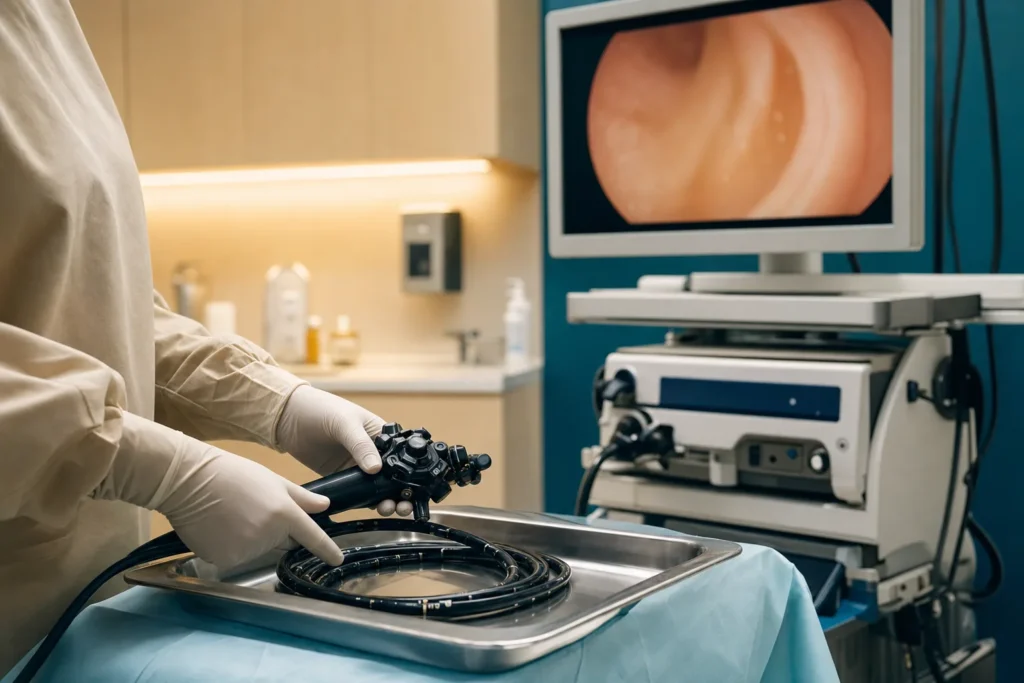
If a cancer is suspected, the key test for both diseases is an endoscopy — a thin, flexible tube with a tiny camera that lets the doctor look directly at the lining of the digestive tract.
- For the stomach, this is an upper endoscopy (gastroscopy), passed through the mouth.
- For the bowel, this is a colonoscopy, passed through the bottom.
During the examination the doctor can take a biopsy — a small tissue sample examined under a microscope to confirm whether cancer is present and what type it is. Cleveland Clinic and the NCI also describe further tests to work out the extent of disease, including endoscopic ultrasound (which shows how deep a tumour goes), CT, MRI and PET scans, and blood tests such as CEA (a marker that can be useful for bowel cancer). Occasionally a small keyhole operation (laparoscopy) is used to check for spread.
Staging describes how far a cancer has grown. Doctors commonly use the TNM system: T for the size and depth of the tumour, N for whether nearby lymph nodes contain cancer, and M for whether it has metastasised (spread to distant organs). These combine into stages from 0 (very early, confined to the innermost lining) through I, II and III to IV (spread to distant parts of the body). Early gastric and colorectal cancers are typically stage 0 or I.
Treatment options
Treatment depends on the cancer type, its stage and your overall health, and is planned by a multidisciplinary team — typically a gastroenterologist (digestive specialist), a surgeon, an oncologist (cancer-medicine specialist), a radiologist, a pathologist and specialist nurses, who together agree the best approach for you.
Endoscopic removal (for very early cancers). When a cancer is confined to the most superficial layers, it can sometimes be removed through the endoscope, without external surgery. The NCI and Cleveland Clinic describe endoscopic mucosal resection (EMR) and endoscopic submucosal dissection (ESD), in which the diseased lining is lifted and removed via the same tube used for the camera. For colorectal cancer, a cancer found within a polyp may be removed by simple polypectomy or local excision during colonoscopy.
Surgery. When more tissue needs removing, surgeons may perform a gastrectomy (removing part or all of the stomach) or a bowel resection with anastomosis (removing the affected section and rejoining the healthy ends), usually taking out nearby lymph nodes too. Many of these operations can be done with keyhole (laparoscopic) or robotic techniques.
Additional (systemic and supportive) treatments. Depending on the findings, the team may add chemotherapy, radiation therapy, or modern targeted and immunotherapy drugs. Truly early cancers often need surgery or endoscopic removal alone. Supportive (palliative) care — managing symptoms and quality of life — is part of good care at any stage.
Outlook / what to expect
The single most encouraging message about both cancers is that stage strongly influences outlook, and early-stage disease generally does well. The figures below are population-level averages from cancer authorities. They describe groups of people studied in the past and cannot predict what will happen for any one individual; survival depends on many factors, including cancer grade, your general health and the treatment you receive, and no one can tell anyone exactly how long they will live.
Bowel cancer (Cancer Research UK, England): around 90 in 100 people (about 90%) with stage 1 survive their cancer for five years or more, and around 85 in 100 (about 85%) with stage 2. By contrast, around 10 in 100 (about 10%) survive five years with stage 4 — which is why finding it early matters so much.
Stomach cancer (Cancer Research UK, England): around 65 in 100 people (about 65%) with stage 1 survive five years or more; the figure is lower at later stages. Cleveland Clinic similarly notes the five-year survival rate may be as high as around 70% when there is little spread.
These numbers are a general guide, not a personal forecast. Your own specialist can give you the most relevant information for your situation.
Living with it & follow-up
Life after treatment for an early gastric or colorectal cancer is, for many people, a return to normal activities — though it can take time and patience. Your team will arrange follow-up to check that you are recovering well and to look for any sign of the cancer returning. The NCI notes that some tests used to diagnose or stage the cancer may be repeated during follow-up, and follow-up commonly includes clinic visits, scans, blood tests such as CEA for bowel cancer, and repeat endoscopy or colonoscopy at agreed intervals.
Practical aspects of living well may include:
- Eating and digestion. After stomach surgery, you may need to eat smaller, more frequent meals and take certain vitamins; a dietitian can help. After bowel surgery, bowel habits may change for a while.
- Emotional wellbeing. Anxiety after a cancer diagnosis is normal. Support from family, patient groups, counselling and specialist nurses can make a real difference.
- Healthy habits. Not smoking, limiting alcohol, staying active and eating well support recovery and general health.
If new or returning symptoms appear between appointments, contact your care team rather than waiting.
Planning treatment abroad: what affects cost & how to prepare your records
Many people travelling for care want to understand what will shape the cost before they commit. We do not quote prices in this guide because every case is genuinely different, and the most accurate figure comes from a personalised estimate after a specialist reviews your records. The main factors that affect cost include:
- The exact diagnosis, cancer type and stage
- Whether treatment is endoscopic removal (EMR/ESD or polypectomy) or open/keyhole/robotic surgery
- Whether additional treatments such as chemotherapy, radiation or targeted/immunotherapy are needed
- The diagnostic and staging tests required (endoscopy, scans, pathology, genetic tests)
- Length of hospital stay, anaesthesia, and any complications or rehabilitation
- Follow-up appointments, plus travel and accommodation for you and a companion
To prepare, gather your medical records: recent endoscopy or colonoscopy reports, biopsy/pathology results, scan images and reports (CT, MRI, PET) on disc or digitally, blood test results, a list of your current medications, and a summary of your medical history. Having these ready allows a specialist to review your case remotely and give a tailored plan. A free consultation is the simplest way to obtain a personalised estimate and an honest view of your options.
Why Turkiye & how to choose a good centre
Turkiye has become a well-known destination for medical care, with large hospitals that offer advanced endoscopy, surgery and oncology under one roof, experienced multidisciplinary teams, and international patient services. As with any country, quality varies between centres, so it is worth checking a few things rather than relying on reputation alone. We do not claim any clinic is the "best" — the right choice is the one that fits your specific diagnosis and needs.
What to verify when choosing a centre:
- Accreditation. Look for recognised international accreditation such as Joint Commission International (JCI), which signals that a hospital meets defined quality and patient-safety standards.
- Specialist team. Confirm there is a genuine multidisciplinary team — gastroenterologist, surgeon, medical and radiation oncologists, pathologist and specialist nurses — experienced in gastric and colorectal cancer.
- Procedure experience. Ask whether the centre routinely performs the specific treatment you need, such as ESD/EMR for early cancers or laparoscopic/robotic surgery.
- Clear communication. Check for interpreters, a written treatment plan, transparent itemised estimates, and a named contact.
- Continuity of care. Ask how follow-up, records and any complications will be handled once you return home, in coordination with your local doctors.
A reputable concierge service can help you compare accredited centres, arrange a specialist review of your records, and obtain a personalised plan.
Clinical trials & getting a second opinion
Because gastric and colorectal cancers are cancers, two further options are worth knowing about alongside everyday prevention.
Prevention and self-care can lower risk and support recovery: not smoking, limiting alcohol, keeping a healthy weight, staying active, and eating plenty of fibre, fruit and vegetables while limiting salted, smoked, pickled and processed foods. For colorectal cancer in particular, taking up screening when invited is one of the most effective preventive steps, because removing polyps can stop cancer before it starts. Testing and treating H. pylori is a meaningful step for stomach health.
A second opinion is a normal and reasonable part of cancer care, not a sign of distrust. Many people seek one to confirm the diagnosis, the stage and the proposed plan; cancer authorities encourage patients to ask questions and to feel confident in their decisions. Sharing your full records makes a second opinion more useful.
Clinical trials are carefully run research studies that test new or improved treatments. For some patients they offer access to promising approaches, always with informed consent and oversight. Whether a trial is suitable depends on your specific situation; ask your oncologist whether any relevant trials are open to you. The aim of all of these steps is the same — helping you and your medical team make well-informed choices.
Frequently asked questions
Can early gastric or colorectal cancer be cured?
What are the early warning signs I should not ignore?
Is there a screening test for these cancers?
What is the difference between EMR/ESD and surgery?
How is the cancer diagnosed and staged?
Do I always need chemotherapy or radiation?
What records should I prepare before seeking treatment abroad?
How much will treatment cost?
How do I choose a good hospital in Turkiye?
Is it worth getting a second opinion?
Can these cancers be prevented?
This article is for general information only and is not medical advice. Always consult a qualified doctor about your individual case.
Considering this procedure?
Send us your photos and questions. A BergemHealth coordinator and a department-head specialist will review your case and reply with honest, personalised guidance — no obligation.
Free consultation