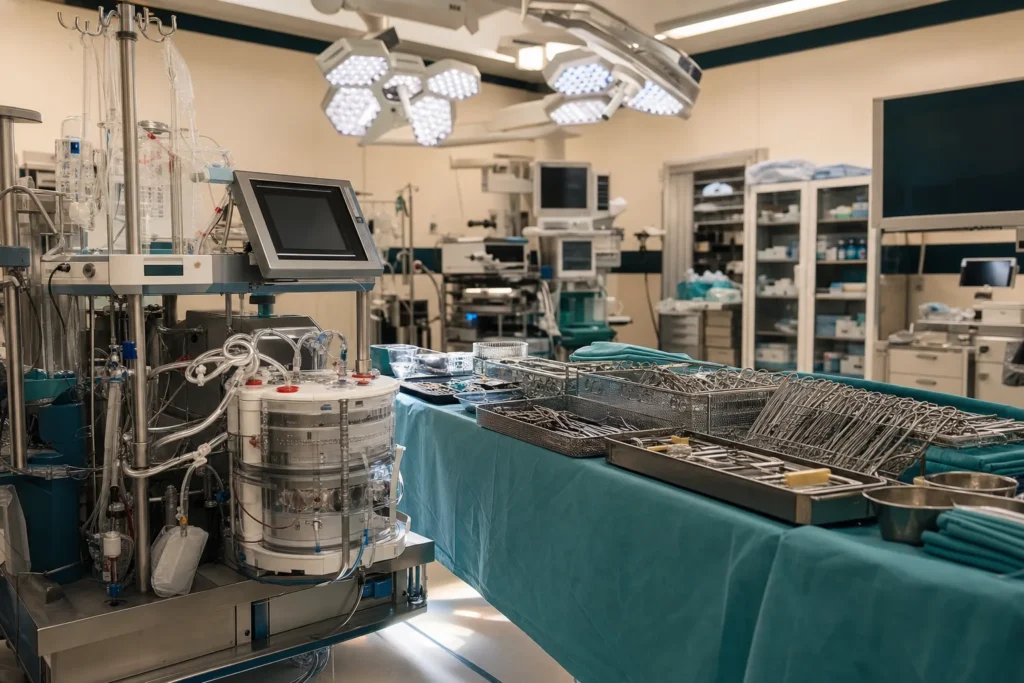
Liver transplant (living donor)
A living donor liver transplant lets a healthy person give part of their liver to someone whose own liver is failing. Because the liver can regrow, both people end up with a full-size organ within a few months. This guide explains, in plain words, how it works, who it suits, what recovery looks like, the real risks, and how to choose a safe hospital if you are considering treatment in Turkiye.
- Anaesthesia
- General anaesthesia (you are fully asleep) for both donor and recipient.
- Duration
- Donor surgery about 4-6 hours; recipient surgery often 6-12 hours.
- Recovery
- Donor: back to normal life in roughly 6-8 weeks. Recipient: 6-12 months for full recovery.
- Hospital stay
- Donor: about 1 week. Recipient: several days in intensive care, then 1-3 weeks in hospital.
What a living donor liver transplant is
A liver transplant replaces a liver that no longer works with a healthy one. In a living donor transplant, that healthy liver does not come from someone who has died. Instead, a healthy living person gives away part of their own liver, and surgeons place it into the patient who needs it.
This is possible because of a remarkable feature of the liver: it can regenerate, meaning it grows back. After surgery, both the piece left in the donor and the piece placed in the recipient start growing almost straight away. Within a few weeks to a few months, each side has grown into a full-size, working liver. No other major organ in the body can do this.
How much liver is removed depends on who is receiving it. For an adult recipient, surgeons usually take a larger share (often the right side, somewhere around half to two-thirds of the donor's liver). For a child, a much smaller piece is enough. The aim is always to leave the donor with enough liver to stay healthy while giving the recipient enough to survive and recover.
It helps to know the alternative. The other route is a deceased donor transplant, where the liver comes from someone who has just died and chosen to donate. In many countries there are far more people waiting than there are deceased donors, so waiting lists are long. A living donor transplant can be planned in advance and done before the patient becomes critically ill, which is one of its main advantages.
Who is a good candidate (and who should avoid it)
A liver transplant is considered when the liver is failing and no other treatment can fix it. The most common reason in adults is cirrhosis (severe, permanent scarring of the liver) caused by long-term hepatitis B or C, long-term heavy alcohol use, fatty liver disease, or autoimmune liver conditions. Other reasons include acute liver failure (the liver shutting down quickly), certain inherited liver diseases, and some liver cancers that are still confined to the liver. In children, the most common reason is biliary atresia, a condition where the bile ducts are blocked or missing from birth.
To decide who needs a transplant and how urgently, doctors often use a score called MELD (Model for End-Stage Liver Disease), worked out from blood tests. A higher score means more urgent need.
A transplant is usually not advised if there is cancer that has spread beyond the liver, a severe infection that cannot be controlled, advanced heart or lung disease, or an active substance-use problem that has not been addressed. These conditions make surgery too dangerous or mean the new liver is unlikely to last.
The donor has their own checklist. Most programmes accept donors who are adults (commonly 18 to about 60 years old), in good physical and mental health, with a healthy liver of the right size, and whose blood type is compatible with the recipient's (it does not have to match exactly). People with significant obesity, a fatty or diseased liver, uncontrolled diabetes, or certain heart and lung conditions are usually not accepted, because donation could harm them or leave too little working liver behind. Crucially, donation must be entirely voluntary and unpaid.
Types and techniques
There are a few distinct approaches, and it helps to understand how they differ.
- Living donor transplant. Part of a healthy living person's liver is used, as described above. This is the focus of this guide and is especially common in countries where deceased donors are scarce.
- Deceased donor (whole liver) transplant. A complete liver from someone who has died is transplanted into one recipient.
- Split liver transplant. A deceased donor's liver is divided into two parts so it can help two people, often one adult and one child.
Within living donation, the piece taken depends on the recipient. An adult usually needs the larger right lobe; a child or smaller adult may need only the smaller left lobe or an even smaller segment.
The donor operation itself can be done two ways. Open surgery uses one longer incision across the upper abdomen. Laparoscopic (keyhole) surgery uses several small incisions and a camera, which can mean smaller scars and a quicker recovery; not every donor or every centre is suited to it. Some programmes also run paired donation, where two donor-recipient pairs who are not good matches for each other swap, so each recipient gets a suitable liver.
How it is done (anaesthesia, steps and how long)
Both the donor and the recipient have general anaesthesia, which means they are fully asleep and feel nothing during the operation. The two surgeries are carefully coordinated, often happening at the same time in adjoining operating rooms.
For the donor, the surgeon carefully separates the planned section of liver from its blood vessels and bile ducts (the small tubes that carry bile), removes that piece, and closes the incision. The donor operation typically takes around four to six hours.
For the recipient, the surgeon removes the diseased liver (and usually the gallbladder), then places the donated piece in position and connects it to the recipient's blood vessels and bile ducts so blood can flow through it and bile can drain. Reconnecting these tiny structures is delicate work, which is why the recipient operation can take longer, often somewhere between 6 and 12 hours.
After surgery the recipient is moved to intensive care for close monitoring for several days, then to a regular ward. The donor is monitored too but normally does not need intensive care for long, if at all.
Recovery, step by step
Recovery looks quite different for the donor and the recipient.
For the donor:
- Hospital (about 1 week). Pain is managed, you start eating and walking, and the team checks your remaining liver is working well.
- First few weeks at home. Most donors can care for themselves after the first week. Driving usually becomes possible after about two to three weeks, once you are off strong painkillers and can move comfortably.
- Six to eight weeks. Many donors return to normal activities and work in this window, depending on how physical their job is.
- Two to three months. The donor's liver typically regrows close to its full size.
For the recipient:
- Intensive care, then the ward. Close monitoring is essential while the new liver settles in. Total hospital stay is often one to three weeks.
- Anti-rejection medicines start immediately and continue for life (more on this below).
- First three months. Frequent blood tests and check-ups. Many programmes ask recipients to stay near the hospital during this period.
- Six to twelve months. This is the usual timeframe for a full return to normal activities, with energy and strength gradually improving.
Risks and possible complications
Honest information matters here, because two healthy-enough people are involved, not one.
For the donor, this is major surgery undertaken for someone else's benefit, so the risks deserve real respect. General surgical risks include bleeding, blood clots, infection, and pneumonia. Liver-specific risks include bile leaks or bile duct injury, scar tissue inside the abdomen (adhesions), and an incisional hernia at the wound. Serious complications are uncommon, and the risk of death is low but not zero; published figures put donor death at roughly 0.2%, about 1 in 500. Donors can also experience meaningful pain and an emotional adjustment in the weeks and months afterwards.
For the recipient, risks include bleeding, infection, blood clots, and problems with the reconnected blood vessels or bile ducts. The most distinctive risk is rejection, where the immune system attacks the new liver as if it were a threat. This is managed with medication, and most rejection episodes can be treated; a small share of people have ongoing rejection that can damage the graft.
The anti-rejection (immunosuppressant) medicines themselves carry trade-offs. By calming the immune system they raise the long-term risk of infections and some cancers, and they can contribute to high blood pressure, raised cholesterol, kidney strain, and diabetes. Regular monitoring is how the team keeps these in check.
Results and how long they last
For a person with end-stage liver disease, a transplant can be life-changing and life-saving. Modern results are encouraging, especially with living donors.
Large registry data show that recipients of a living donor liver tend to do at least as well as, and often better than, recipients of a deceased donor liver. Reported five-year survival for living donor recipients has been around 95%, compared with roughly 90% for deceased donor recipients. One reason is that living donor transplants are planned, so they can happen before the patient becomes critically ill, and the donated liver is from a carefully screened healthy person.
A transplanted liver can last for many years, often decades. How long it lasts depends on the original disease, how well rejection is controlled, whether the person takes their medicines consistently, and general health and lifestyle. Some conditions (for example certain viral hepatitis or autoimmune diseases) can affect the new liver over time, which is why lifelong follow-up matters. These are population figures, not promises about any single person; your own outlook depends on your specific situation and is something your transplant team will discuss with you.
Costs: what shapes the price
A living donor liver transplant is one of the most resource-intensive operations in medicine, because it involves two surgeries, two patients, an intensive care stay, and months of follow-up. For that reason, prices vary widely between countries and hospitals, and a single quoted figure rarely tells the whole story.
Rather than focusing on one number, it is more useful to understand what changes the price:
- Donor evaluation and surgery. The donor needs their own full work-up and operation, all of which is part of the overall cost.
- Length of hospital and intensive care stay. Complications or a slower recovery extend the stay and the bill.
- Medicines. Anti-rejection drugs are needed for life and are an ongoing cost after you go home.
- Tests and imaging before surgery for both donor and recipient.
- Follow-up care in the first months, when frequent blood tests and check-ups are essential.
- Travel and accommodation if you are treated abroad, including a long stay near the hospital.
Many hospitals that treat international patients offer an all-inclusive package that bundles surgery, donor testing, the hospital stay, and early follow-up. When comparing options, always ask exactly what is and is not included, and what happens (and what it costs) if there are complications.
Why people travel to Turkiye, and how to choose a safe clinic
Turkiye has become a notable centre for liver transplantation, particularly living donor transplants. Because deceased-donor organs are limited there, Turkish centres have developed deep experience in the living donor technique, and several large hospitals perform high volumes each year with experienced multidisciplinary teams. Combined with shorter waiting times and competitive package pricing, this draws international patients.
There is an important legal and ethical point to understand. Under Turkish law, a living liver donor must generally be a relative of the recipient (commonly up to the fourth degree of kinship), or a spouse. If there is no related donor, the case must be reviewed and approved by a government-authorised ethics committee before any surgery can go ahead. For patients coming from abroad, hospitals typically require official documents proving the family relationship, often validated through an embassy or consulate. This framework exists to prevent organ trafficking and to protect donors from coercion.
When choosing a hospital, verify the essentials:
- Accreditation. Look for recognised quality accreditation such as JCI (Joint Commission International).
- Surgeon and team credentials. Confirm the transplant surgeons are board-certified and that there is a full team (hepatologists, anaesthetists, intensive care, transplant nurses).
- Volume and outcomes. Ask how many living donor transplants the centre does each year and about its complication and survival figures.
- Donor protection. Confirm there is an independent advocate looking after the donor's interests, separate from the recipient's team.
- Clear, written agreements on what the package covers, follow-up, and how complications are handled.
Be cautious of any offer that bypasses ethics approval or hints at a paid, unrelated donor; that is both illegal and dangerous.
How to prepare and what to ask at your consultation
Preparation for a transplant is thorough, and it covers both the patient and the potential donor. Expect detailed blood tests, imaging such as CT or MRI scans to measure liver size and map blood vessels, heart and lung checks, and a psychological and social assessment. The donor's blood type must be compatible with the recipient's, and the donor's liver must be large enough that the piece given is adequate while the piece left behind keeps the donor safe.
The donor also meets an independent donor advocate, a professional whose only job is to protect the donor's interests, confirm the decision is voluntary, and make sure the donor fully understands the risks. This person is not part of the recipient's care team.
Good questions to bring to a consultation include:
- How many living donor liver transplants does this centre perform each year, and what are your outcomes and complication rates?
- Which lobe will be used, and will the donor have open or keyhole surgery?
- What are the specific risks for the donor, and how are they supported afterwards?
- Which anti-rejection medicines will I take, for how long, and what are their side effects?
- What does the package include, and what happens if there are complications?
- How long will I need to stay near the hospital, and what follow-up will I need back home?
- For international patients, exactly what documents are required to satisfy the ethics committee?
Aftercare and travelling for treatment (including when it is safe to fly)
Aftercare is not optional, it is part of the treatment. The recipient takes anti-rejection medicines for life and needs regular blood tests and check-ups, very frequently in the first months and then less often as things stabilise. Watch for warning signs the team will explain, such as fever, yellowing of the skin or eyes (jaundice), pain, redness or drainage at the wound, or feeling generally unwell, and report them promptly. Donors also have follow-up appointments to confirm their liver has regrown and they have healed well.
If you have travelled for treatment, plan to stay nearby for an extended period rather than flying home quickly. Both donor and recipient have had major abdominal surgery, and sitting still on a long flight raises the risk of blood clots in the legs (deep vein thrombosis).
When is it safe to fly? There is no single rule, and the decision must come from your transplant team, but recipients are commonly advised to wait several months, often around three to six months (sometimes longer), until liver function is stable, medicines are settled, and there are no signs of rejection or infection. Donors can usually fly sooner, once they have healed and are cleared by their surgeon. For any flight, ask about wearing compression stockings, staying hydrated, and getting up to move regularly. Carry enough medication and a clear medical summary, and never stop your anti-rejection drugs to travel.
Frequently asked questions
Does the donor's liver really grow back?
Is it dangerous to be a living liver donor?
Does the donor's blood type have to match the recipient's exactly?
How long will I stay in hospital?
How long does full recovery take?
Will the recipient need medication for life?
Can a stranger donate part of their liver to me in Turkiye?
How successful are living donor liver transplants?
When can I fly after the surgery?
What conditions lead to needing a liver transplant?
What is a MELD score?
Is the cost lower in Turkiye than elsewhere?
This article is for general information only and is not medical advice. Always consult a qualified doctor about your individual case.
Considering this procedure?
Send us your photos and questions. A BergemHealth coordinator and a department-head specialist will review your case and reply with honest, personalised guidance — no obligation.
Free consultation