Paediatric epilepsy
If your child has had a seizure, or has just been diagnosed with epilepsy, it is natural to feel worried and to have many questions. This guide explains, in plain language, what paediatric (childhood) epilepsy is, why it happens, how doctors find out what is going on, and the many ways it can be treated. The reassuring news, supported by major health bodies, is that most children with epilepsy do well: with the right care, the majority become free of seizures, and a large share simply grow out of the condition as they get older.
What paediatric epilepsy is
Epilepsy is a condition of the brain that causes a child to have repeated seizures. A seizure is a short burst of unusual electrical activity in the brain. The brain normally works by sending tiny, well-organised electrical signals between its cells. During a seizure, a group of brain cells fire all at once in a disorganised way, and this brief "electrical storm" changes how a child moves, feels, behaves, or what they are aware of for a short time.
Doctors generally only use the word epilepsy when a child has had more than one seizure that was not caused by a clear, temporary trigger (such as a very high fever or a head injury). Having a single seizure does not automatically mean a child has epilepsy.
Epilepsy in children is more common than many parents expect. The World Health Organization estimates that around 50 million people of all ages worldwide live with epilepsy, and the United States alone had roughly 456,000 children under 18 with active epilepsy in 2022, according to the CDC. It is important to know that epilepsy is not contagious (it cannot be "caught"), it is not a mental illness, and it is not anyone's fault.
Most children with epilepsy go on to live full, active lives. The Cleveland Clinic notes that around 70% of children with epilepsy have no lasting effect on their development or daily activities, and that more than 60% outgrow the condition before adulthood.
Types and subtypes
There is no single "epilepsy". Doctors describe it in two main ways: by where the seizure starts in the brain, and sometimes by a named syndrome (a recognisable pattern of seizure type, age of onset, and brain-wave findings).
By where seizures start:
- Focal seizures begin in one area of the brain. The child may notice an unusual smell, taste, feeling or movement, and may or may not lose awareness.
- Generalised seizures involve both sides of the brain from the start. These include tonic-clonic seizures (stiffening then rhythmic jerking, the type many people picture), absence seizures (brief staring spells), myoclonic seizures (quick muscle jerks), tonic seizures (sudden stiffening), and atonic seizures (a sudden loss of muscle tone, sometimes called drop attacks).
Some common childhood epilepsy syndromes include:
- Childhood absence epilepsy short, frequent staring spells, often starting between about 4 and 10 years.
- Self-limited epilepsy with centrotemporal spikes (sometimes called benign rolandic epilepsy) which, according to Johns Hopkins, affects roughly 15% of children with epilepsy and tends to involve seizures around sleep.
- Juvenile myoclonic epilepsy which often begins around puberty, with morning muscle jerks.
- Infantile spasms (West syndrome) a serious form in babies that needs prompt specialist care.
- Lennox-Gastaut syndrome and Dravet syndrome rarer, more difficult-to-treat forms that usually begin in early childhood.
Knowing the type matters because it guides which treatment is most likely to help and gives a clearer idea of the outlook.
Causes and risk factors
In a large share of children, no specific cause is ever found, and that is completely normal. The WHO notes that the cause of epilepsy is unknown in about half of all cases worldwide, and the CDC reports that fewer than half of newly diagnosed cases have an identifiable cause. This does not mean anything was missed it simply reflects how the brain works.
When a cause is identified, it may include:
- Genetic factors some forms run in families or are linked to specific genetic changes. A family history of epilepsy can slightly raise the chance.
- Differences in how the brain formed before birth (brain malformations).
- Problems around birth, such as a lack of oxygen.
- Brain infections, such as meningitis or encephalitis (inflammation of the brain).
- Head injury, stroke, or a brain tumour (tumours are an uncommon cause in children).
- Certain developmental or neurological conditions, such as some forms associated with Down syndrome.
It is worth gently separating epilepsy from febrile seizures, which are convulsions triggered by fever in young children. According to the US National Institute of Neurological Disorders and Stroke (NINDS), these are common between 6 months and 5 years of age, do not usually cause long-term problems, and most children who have them do not go on to develop epilepsy.
Signs and symptoms (and when to see a doctor)
Seizures look very different from child to child, because what happens depends on which part of the brain is involved. They are not always dramatic. As the CDC points out, a seizure may not look the way you expect.
Signs to watch for include:
- Stiffening of the body, or suddenly going floppy and falling.
- Rhythmic jerking or twitching of the arms, legs or face.
- Staring spells brief moments where the child seems "switched off", does not respond, and then carries on as if nothing happened.
- Loss of awareness or unresponsiveness.
- Unusual sensations a strange smell or taste, tingling, fear, or a "rising" feeling in the tummy.
- Repetitive movements such as lip-smacking, fidgeting, or wandering with no awareness.
- Sometimes loss of bladder control during a seizure.
Most seizures stop on their own within seconds to a few minutes. Make a routine GP or paediatrician appointment if your child has a first-ever seizure, or a seizure after a long seizure-free period.
Call emergency services (such as 999 or 112) straight away if:
- A seizure lasts longer than 5 minutes.
- One seizure follows another without the child recovering in between.
- The child does not wake up or breathe normally afterwards, or is injured.
- It is the child's first seizure and you are unsure what is happening.
A seizure lasting more than five minutes is called status epilepticus and needs urgent medical treatment.
Screening and early detection
There is no routine screening test for epilepsy the way there is for some other conditions. Epilepsy cannot be predicted in a healthy child before any symptoms appear, and there is no blood test or scan that is done in advance to look for it.
Instead, the path to diagnosis usually begins after a first seizure or after a parent, teacher or carer notices something unusual such as repeated staring spells, unexplained jerks, or odd episodes of confusion. "Early detection" in epilepsy really means recognising these episodes and getting them assessed promptly, rather than dismissing them.
Because some childhood seizures, especially brief absence (staring) seizures, are easy to mistake for daydreaming, it can help to keep a short written record: when episodes happen, how long they last, what the child was doing, and what you saw. A simple phone video of an episode (when it is safe to film) is one of the most useful things you can bring to the appointment, as it helps the specialist see exactly what is happening.
How it is diagnosed
Diagnosing epilepsy is mostly about careful detective work, not a single test. A children's neurologist (a doctor specialising in the brain and nervous system in children, sometimes called a paediatric neurologist) will start by listening closely to a detailed description of the episodes and your child's history.
Tests that may be used include:
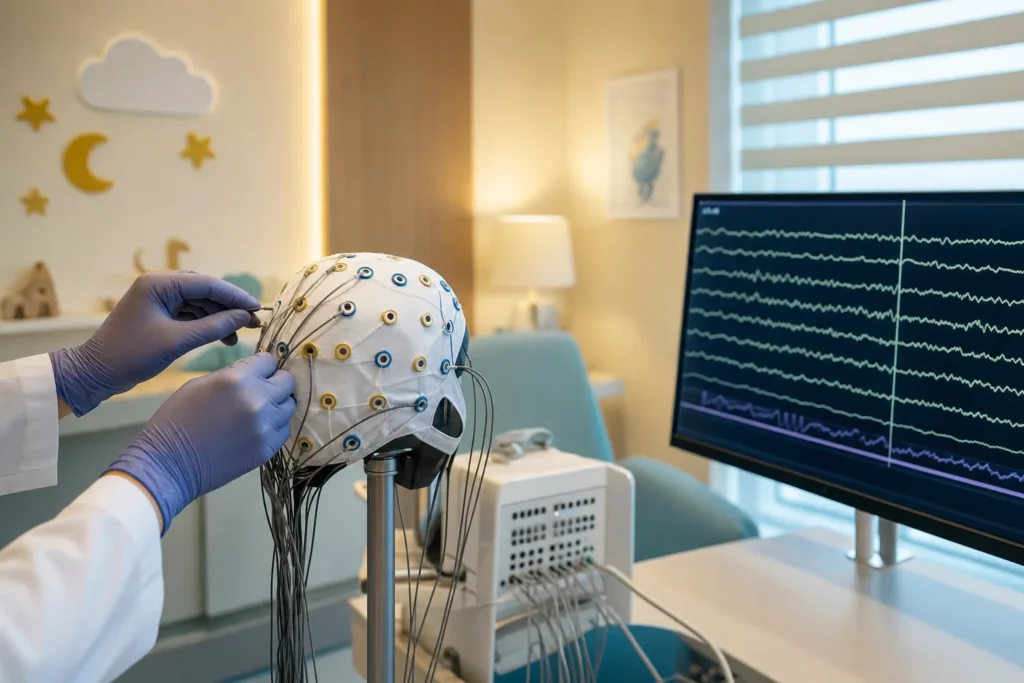
- Electroencephalogram (EEG) a painless test that records the brain's electrical activity through small sensors placed on the scalp. It can pick up patterns that suggest a tendency to seizures.
- Video EEG monitoring sometimes done over hours or days in a hospital unit, where cameras record the child at the same time as the EEG. This helps doctors match what the body does with what the brain is doing, which is especially useful for tricky cases.
- Brain imaging, usually an MRI scan (which uses magnets, not radiation) to look at the structure of the brain. A CT scan may be used in some situations.
- Blood tests to rule out other causes and check general health.
- Genetic testing in selected cases, particularly for certain syndromes.
It is normal for some test results, including the EEG, to be normal even when a child does have epilepsy this is one reason the description of the episodes is so important. The aim is to confirm whether the episodes are seizures, identify the seizure type and any syndrome, and look for a cause, so that treatment can be matched to your child.
Treatment options
The goal of treatment is straightforward: as few seizures as possible (ideally none), with as few side effects as possible, so that your child can get on with childhood. Care is usually led by a multidisciplinary team that may include a paediatric neurologist, epilepsy specialist nurses, a dietitian, a neurosurgeon (for selected children), a neuropsychologist, and a pharmacist, all working together.
Anti-seizure medicines (also called anti-epileptic drugs) are the main treatment for the great majority of children. They do not cure epilepsy, but they reduce or stop seizures. The right medicine depends on the seizure type, the child's age, and other health factors, so it can take time and some adjustment to find the best one and the best dose. The WHO reports that up to 70% of people with epilepsy could become seizure-free with appropriate medicine. If a child stays seizure-free for a couple of years, a specialist may discuss slowly and carefully reducing medication.
When seizures continue despite trying suitable medicines (sometimes called drug-resistant epilepsy), other options may help:
- Ketogenic diet a strictly medically supervised, high-fat, low-carbohydrate eating plan that can reduce seizures in some children. It must be managed by a specialist team and dietitian, never started alone.
- Vagus nerve stimulation (VNS) a small device placed under the skin of the chest that sends gentle electrical signals to a nerve in the neck to help reduce seizures.
- Epilepsy surgery for carefully selected children, an operation to remove or disconnect the small area of brain where seizures begin. Modern centres perform this safely in children and even infants when the source can be precisely located.
- Other neurostimulation approaches such as deep brain stimulation may be considered in specific situations.
Rescue (emergency) medicine may also be prescribed to give at home if a seizure lasts too long, with clear instructions from the team.
Outlook and what to expect
For most children, the outlook is encouraging. With the right treatment, the majority of children with epilepsy become free of seizures, and many gradually grow out of the condition. The Epilepsy Foundation estimates that about two-thirds of children outgrow their seizures by their teenage years, and the Cleveland Clinic similarly notes that more than 60% outgrow epilepsy before adulthood.
The picture does depend on the type of epilepsy. For example, published studies of childhood absence epilepsy suggest that roughly two-thirds of children go into lasting remission, often within a few years of starting treatment. Some other syndromes, such as Lennox-Gastaut or Dravet syndrome, are more difficult to control and need ongoing specialist care.
These figures describe groups of children studied over time. They are not a prediction for any individual child your child's own outlook depends on their specific diagnosis, response to treatment, and other factors that only their medical team can weigh up. The most reliable guidance always comes from the specialist who knows your child. What can be said in general is that getting an accurate diagnosis and starting suitable treatment promptly gives the best chance of good control.
Living with it and follow-up
Living well with epilepsy is very achievable, and a few practical habits make a big difference. Children usually attend regular follow-up appointments so the team can check how well seizures are controlled, watch for medicine side effects, adjust doses as the child grows, and support development and learning.
Helpful day-to-day steps include:
- Give medicines consistently, at the same times each day; missed doses are a common cause of breakthrough seizures.
- Sensible safety measures close supervision around water (baths, pools), a helmet for activities like cycling, and care with heights, in line with the seizure type.
- Protect sleep, since being very tired can trigger seizures in some children.
- Keep a seizure diary to spot patterns and possible triggers.
- Share a simple plan with school, family and carers so everyone knows what to do during a seizure and when to call for help.
Emotional wellbeing matters too. Some children and parents feel anxious or low after a diagnosis, and that is understandable. Talking openly, connecting with epilepsy support groups, and asking the team about psychological support can all help. Most children take part in school, sport and friendships much like their peers.
Planning treatment abroad: what affects cost and how to prepare your records
Families sometimes look abroad, including to Turkiye, for a thorough assessment, a second opinion, or specialist treatment such as advanced diagnostics or epilepsy surgery. Because every child's epilepsy is different, there is no single fixed price, and we do not quote figures on this page. Instead, it helps to understand the factors that influence the overall cost so you can ask the right questions.
These factors typically include:
- The type and depth of assessment needed for example, a standard EEG versus several days of video EEG monitoring.
- Imaging such as MRI, and any specialised scans.
- Whether treatment is medication-focused or involves a procedure or surgery, which is far more involved.
- Length of hospital stay and the level of monitoring.
- Medicines, follow-up visits, and any rehabilitation or therapy.
- Travel and accommodation for the child and accompanying parents, and interpreter support.
To prepare, gather your child's medical records in one folder: seizure diary and videos, previous EEG and MRI reports (and the image files, not just the letters), a current medication list with doses, vaccination history, and any genetic test results. Having these ready means a specialist can give you accurate, personalised advice without repeating tests unnecessarily. We can arrange a free consultation to review your child's situation and provide a personalised estimate based on what they actually need.
Why Turkiye, and how to choose a good centre
Turkiye has become a well-known destination for international medical care, including paediatric neurology, with experienced specialists and modern hospitals. Many of its major hospitals hold international accreditation: Joint Commission International (JCI), a widely recognised quality and patient-safety standard, accredits a large number of Turkish health institutions, with the country among the leaders worldwide for JCI accreditation.
Rather than relying on any claim of being "the best" (a label no responsible clinic should use about itself for a child's brain condition), focus on what you can verify:
- Accreditation check the hospital's JCI status directly on the official Joint Commission International website, and confirm the exact hospital name and location match what you have been told.
- A genuine paediatric epilepsy team a dedicated children's neurologist, epilepsy nurses, and, where surgery may be relevant, a paediatric neurosurgical team and an epilepsy monitoring unit.
- Experience with your child's specific epilepsy type, and clear willingness to explain the plan and the risks.
- Clear communication in a language you understand, written information, and interpreter support.
- A second-opinion-friendly attitude a good team welcomes questions and supports you seeking another view.
It is also wise to ask how care will be coordinated with your child's doctors back home, so that follow-up and medication continue smoothly after you travel.
Prevention, self-care and getting a second opinion
Most childhood epilepsy cannot be prevented, because it often relates to genetics or to how the brain has developed, and that is not something a parent could have changed. However, some general steps lower the risk of brain injury that can sometimes lead to seizures: using car seats and seat belts, helmets for cycling and wheeled sports, safe play around water, and keeping up with childhood vaccinations and prompt treatment of infections.
For a child already diagnosed, the most useful "self-care" is really steady management: giving medicines reliably, attending follow-ups, protecting sleep, noting triggers, and keeping the team informed of any change. Avoid stopping or changing medication without medical advice, as sudden changes can trigger seizures.
Finally, you are always entitled to a second opinion, especially before any major decision such as surgery, or if seizures are not improving. Seeking another specialist's view is a normal, sensible part of caring for a child with epilepsy, not a sign of distrust. A qualified paediatric neurologist remains the right person to confirm the diagnosis, tailor treatment, and answer questions about your child specifically.
Frequently asked questions
Will my child grow out of epilepsy?
Is epilepsy in children dangerous or life-threatening?
What should I do while my child is having a seizure?
Is epilepsy caused by something I did or didn't do?
My child only stares for a few seconds. Could that be epilepsy?
Are febrile seizures the same as epilepsy?
How is epilepsy diagnosed in children?
What treatments are available besides medicine?
Can my child go to school and play sports?
Why might we consider treatment in Turkiye?
How much does epilepsy assessment or treatment cost?
Should we get a second opinion?
This article is for general information only and is not medical advice. Always consult a qualified doctor about your individual case.
Considering this procedure?
Send us your photos and questions. A BergemHealth coordinator and a department-head specialist will review your case and reply with honest, personalised guidance — no obligation.
Free consultation