Kidney cancer
Hearing the words "kidney cancer" can be frightening, but it helps to know that many kidney tumours are found early, while they are small and confined to the kidney, and that treatment has advanced a great deal in recent years. This guide explains, in plain language, what kidney cancer is, how doctors find and treat it, what the outlook depends on, and how to prepare if you are considering treatment abroad.
What kidney cancer is
Your two kidneys are bean-shaped organs, each about the size of a fist, sitting near the middle of your back just below the ribcage. Their main job is to filter waste and extra water out of your blood and turn it into urine (pee). They also help control blood pressure and help your body make red blood cells. Most people are born with two kidneys, but you can live a healthy life with just one.
Kidney cancer happens when cells in a kidney start to grow in an uncontrolled way and form a lump called a tumour. The most common form in adults begins in the lining of the tiny tubes (called tubules) inside the kidney that do the filtering. This type is named renal cell carcinoma ("renal" simply means "relating to the kidney"). According to the American Cancer Society, about 9 out of 10 kidney cancers are renal cell carcinomas.
An important and reassuring point: not every lump found on a kidney is cancer, and many kidney cancers are found by chance during a scan done for some other reason, often before they cause any symptoms. Finding a tumour early, while it is still inside the kidney, generally gives more treatment choices.
Types and subtypes
Knowing the type of kidney cancer matters because it guides treatment. Doctors usually divide it into a few groups.
Renal cell carcinoma (RCC) is by far the most common. Within RCC there are several subtypes, named after how the cells look under a microscope:
- Clear cell RCC — the most common subtype. The American Cancer Society describes it as about 7 in 10 cases of RCC; Cleveland Clinic puts it at up to 85%.
- Papillary RCC — about 1 in 10 RCCs (roughly 10 to 15%).
- Chromophobe RCC — around 5% of RCCs (Cleveland Clinic gives 5 to 10%).
- Rare subtypes — including collecting duct and renal medullary carcinoma, each making up less than 1% of cases.
Other, less common kidney cancers include:
- Transitional cell carcinoma (urothelial carcinoma) — starts in the lining of the renal pelvis, the part of the kidney where urine collects before passing to the bladder. The American Cancer Society notes this makes up roughly 5 to 10 of every 100 kidney cancers; it behaves more like bladder cancer.
- Wilms tumour — a type that almost always affects children.
- Renal sarcoma — a rare cancer of the kidney's connective tissue (less than 1% of cases).
This article focuses mainly on renal cell carcinoma, the type most adults are diagnosed with.
Causes and risk factors
In most cases doctors cannot point to a single cause, and many people who develop kidney cancer have no obvious risk factors at all. The NHS states plainly that "anyone can get kidney cancer." A risk factor simply means something that raises the chance a little; having one does not mean you will get the disease, and not having any does not mean you cannot.
Things that have been linked to a higher risk include:
- Smoking — one of the strongest modifiable (changeable) risk factors.
- Being overweight or living with obesity.
- High blood pressure (hypertension).
- A close relative who has had kidney cancer (a family history).
- Long-term dialysis for chronic kidney disease.
- Older age — kidney cancer becomes more common as people get older.
- Certain inherited genetic conditions, such as von Hippel-Lindau disease, hereditary papillary renal cancer, and tuberous sclerosis. These are uncommon, but they can run in families.
- Long-term, heavy misuse of some pain medicines, as noted by the U.S. National Cancer Institute.
The encouraging side of this list is that some of these factors are within your control. Not smoking, keeping to a healthy weight, and managing blood pressure are good for your kidneys and your overall health.
Signs and symptoms (and when to see a doctor)
Early kidney cancer often causes no symptoms at all. The NHS says directly: "Often there are no obvious symptoms of kidney cancer." This is one reason many cases are found by accident on scans done for other problems.
When symptoms do appear, they may include:
- Blood in your urine (it may look pink, red or brown).
- A lump or swelling in your back, under your ribs, or in your neck.
- Pain between your ribs and your waist that does not go away.
- Losing weight without trying, or loss of appetite.
- Feeling very tired or having no energy.
- A high temperature that does not go away, or heavy sweating, including at night.
When to see a doctor. See your GP or a doctor if you notice blood in your urine, an unexplained lump, persistent pain in your side, unexplained weight loss, a temperature that will not settle, or lasting tiredness. The NHS is reassuring here: "Having them does not definitely mean you have kidney cancer. But it's important to get them checked." Many of these symptoms have other, far more common causes, such as a urine infection. Getting checked simply lets a doctor rule things out or start the right treatment sooner.
Screening and early detection
It helps to understand the difference between symptoms and screening. Screening means testing people who feel completely well, to catch a disease before it causes any problems. For kidney cancer, there is currently no national screening programme for the general population. As Cancer Research UK explains: "There is no national screening programme for kidney cancer in the UK. Many kidney cancers are diagnosed when having a scan for another reason and before they cause symptoms."
This means most kidney cancers are found in one of two ways: by chance on a scan (such as an ultrasound or CT done for back pain, stomach trouble or another condition), or after symptoms appear.
There is an important exception. People with certain rare inherited conditions, such as von Hippel-Lindau disease, are known to be at higher risk and may be offered regular monitoring, for example yearly ultrasound or MRI scans of the kidneys. If kidney cancer or one of these inherited syndromes runs in your family, it is worth talking to a doctor about whether monitoring is right for you.
How it is diagnosed
Diagnosing kidney cancer usually involves a combination of an examination, simple tests, and imaging (pictures of the inside of your body). The aim is to confirm whether a tumour is present, work out its type where possible, and find out whether it has spread.
Common steps include:
- Examination and medical history. A doctor asks about your symptoms and feels your abdomen for any lump.
- Urine test (urinalysis). This checks your urine for blood and other signs.
- Blood tests. A blood chemistry study measures substances released by organs and tissues, and gives a picture of how well your kidneys are working.
- Ultrasound scan. Sound waves create an image of the kidney and can show a solid lump or a fluid-filled cyst.
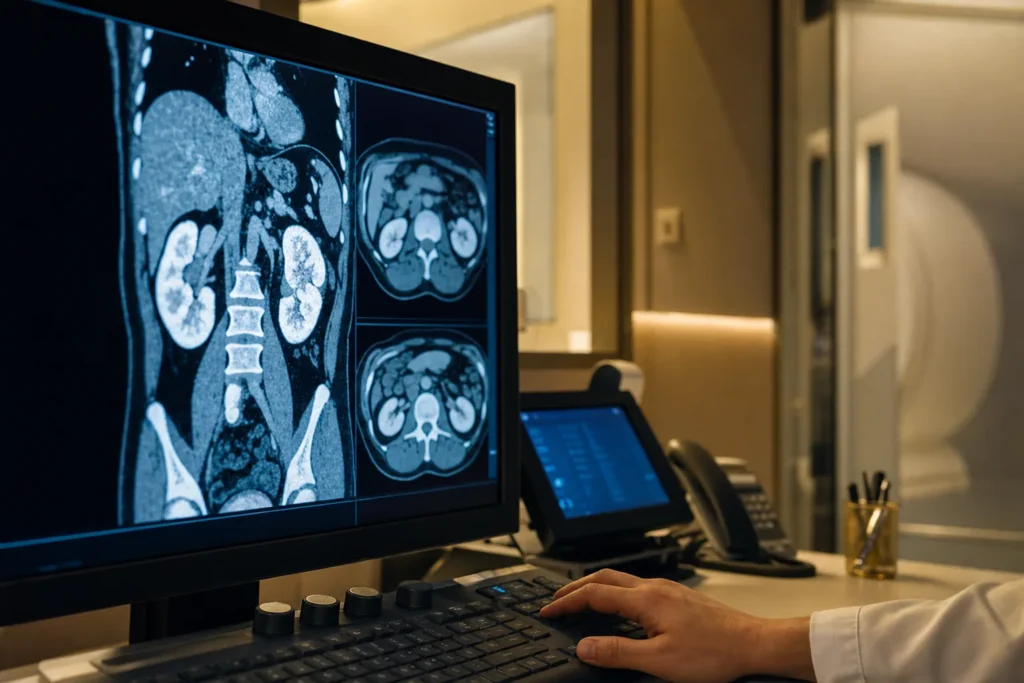
- CT scan. An X-ray-based scan, often with a contrast dye, that gives detailed pictures and is one of the main tests for kidney cancer.
- MRI scan. Uses magnets and radio waves to produce detailed images, sometimes used to look at blood vessels or when CT is not suitable.
- Biopsy. Removing a small sample of tissue to look at under a microscope. For kidney tumours, imaging is often clear enough that surgery to remove the tumour is planned without a biopsy; a biopsy is used in selected situations, and your team will explain whether you need one.
Staging. If cancer is confirmed, doctors describe how advanced it is using a system from Stage 1 to Stage 4 (based on the TNM system, which looks at the Tumour, the lymph Nodes, and any Metastasis or spread). In simple terms, using the U.S. National Cancer Institute's descriptions: in Stage I the tumour is 7 centimetres or smaller and only in the kidney; in Stage II it is larger than 7 centimetres but still only in the kidney; in Stage III it has reached nearby lymph nodes, blood vessels or surrounding tissue; and in Stage IV it has spread to more distant parts of the body, such as the lungs, liver, bones or brain. Staging is what allows your team to recommend the most suitable treatment.
Treatment options
Treatment depends on the type and stage of the cancer, your general health, and your own wishes. Decisions are usually made by a multidisciplinary team — a group that may include a urologist (a surgeon specialising in the urinary system), an oncologist (a cancer doctor), a radiologist, a pathologist, and specialist nurses, who together agree on a plan and discuss it with you.
Surgery is the main treatment for kidney cancer that has not spread. It may mean:
- Partial nephrectomy — removing only the tumour and leaving as much healthy kidney as possible.
- Radical (or simple) nephrectomy — removing the whole kidney, and sometimes nearby tissue or lymph nodes.
These operations can sometimes be done with keyhole (laparoscopic) or robot-assisted techniques, which your surgeon can explain.
Ablation destroys small tumours without removing the kidney, often for people who are not well enough for major surgery. It includes cryotherapy (freezing the cancer cells through fine needles) and radiofrequency ablation (using radio waves to heat and kill the cells).
Arterial embolisation blocks the blood supply to a tumour and may be used when surgery is not possible.
Active surveillance — for some small tumours, especially in older people or those with other health problems, the team may recommend careful monitoring with regular scans rather than immediate treatment.
For cancer that has spread or come back, medicines are central:
- Targeted therapy — drugs that interfere with the specific signals cancer cells use to grow and form blood vessels (examples include sunitinib, pazopanib, axitinib and cabozantinib).
- Immunotherapy — drugs that help your own immune system recognise and attack cancer cells (examples include nivolumab, pembrolizumab, ipilimumab and avelumab).
Radiotherapy and chemotherapy are used less often for the common type of kidney cancer, but may help in particular situations, such as easing symptoms. Supportive (palliative) care, which focuses on comfort and quality of life, can be given alongside any treatment, not only at the end of life.
Outlook: what to expect
It is natural to want to know what the future holds. Survival statistics can give a general sense of how groups of people have done, but they cannot predict what will happen for any one person. Your own outlook depends on the type and stage of the cancer, your age and general health, and how the cancer responds to treatment.
The American Cancer Society reports 5-year relative survival rates for kidney cancer (for people diagnosed between 2015 and 2021), grouped by how far the cancer had spread when first found:
- Localised (still only in the kidney): about 93%.
- Regional (spread to nearby structures or lymph nodes): about 76%.
- Distant (spread to far parts of the body): about 19%.
- All stages combined: about 79%.
A few things are important to understand about these numbers. A "5-year relative survival rate" compares people with the cancer to the general population; it is a population-level figure, not a forecast for you. The American Cancer Society stresses that these figures "apply only to the stage of the cancer when it is first diagnosed" and "can't predict what will happen in any particular person's case." Treatments have also improved since the period these statistics cover, particularly the newer targeted and immunotherapy medicines, which Cleveland Clinic notes have helped many people with advanced disease live considerably longer than was once expected. Your own specialist is the best person to discuss what your stage and treatment plan mean for you.
Living with it and follow-up
Life after a kidney cancer diagnosis is different for everyone. Some people have surgery and return to their normal routine; others live with the condition over a longer period while having medicines. Whatever your path, a few practical points tend to help.
Follow-up appointments. After treatment you will have regular check-ups, usually including scans and blood tests. How often these happen depends on your stage and how you responded to treatment. These visits are there to spot any change early and to support your recovery.
Kidney health. If a whole kidney was removed, the remaining kidney usually takes over the work well. Your team will keep an eye on kidney function with blood tests and may give advice on staying well hydrated, managing blood pressure, and being cautious with certain medicines.
Emotional wellbeing. Feeling anxious, low or overwhelmed is common and understandable. Talking to your team, a counsellor, family, or a support group can make a real difference. Tiredness can linger for a while; gentle activity, rest, and patience with yourself all help.
Speak up about symptoms. Between appointments, contact your team if you notice new or returning symptoms rather than waiting. You know your body best.
Planning treatment abroad: what affects cost and how to prepare your records
If you are considering treatment in another country, planning ahead makes everything smoother and less stressful. We do not list prices here, because the right plan, and therefore the cost, depends entirely on your individual situation. Instead, it helps to understand the factors that shape it.
Things that influence the cost and shape of a treatment plan include:
- The type and stage of the cancer.
- The treatment recommended — for example a partial versus radical nephrectomy, whether surgery is open, keyhole or robot-assisted, or whether ablation or medicines are involved.
- The hospital and the specialist team.
- Diagnostic tests needed before and after treatment, such as CT or MRI scans and laboratory work.
- Length of hospital stay and any aftercare, including medicines and follow-up scans.
- Practical extras such as accommodation, translation, and transfers.
To prepare, gather your medical records in one place: recent scan images and reports (CT, MRI, ultrasound), any biopsy or pathology results, blood test results, a list of your current medicines, and a short summary of your medical history. Having these ready allows a specialist to review your case properly and give you a clear, personalised picture of the options. Because every case is different, the most reliable way to understand what your treatment would involve is to request a personalised estimate through a free consultation, where your records can be reviewed by a qualified team.
Why Turkiye, and how to choose a good centre
Turkiye has become a well-known destination for international patients seeking urology and cancer care, with many large hospitals that treat patients from abroad and provide services in several languages. As with any country, quality varies between centres, so the goal is to choose carefully rather than to assume any single hospital is best.
Here are sensible things to verify:
- Accreditation. Look for hospitals with recognised international accreditation, such as Joint Commission International (JCI). JCI accreditation means a hospital has been independently assessed against international standards for patient safety and quality of care. Turkiye has a number of JCI-accredited hospitals.
- The specialist team. Check that your care will be led by qualified urologists and medical oncologists who regularly treat kidney cancer, ideally within a multidisciplinary team.
- Technology and techniques. Ask whether the centre offers the approach recommended for you, for example kidney-sparing (partial) surgery, keyhole or robot-assisted surgery, ablation, and access to modern targeted and immunotherapy medicines.
- Clear communication. A good centre explains your diagnosis, the proposed plan, expected recovery, and follow-up in language you understand, and answers your questions without pressure.
- Continuity of care. Ask how follow-up and any complications would be handled, and how your records would be shared with doctors back home.
A reputable concierge service can help arrange a review of your records, a second opinion, and a clear plan before you travel, so that you arrive informed and supported.
Prevention, second opinions and clinical trials
There is no guaranteed way to prevent kidney cancer, but you can lower your risk and protect your overall health. The most useful steps are practical and familiar: do not smoke (and get help to stop if you do), keep to a healthy weight, stay physically active, eat a balanced diet, and keep your blood pressure under control with your doctor's help. These habits benefit your kidneys, heart and general wellbeing.
Second opinions. Asking another qualified specialist to review your diagnosis and treatment plan is a normal and reasonable thing to do, especially before major surgery or when choosing between treatments. A good doctor will not be offended; a second opinion can confirm a plan or offer alternatives, and it often brings peace of mind.
Clinical trials. These are research studies that test new or improved ways to find, prevent and treat cancer. The National Cancer Institute describes them as "research studies that test how well new medical approaches work in people," and notes that "today, people are living longer lives thanks to results of past cancer clinical trials." Taking part is voluntary, and for some people a trial offers access to newer treatments while contributing to knowledge that helps future patients. If you are interested, ask your specialist whether any trials might be suitable for you.
Above all, the single most useful step is to see a qualified specialist who can assess your individual situation and guide you. This article is general information and is not a substitute for personal medical advice.
Frequently asked questions
Is kidney cancer curable?
What are the first signs of kidney cancer?
Does blood in my urine mean I have kidney cancer?
Is there a screening test for kidney cancer?
How is kidney cancer diagnosed?
Can I live with only one kidney after surgery?
What treatments are available for kidney cancer?
What causes kidney cancer?
How can I reduce my risk of kidney cancer?
Should I get a second opinion before treatment?
Why do people consider treatment in Turkiye, and how do I choose a safe hospital?
This article is for general information only and is not medical advice. Always consult a qualified doctor about your individual case.
Considering this procedure?
Send us your photos and questions. A BergemHealth coordinator and a department-head specialist will review your case and reply with honest, personalised guidance — no obligation.
Free consultation